Wormwood replacement
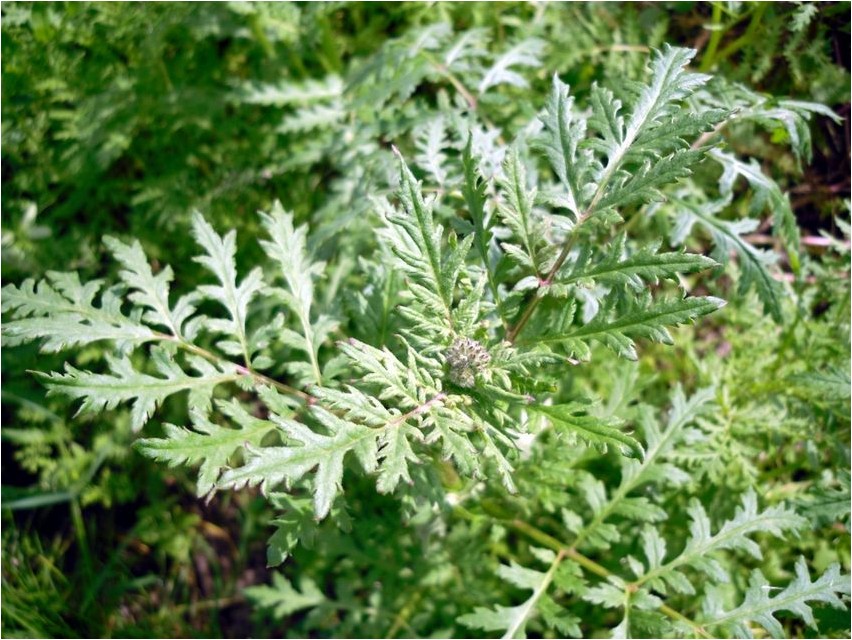
Wormwood substitute is one of the plants of the family called Asteraceae or Asteraceae; in Latin the name of this plant will be as follows: Artemisia commutata Bess.
As for the name of the wormwood family itself, in Latin it will be like this: Asteraceae Dumort. (Compositae Giseke).
Description of wormwood substitute
Wormwood is a perennial herbaceous plant whose height will vary between twenty and eighty centimeters. The root of this plant is taprooted and woody, and its thickness can reach one and a half centimeters. The stems of replacement wormwood themselves are thin and straight, and they will be colored in reddish-brown tones. The baskets of this plant are on elongated or short legs, they can be either broadly ovoid or oblong-ovate, the length of the baskets will be about three to three and a half millimeters, while the width will not exceed two to three millimeters. The baskets of this plant will be in a paniculate inflorescence; the marginal flowers of wormwood are pistillate and fertile, there are only about ten to fifteen of them. Moreover, the corolla of such a plant is two-toothed and narrow-tubular, and its length will be about fifteen millimeters, while the corolla itself will be bare and tubular-conical in shape. The length of the achenes of this plant will be one millimeter, they are elongated-ovoid in shape and colored in black-brown tones.
The flowering of replacement wormwood occurs in August. Under natural conditions, this plant is found in Western and Eastern Siberia, Primorye, Amur Region and Sakhalin in the Far East, as well as in the Volga-Kama region of the European part of Russia. For growth, this plant prefers forests, saline and dry meadows, forest edges, steppes, gravelly and rocky slopes, sandy and pebble floodplains of rivers up to the mid-mountain zone.
Description of the medicinal properties of wormwood substitute
Wormwood substitute is endowed with very valuable healing properties, and it is recommended to use the grass and fruits of this plant for medicinal purposes. The presence of such medicinal properties is recommended to be explained by the content of essential oil in the composition of this plant, while alkaloids will be present in the leaves.
A hydroalcoholic extract of this plant will exhibit tubeculostatic activity, while an aqueous extract will exhibit antibacterial activity.

In Tibetan medicine, this plant is widely used. A decoction made from Artemisia substituta is recommended for chest tumors as a pain reliever, while this remedy is also used in complex formulas for tumors of various etiologies. An infusion and decoction made from Artemisia substituta fruits and flowers are used as a hemostatic agent and are also indicated for bronchitis, pneumonia, and various gastrointestinal ailments.
For pain relief, the following highly effective remedy based on this plant is recommended: to prepare this remedy, take one teaspoon of crushed dried Artemisia substituta herb per one cup of boiling water. The resulting medicinal mixture should be steeped for approximately thirty to forty minutes, after which it should be thoroughly strained. Take this wormwood-based remedy three times a day, one-third to one-quarter of a glass at a time.