Alibertia
Alibertia (lat. Alibertia) is a tree fruit crop from the Rubiaceae family.
Description
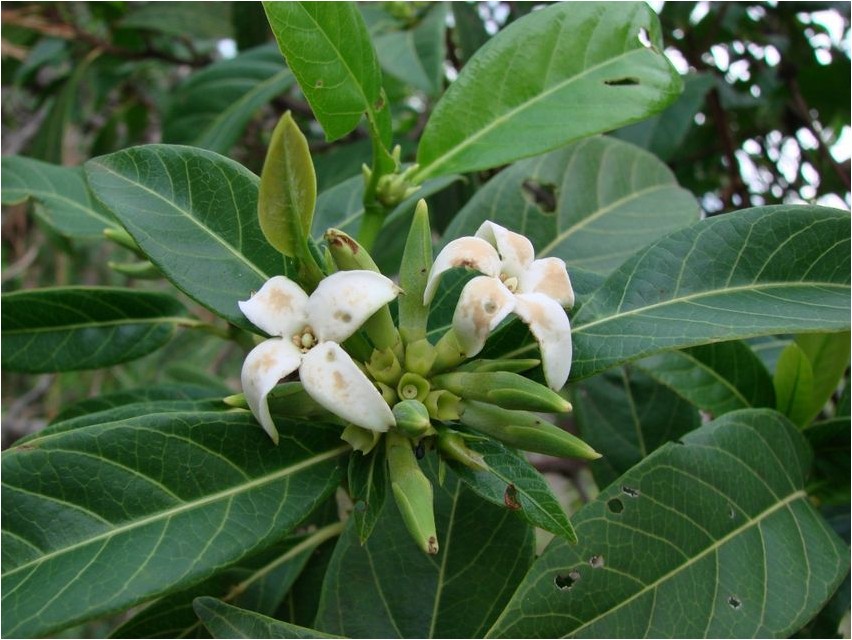
Alibertia is a rather nice fruit tree of relatively small height (as a rule, its height almost never exceeds six meters). All trees are erect and have spectacular bright green leaves. And they bloom and bear fruit throughout the year.
The diameter of the spherical fruits of alibertia ranges from two to four centimeters. Moreover, they are all equipped with barely visible longitudinal veins. The shape of these fruits is similar to a pomegranate, and their color can be either yellow, yellow-brown or yellow-green.
The black flesh of Alibertia is very juicy and jelly-like. In addition to the pulp, each fruit contains several miniature flattened seeds, the length of which varies from three to eight millimeters.
The most common variety of alibertia is alibertia edible, which is often called the “marmalade tree.”
Where does it grow
In the wild, alibertia can most often be found in Central American and South American forests. And as a cultivated plant, Alibertia edible is actively cultivated in Brazil.

Application
The pulp of alibertia is good both fresh (to enjoy it, you need to cut the fruit and then scoop out its contents with a spoon), and as part of all kinds of soft drinks and desserts, as well as juices, jellies, confitures and jams. It also makes excellent candy, and it’s also very good in other confectionery products!
Regular consumption of alibertia has a powerful tonic and immunostimulating effect on the body, and also helps prevent certain diseases of the digestive and cardiovascular systems.
Ripe alibertia fruits can easily be preserved for up to several days, although these fruits still cannot boast of having too long a shelf life. At room temperature they are stored for about two to three days, and in the refrigerator it is possible to store alibertia for a week. If you want to preserve it even longer, you will have to preserve it by making aromatic jelly or jam from it.
Since only ripe fruits are suitable for consumption, when choosing alibertia, it does not hurt to carefully examine its peel — the peel of ripe fruits is colored in all sorts of yellowish shades, ranging from greenish-yellowish to yellowish-brownish. And, of course, there should be absolutely no damage to the skin.
And the amazingly beautiful white inflorescences of alibertia also make it an excellent ornamental crop — amateur flower growers very willingly use it for planting in squares and parks, when creating hedges and for cultural afforestation. It is quite possible to grow this beauty either as a houseplant or as a garden plant in special containers.
Contraindications
As for contraindications, they have not been identified at the moment. However, even in this case, the occurrence of individual intolerance cannot be completely ruled out.
Growing and care
Alibertia is capable of growing only in tropical climates — even the slightest frost inevitably entails its death. At the same time, this plant is completely undemanding in terms of care (alibertia is demanding only of soil — they must be nutritious) and tolerates pruning well — it is thanks to systematic pruning that the high decorativeness of its crown is achieved.
Alibertia is propagated by both cuttings and seeds. By the way, when growing this crop, it is important not to forget to provide it with sufficient watering!