Weltheimia
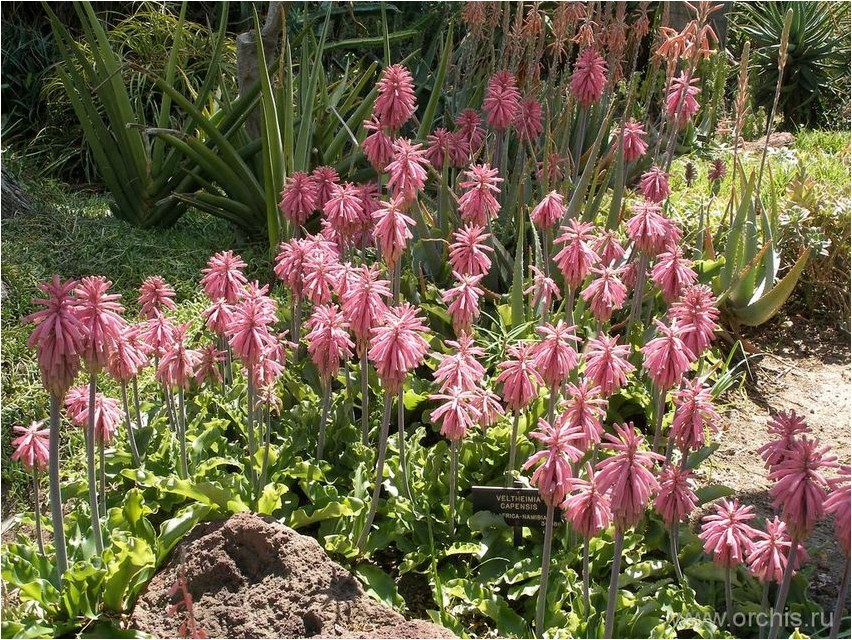
Weltheimia is a perennial bulbous plant that belongs to the hyacinth family. There are only a few species in the genus, which are naturally found in South Africa.
This plant grows naturally on the sea coast and hilly areas, choosing shady areas.
Description of the plant
This plant is quite small and consists of rosettes of strap-shaped green leaves that will be slightly wavy along the very edge. At the very beginning of winter, the plant develops a peduncle quite quickly. The shape of such a peduncle is an inflorescence of drooping pink flowers, which makes the plant look like a firework. Actually, it is for this reason that Weltheimia is sometimes also called a winter rocket. The flowers of the plant will be narrowly bell-shaped, and their flowering will last for two to three months.
At home, this plant can be seen quite rarely. After all, Weltheimia can bloom at a temperature of only ten to fourteen degrees Celsius, and in winter conditions in an apartment it is very difficult to maintain such a temperature regime. However, cool winter gardens are an excellent place for this plant to grow. In addition, Veltheimia can also be grown on closed balconies and loggias, provided that the temperature there does not exceed fourteen degrees.
Growing and caring for Weltheimia

As for lighting, the plant will need very good lighting, but it should not be exposed to direct sunlight. And during the dormant period, the plant can develop favorably in complete darkness.
The temperature regime, as has already been said, is extremely important for weltheimia. When new leaves appear on the plant, which usually happens in September, a temperature regime of twenty degrees will be required. The plant can also be kept on the balcony, but already in November the temperature should not exceed fourteen degrees Celsius. After this, already in winter, this plant will bloom even at a temperature of ten degrees Celsius.
It is worth noting that air humidity does not matter for the favorable development of Weltheimia.
As for watering, it will be required moderately from mid-September until the start of the plant’s dormant period. It is also important to remember that when watering there should be no contact between water and the plant bulb. Watering should continue until the leaves of the plant dry out. As soon as new shoots appear, watering should begin again.
After the leaves appear, Weltheimia will need to be fed with fertilizer for flowering plants, which should be diluted by half. These measures should be taken approximately once a month.
The plant should be replanted every two to three years, this should be done after the end of the dormant period. The veltheimim bulb should rise approximately one third above the ground surface.
The substrate for the plant will need the following: you need to take turf and leaf soil in equal quantities, as well as sand. Weltheimia pots should be quite wide.
The dormant period begins after flowering ends. Around the end of spring, the leaves of the plant will dry out, then the bulb and the pot should be moved to a room where it will be quite dark. Already in September, the dormant period will end and then new leaves will begin to grow, and the pot with the plant will need to be moved to a room with good lighting.
Weltheimia can be propagated both through bulbs and seeds.