Spotted slipper
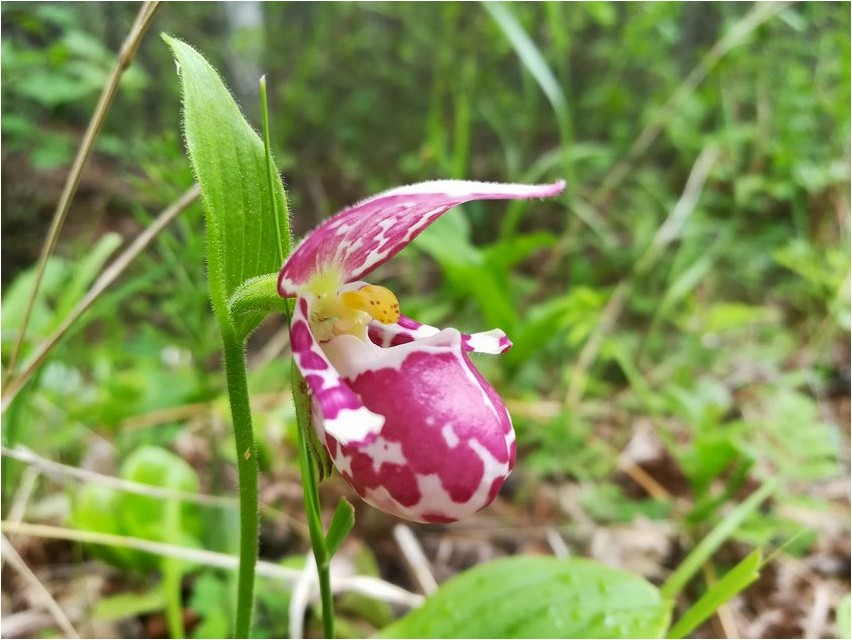
The spotted slipper is one of the plants of the family called orchidaceae. In Latin, the name of this family is as follows: Orchidaceae Lindl, while the name of the plant itself in Latin will look like this: Cypripedium guttatum.
Description of the spotted slipper
The spotted slipper is a perennial herbaceous plant, the height of which can reach even twenty-five centimeters. This plant is endowed with a creeping rhizome. The spotted slipper has a very peculiar stem, on which there are two closely spaced, oblong-oval, whole-edged leaves, which will certainly turn black after drying. As for the spotted slipper flower, it will be single, and also quite large and irregular. In color, this flower will be purple with the addition of white spots, and the upper leaf of the spotted shoe is white.
Under natural conditions, a plant such as the spotted slipper grows in Siberia in its forest zones.
Description of the medicinal properties of the spotted slipper
It is worth noting that the spotted slipper is endowed with quite important healing properties, which is explained by its beneficial composition. For medicinal purposes, it is recommended to use the aerial part of the plant, namely, flowers and grass.

It should be noted that the chemical composition of this plant has not yet been fully studied. However, special studies have shown that essential oil, tannins, and also resins were found in the spotted slipper. Actually, the content of these substances in the composition of the spotted slipper is used for medicinal purposes. The plant should be classified as toxic. It has been proven that the spotted slipper can have a calming, hypotensive, and also analgesic effect.
In folk medicine, not only infusions, but also tinctures made from the flowers of the spotted slipper have become quite widespread. Such drugs are used as a so-called sedative for a variety of neuropsychiatric disorders. The diseases for which the use of infusions and tinctures from the flowers of the lady’s slipper are indicated include, first of all, epilepsy, convulsions in childhood, as well as neurasthenia and insomnia. In addition, such drugs are also considered useful as a diuretic.
Decoctions made from the herb of the spotted lady’s slipper are also recommended for gastralgia as an appetite stimulant. A decoction made from the flowers of the spotted lady’s slipper is sometimes given to emaciated children, and folk medicine also recommends this remedy as a laxative. The herb and flowers are also used as a diaphoretic or antipyretic for fever and malaria.
If both adults and children experience eating disorders, specifically a significant loss of appetite, the following decoction is recommended. To prepare this decoction, add one teaspoon of flowers to one cup of boiling water. Let the mixture steep for one hour, then strain. Take one tablespoon of this decoction three to four times daily. For neurasthenia and anxiety, the following decoction is recommended. To prepare it, take two teaspoons of the herb and flowers, then steep the mixture in one cup of boiling water for one hour. Strain the mixture and then take one tablespoon three to four times daily.
Spotted Lady’s Slipper





