Pemphigus vulgare
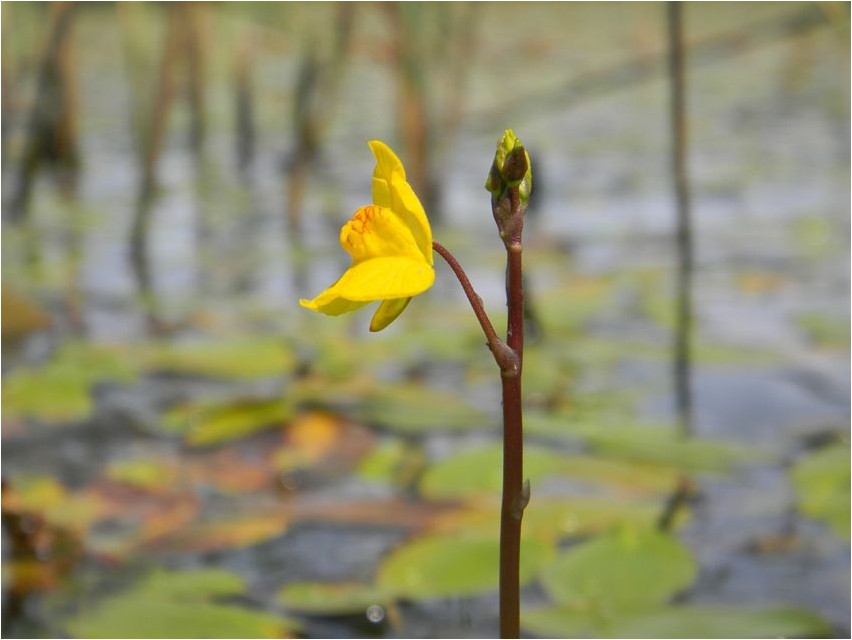
The common bladderwort is one of the plants of the family called bladderworts; in Latin the name of this plant will be as follows: Urticularia vulgaris L.
As for the name of the common bladderwort family itself, in Latin it will be: Lentibulariaceae Rich.
Description of pemphigus vulgaris
The common bladderwort is a herbaceous plant, endowed with stems that will be immersed in water, and their length will be about one meter. Catching bubbles can reach three and a half millimeters in length; they will sit on green leaves. The leaves of this plant are multi-pinnately dissected, and their length will reach about five centimeters and such leaves will be arranged in a spiral. The leaf lobules of bladderwort and the outer segments are endowed with cilia. The diameter of the corolla of this plant will be about twelve to twenty-two millimeters, it will be colored orange-yellow with reddish-brown stripes. The upper lip of pemphigus vulgaris is endowed with folded edges, which will be slightly longer or shorter than the convexity of the lower lip. The length of the curtain of this plant reaches nine millimeters, and the thickness does not exceed two millimeters. The anthers of the stamens of bladderwort will be stuck together, and the pedicels after flowering will begin to deviate in an arched manner.
Flowering of bladderwort occurs in the second half of the summer season. For growth, this plant prefers stagnant ponds and swamps. Under natural conditions, this plant is found in Moldova, Central Asia, the Caucasus, Belarus and the European part of Russia. It is noteworthy that bladderwort is also a very ornamental plant.
Description of the medicinal properties of pemphigus vulgaris
Pemphigus vulgaris is endowed with very valuable healing properties, and it is recommended to use the herb of this plant for medicinal purposes. The term grass includes flowers, stems and leaves. The presence of such valuable healing properties is recommended to be explained by the content of flavonoids in the leaves of this plant, while carotenoids will be present in the flowers and leaves.
Freshly crushed leaves of this plant are recommended for burns and as a wound-healing agent. A decoction prepared from the leaves and stems of bladderwort is indicated for cystitis. Notably, this plant possesses phytoncidal properties and also exhibits bacteriostatic activity against the typhus pathogen in rodents.

For cystitis, the following highly effective remedy based on this plant is recommended: to prepare this remedy, take approximately three tablespoons of bladderwort per half liter of water. The resulting medicinal mixture is recommended to be boiled for approximately three to four minutes, then steeped for approximately one hour, and then thoroughly strained. Take one-third of a glass of this bladderwort remedy three to four times daily for cystitis. It should be noted that to achieve maximum effectiveness when taking this remedy based on common pemphigus, it is important not only to follow all the instructions for preparing this medicine, but also to strictly adhere to all the instructions for taking it. With proper use, a positive effect will be noticeable quite quickly.





