Annona
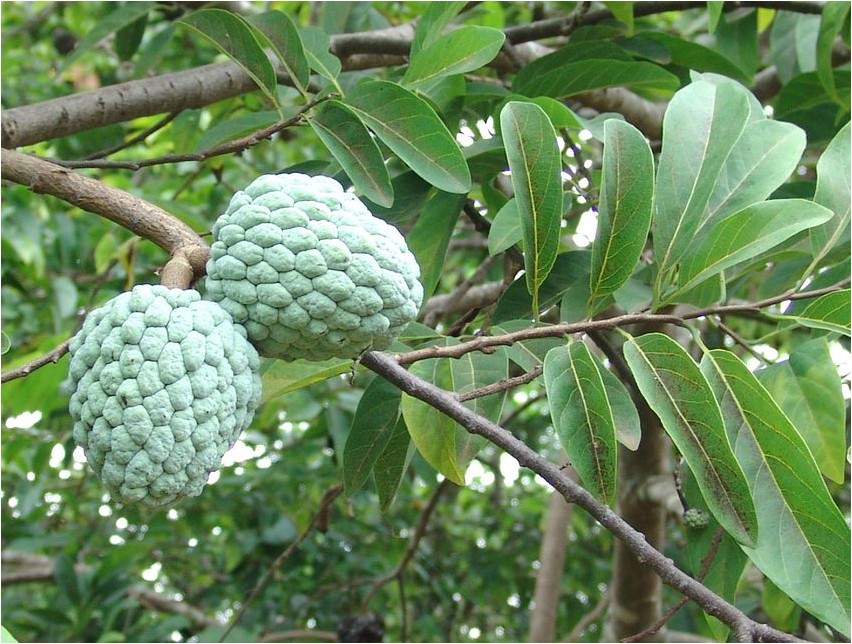
Annona (lat. Annona) — in the large family Annonaceae, the second place in the number of plant species is occupied by the genus Annona. These are woody plants, including shrubs and trees.
Representatives of the genus are distinguished by fragrant flowering, and a number of species give people edible unique fruits, which also have healing abilities. The heat-loving plant of the tropics agrees to grow indoors in areas where the climate is too harsh for the plant.
What”s in your name
In the world of plants there are often names that do not evoke associations with objects known to man. “Annona” also belongs to such names. The answer is that such names smoothly grow into different languages of the world, having been born in ancient languages that are rarely heard today.
As for Annona, this is what the plant was called by the Indians, the indigenous inhabitants of the island of Haiti, before the arrival of European conquerors in America. The forced introduction of Indians to Christianity and European infectious diseases, to which the Indians did not have protective immunity, almost completely destroyed the local population. But it continues to live in words that migrated first to English and Spanish, and then to many other languages of the world. For example, words such as Annona, tobacco, tomatoes, hammock, hurricane, sweet potato, barbecue.
In addition, the plant has many names in which people reflect its versatile qualities. For example, “sugar apple”, “cream apple”, “soursop”, “Annona prickly”, and there are also several common names: “Annona needle”, “Guanabana”, “Graviola”.
Description
Tropical shrubs and trees prefer to grow where the air temperature does not drop below 28 degrees Celsius, and therefore they can be found on islands such as Jamaica, Cuba, and the Philippines. Although the plant has been spotted in some areas of the American state of Florida.

The trunks, covered with fissured thin bark, give rise to slender, flexible shoots.
On the branches, held by short petioles, are simple fragrant leaves with a smooth edge. They can be leathery or soft, glabrous or pubescent, evergreen or partially deciduous.
Flowers can be single or collected in a small bunch. They appear into the world on short peduncles from the axils of the leaves. Flowers have numerous stamens and pistils.
The latter, after fertilization, turn into fruits of an unusual shape, consisting of many independent small fruits containing seeds, the kernels of which are toxic, while the pulp is tasty and edible.
Some types of Annona
* Annona smooth, or Monkey apple, or Alligator skin apple (lat. Annona glabra)
* Annona “Sugar Apple” (lat. Annona squamosa)
* Annona prickly or “Soursop” (lat. Annona muricata)
* Annona “Cherimoya” (lat. Annona cherimola)
* Annona “African cream apple” (lat. Annona senegalensis)
* Annona macrocarpa (lat. Annona macrocarpa)
* Annona varifolia, “Ilama” (lat. Annona diversifolia)
Healing abilities
The pulp of the fruits of edible Annona species is rich in vitamins, mineral salts, carbohydrates, proteins, and folic acid. This composition has a beneficial effect on the functioning of the entire human digestive system, thereby healing the entire body as a whole.
Some sources report Annona”s ability to resist the growth of cancer cells in the body. But the issue has not yet been sufficiently studied by official medicine, and therefore remains on the conscience of propagandists.
Toxic seeds
The seeds of some delicious fruits, such as Annona Soursop seeds, contain the chemical compound “annonacin”, which is a neurotoxin that can damage human nervous tissue when accumulated. When a certain amount of such a substance accumulates in the body, the death of nerve cells occurs, leading to impaired movement, even paralysis.
Annona
https://www. youtube. com/watch? v=PkOy0djzVss