Parthenocissus tricuspidata
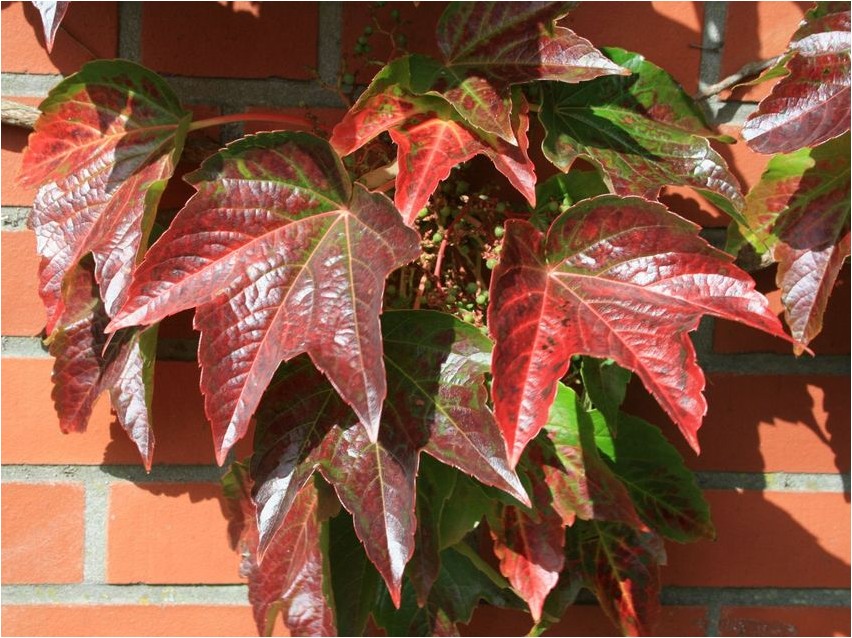
Parthenocissus tricuspidata is a member of the viticultural family. Its Latin name is Parthenocissus tricuspidata (Siebold et Zucc.) Planch.
The Latin name for Parthenocissus tricuspidata is Vitaceae Juss.
Description of Parthenocissus tricuspidata
Parthenocissus tricuspidata is a woody vine. This plant has disc-shaped tendrils that widen at the tips. These tendrils are used to attach the plant to tree bark or rocks. The leaves of the sterile shoots are rounded-ovate and approximately ten to twelve centimeters wide. These leaves may have serrate-toothed edges or be trifoliate or subtrifoliate. On fruiting shoots, the leaves of this plant have long petioles and are cordate-trifoliate in shape. The flowers of the triacuna are small, greenish-yellow in color, and are borne in paired umbels. The berries are bluish-black in color, approximately six to eight millimeters in diameter, and contain two seeds.
In the wild, the triacuna can be found in the Primorsky Krai, specifically in the southern Khasansky District. As for its general distribution, it can be found on the Korean Peninsula and in Japan. This plant prefers vertical granite walls along the seashore. It is noteworthy that this plant is ornamental and can be used for landscaping various buildings.
Description of the medicinal properties of the triostrennoe maiden grape
The triostearn grape is endowed with valuable medicinal properties, and its leafy branches are recommended for medicinal purposes. These valuable medicinal properties are due to the phenol resvatrol found in the branches, while the petioles and leaves of the triostearn grape contain glucose, sucrose, fructose, and the following acids: malic, citric, and tartaric. The leaves also contain tartaric acid, quercetin, chrysanthemin, leucocyanidin, steroids, and the following phenolic carboxylic acids: gallic, ellagic, and caffeic. The fruits of this plant contain anthocyanins, nitrogen-containing compounds, and beta-sitosterol. The seeds contain higher aliphatic alcohols, fatty oil, steroids, heptacosane, and the following acids: stearic, oleic, palmitic, linoleic, and linolenic. In Chinese medicine, a decoction made from the branches of this plant is used as a hemostatic and tumor-resolving agent.
For various types of bleeding, a very effective remedy made from the tri-acuminate Virginia creeper is recommended: to prepare this remedy, take six to eight grams of crushed dried branches of this plant per three hundred milliliters of water. The resulting mixture should be simmered over low heat for seven to eight minutes, then steeped for one hour and strained. Finally, add boiled water to the resulting mixture to bring the original volume up to the original volume. Take this tri-acuminate Virginia creeper remedy, one-third of a glass three to four times daily. For maximum effectiveness, all directions for use should be strictly followed.

Tri-acuminate Virginia creeper