Meadow sable
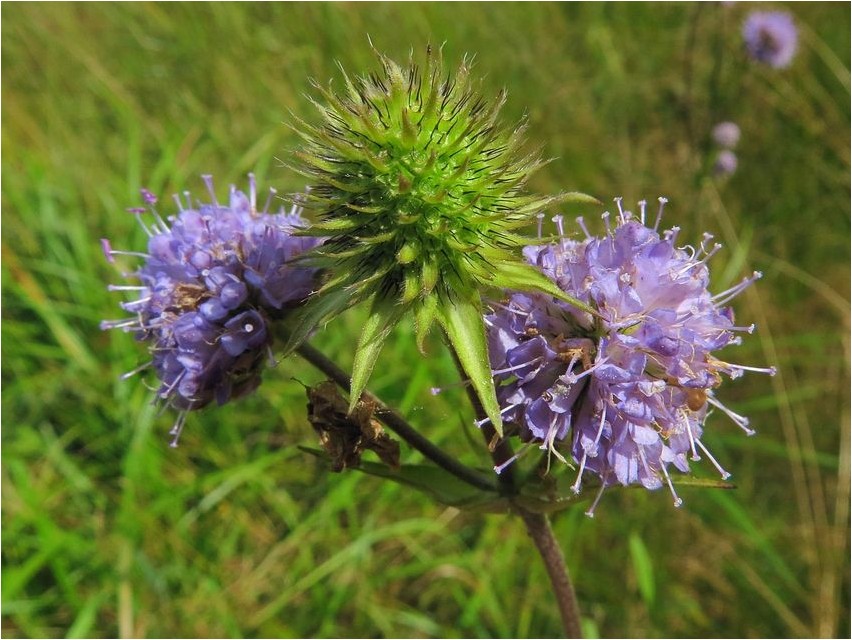
Meadow sable is a member of the teasel family, the Latin name for this plant being Succisa pratensis Moench (Scabiosa succissa L.).
As for the family name of meadow sable itself, the Latin name is Dipsacaceae Juss.
Description of meadow sable
Meadow sable is known by many common names: breast grass, breath grass, lyubka, navel grass, itchy grass, and detorodin. Meadow sable is a perennial herb with a thick, truncated rhizome that appears truncated, and this root is also equipped with thick root filaments. The stem of this plant is erect, reaching a height of between thirty and ninety centimeters. At the top, this stem bears two opposite, flower-bearing branches. The basal leaves of the meadow oxeye daisy are on oblong and rather long petioles, while the cauline leaves of this plant are opposite, smooth, entire, glossy, and lanceolate. The flower heads of the meadow oxeye daisy are hemispherical, covered with a herbaceous, multi-leafed involucre, and can be colored in shades of bluish-lilac or white. Each flower of this plant has a four-toothed corolla, and there are only four stamens. The pistil of the meadow oxeye daisy, in turn, has a single style and an inferior ovary. The fruit of the meadow oxeye daisy is an achene. This plant blooms from July to August.
In the wild, the meadow sable is found in Moldova, Belarus, the Caucasus, the Dnieper region and the Carpathians in Ukraine, the Irtysh, Ob, and Verkhne-Tobolsk regions of Western Siberia, the Angara-Sayan region of Eastern Siberia, and the following regions of European Russia: Upper Volga, Lower Don, Dvina-Pechora, Karelo-Murmansk, Black Sea, Trans-Volga, Karelo-Murmansk, Baltic, Lodazhsko-Ilmensky, and Volga-Don. This plant prefers clearings, grassy marshes, shrubs, lowland meadows, alkaline meadows, forest edges, and clearings.
Description of the medicinal properties of meadow sable
Meadow greenweed is endowed with very valuable healing properties, and it is recommended to use the rhizomes and grass of this plant for medicinal purposes. The term grass includes flowers, stems and leaves. The presence of such valuable healing properties should be explained by the content of an unstudied glycoside, tannins and saponins in this plant.
It is noteworthy that the roots of meadow greenweed have become quite widespread in homeopathy. As for traditional medicine, a decoction prepared from the roots of this plant is used as a very effective emetic, expectorant, anthelmintic, wound healing, diuretic and expectorant. In addition, this medicinal plant is used for stomach colic and ascites, and a powder based on the rhizomes of meadow grass is used externally for toothache as an anesthetic. An alcoholic extract of the herb and rhizomes is used for various skin diseases, including stomatitis, scabies, bruises, weeping rashes and pustular diseases. A decoction prepared on the basis of the meadow grass is indicated for use against bites of rabid dogs and snakes, stomach colic, headaches, various venereal diseases, acute respiratory diseases, and this medicine is also used for washing wounds and areas of skin that have been affected by scabies mites.





