Alien snakehead
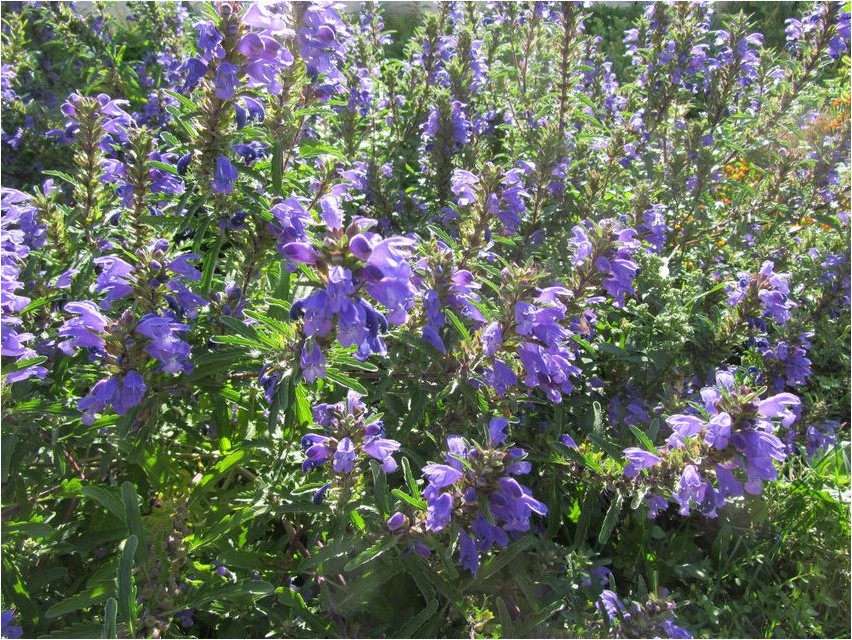
The alien snakehead is one of the plants of the family called Lamiaceae; in Latin the name of this plant will be as follows: Dracocephalum perigrinum L.
As for the name of the alien snakehead family itself, in Latin it will be like this: Lamiaceae Lindl.
Description of the alien snakehead
Alien snakehead is a perennial plant. The rhizome of such a plant will be quite thick and woody, the height of the stem is about twenty to seventy centimeters, and from the very base such a stem will be branched. The lower leaves of the alien snakehead are on petioles that will be almost equal to the blade. Such leaves are lanceolate or ovate-lanceolate, and also serrated. The upper leaves of this plant are often entire and short-petioled. The flowers of the alien dragonhead are located at the top of the stem and they form false whorls, about five to fifteen centimeters long. The calyx of this plant is two-lipped, its length is thirteen to fifteen millimeters, the corolla is colored in light bluish-lilac or dark blue tones, and sometimes this color can be white and even pink. The length of the corolla of the alien snakehead will be about twenty-seven to thirty-two millimeters.
Under natural conditions, this plant is found in Altai in Western Siberia, in the Daursky and Angaro-Sayan regions of Eastern Siberia, as well as in the Balkhash and Dzungaro-Tarbagatai regions of Central Asia. For growth, the alien snakehead prefers gravelly slopes, rocky slopes, as well as rocks up to the mid-mountain zone. It should be noted that this plant is a very valuable honey plant.
Description of the medicinal properties of the alien snakehead
The alien snakehead is endowed with very valuable healing properties, and it is recommended to use the grass of this plant for medicinal purposes. The concept of grass includes flowers, leaves and stems.
The presence of such valuable healing properties is explained by the content of alkaloids, coumarin, essential oil and flavonoid luteolin in the aerial part of the plant. The seeds of this plant contain fatty oil, which will include the following acids: oleic, stearic, palmitic, linolenic and linoleic.

An infusion prepared from this plant’s herb is recommended for gastralgia, gastritis, and as a hemostatic agent. It can also be applied as a poultice as an antitumor agent.
Experiments have shown that the extract of this plant, depending on its concentration, will stimulate or depress the central nervous system. This extract also has hypotensive properties, while also exhibiting antibacterial activity.
The essential oil can be used in cosmetics and perfumes, and it also has antifungal and antibacterial properties.
For biliary dyskinesia, the following rather effective remedy based on dragonhead is recommended: to prepare this remedy, take one tablespoon of dry, crushed dragonhead per cup of boiling water. Let the mixture steep for one hour, then strain thoroughly. Take one tablespoon of the resulting herbal remedy three times daily before meals. It’s important to note that to ensure maximum effectiveness when taking this remedy, not only should you follow all the instructions for preparing the remedy, but you should also strictly adhere to all the instructions for taking it.





