Safflower dyeing
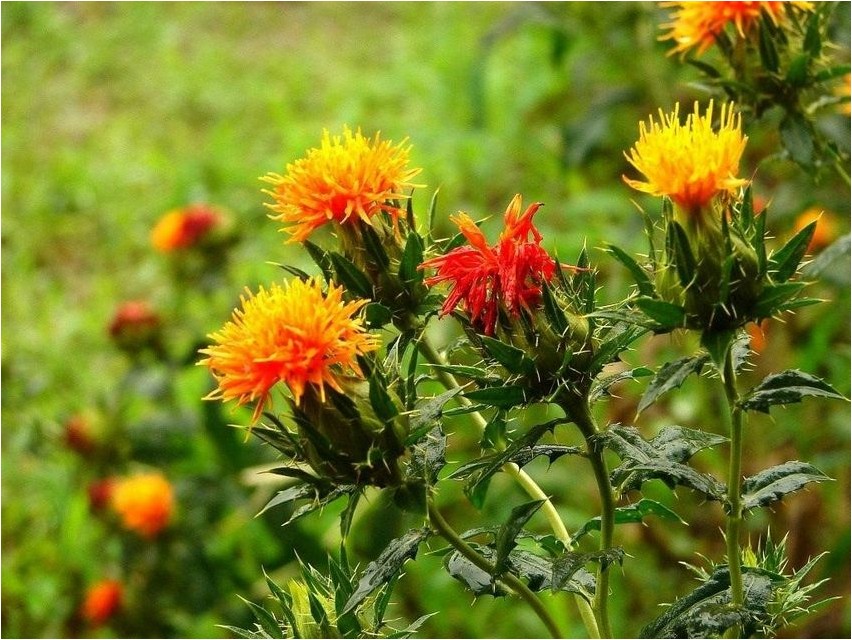
Safflower is one of the plants of the family called Asteraceae or Asteraceae; in Latin the name of this plant will be as follows: Carthamus tinctorium L.
As for the name of the safflower family itself, in Latin it will be like this: Asteraceae Dumort. (Compositae Giseke).
Description of safflower
Safflower is an annual herbaceous plant, endowed with a straight, branched stem, the height of which will vary between sixty and eighty centimeters. The leaves of this plant are rigid, sessile, alternate and oblong-ovate in shape, and they will also be spiny-toothed and endowed with a rather sharply protruding network of veins from below. The flowers of safflower are tubular, they are painted in bright orange tones and are equipped with a five-toothed corolla, and are also collected in large spherical baskets. There are only five stamens of this plant; they will be equipped with anthers, which in turn are fused into a tube. The pistil of safflower is endowed with an inferior ovary and a forked stigma. The fruit of this plant is a hard, shiny achene, colored white.
Flowering of safflower occurs during the period from July to August. Under natural conditions, this plant can very rarely be found as a weed in Central Asia, the Caucasus and the southern regions of the European part of Russia. Safflower will be cultivated in the fields, and sometimes it is bred as an ornamental plant and in front gardens.
Description of the medicinal properties of safflower
Safflower is endowed with very valuable healing properties, and for medicinal purposes it is recommended to use the seeds and outer flowers of the flower basket of this plant. The presence of such valuable healing properties should be explained by the content of the red pigments isocartamine and cartamine in the flowers of this plant, and the yellow pigment saflorgel. In addition, the flowers will contain the yellow pigment cartamine, the new red pigment cartamon and luteolin 7-glucoside. The seeds of this plant contain semi-drying fatty oil, which in turn will contain linolenic, oleic, stearic, linoleic, palmitic, myristic, arachidic and lignoceric acid.
Safflower flowers are endowed with very effective laxative, diuretic and choleretic effects.

As for traditional medicine, here this plant is quite widespread. A decoction prepared from the flowers of safflower is indicated for use in jaundice, gastritis, enterocolitis and gastric ulcers, while the seeds of this plant are used as a very effective blood cleanser and laxative.
It is noteworthy that medicine completely allows the use of fatty oil from safflower seeds along with sunflower oil. In addition, the oil of this plant is used in the food industry.
As a choleretic agent, it is recommended to use the following very effective healing remedy based on this plant: to prepare such a healing remedy, you will need to take two teaspoons of dried safflower flowers per glass of boiling water. The resulting healing mixture should first be kept in a thermos for about one hour, after which it is recommended to carefully strain this mixture based on safflower. Take the resulting medicine three to four times a day, one tablespoon before meals.