Jerusalem artichoke
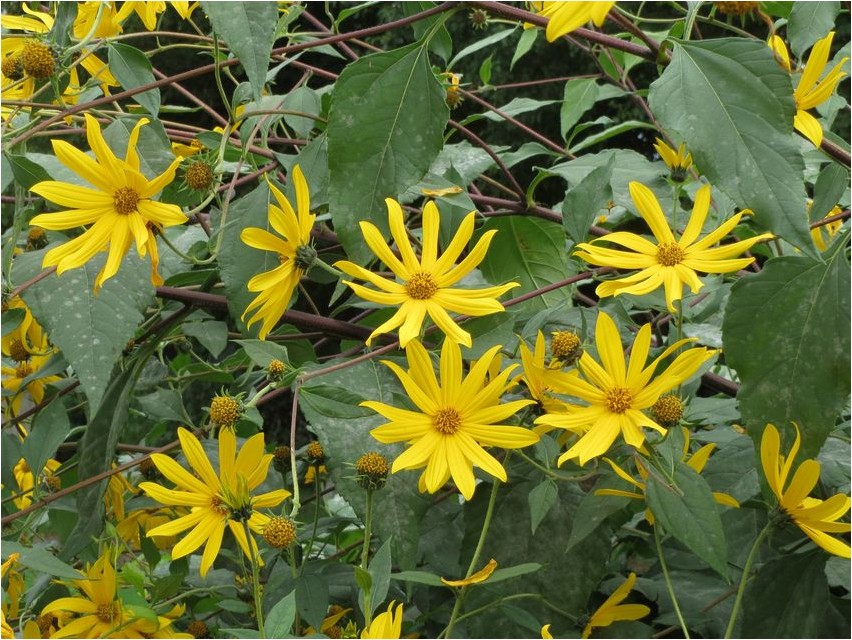
Jerusalem artichoke (lat. Helianthus tuberosus) is a species of perennial tuberous plants of the Sunflower genus of the Asteraceae, or Asteraceae, family.
Other names are tuberous sunflower, earthen pear or Jerusalem artichoke. The plant received its name in honor of the Indians from the Tupinambas tribe, with whom the tubers of the plant came to Europe. The birthplace of Jerusalem artichoke is considered to be South and North America. In Russia, they learned about the plant during the reign of Tsar Alexei Mikhailovich Romanov.
Characteristics of culture
Jerusalem artichoke is an annual or perennial plant with a powerful root system and underground shoots, which produce edible pear-shaped, oblong-oval or spindle-shaped tubers of white, yellow, purple or red color. The weight of the tubers varies from 10 to 90 g. The stem is green, erect, rather dense, pubescent over the entire surface with short, stiff hairs, 40-400 cm high, branching on the upper part.
The leaves are petiolate, serrate-toothed. The lower leaves are opposite, cordate-ovate or ovate, the upper leaves are alternate, lanceolate or oblong-ovate. The flowers are tubular and marginal, collected in baskets, 2-10 cm in diameter. The marginal flowers are false-ligulate, golden yellow, tubular — yellow, bisexual. The fruit is an achene. Jerusalem artichoke blooms in August-September, the fruits ripen in September-October. Externally, the plant is similar to a sunflower.
Jerusalem artichoke is characterized by increased cold resistance. Seedlings can withstand frosts down t o-4C, adult plants — up t o-7C. Jerusalem artichoke is classified as a short-day plant. At low temperatures and long days, tubers form very slowly, and the plant devotes all its strength to building up a powerful vegetative mass.

Growing conditions
Jerusalem artichoke is undemanding to soil conditions and can grow freely on any type of soil, with the exception of salt marshes. It has a negative effect on dry soils, especially during budding and tuberization. The crop does not tolerate waterlogged soils. Sandy loam and loamy soils with a cultivated and deep topsoil are optimal. Well-lit areas are desirable; light shading is not prohibited.
Soil preparation and planting
The area for growing crops is prepared in the fall: the soil is carefully dug up, organic fertilizers, for example, humus, are added at the rate of 5-10 kg per 1 sq. m. m. In spring, the ridges are loosened and fed with superphosphate and wood ash. Acidic soils require preliminary liming.
Jerusalem artichoke is propagated mainly by tubers, less often by cuttings. Tubers are planted in early May, following the principle of planting potatoes. Planting depth is 12-18 cm (depending on the size of the tubers). The distance between the holes should be about 90-100 cm, between the rows — 70-80 cm. If fertilizers were not applied during digging, they are poured into each hole.
Care
At the beginning of summer, the plants are earthed up. This procedure increases the resistance of Jerusalem artichoke to lodging. Tall specimens are tied to stakes, otherwise they can break even from light gusts of wind. The second hilling is carried out when the plants reach a height of 60-70 cm. Young plants are watered regularly; in the future, watering is carried out only during drought.
It is important to remember that lack of moisture has a detrimental effect on the development of tubers. The culture has a positive attitude towards fertilizing. On poor soils, Jerusalem artichoke is fed with a liquid solution of mullein or chicken droppings once every three weeks. In the future, plant care consists of weeding and shallow hilling.
Harvest
Harvesting takes place in late autumn. Larger tubers are dug up, but not stored, but immediately eaten. Jerusalem artichoke tubers are very juicy, for this reason they rot very quickly. In the first year, the harvests will not please the owners in quantity; in subsequent years, 6-8 kg are received from each specimen.





