Arugula
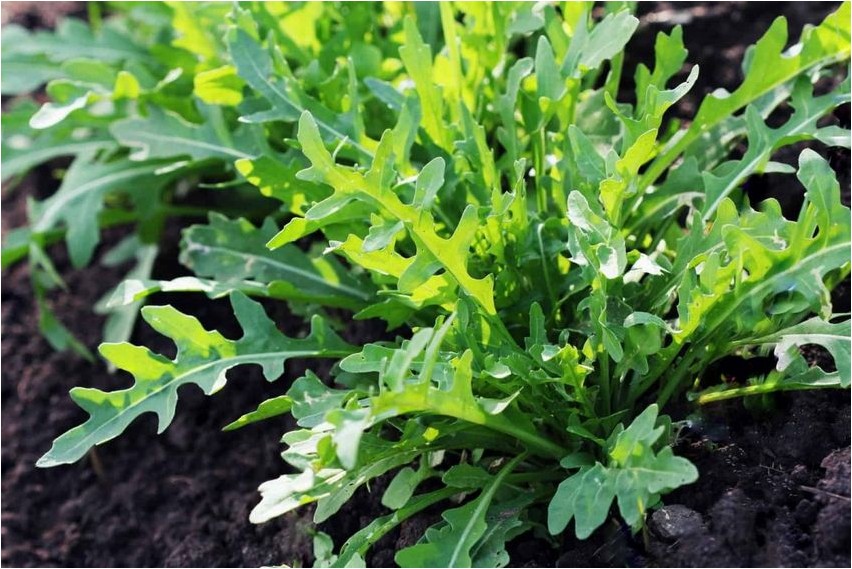
Arugula (lat. Eruca sativa) is an annual plant that is part of the Brassica family and grows in loose, dry soils. Eruka, indau or caterpillar — all these are also names for arugula.
Description
Arugula is an annual plant whose height reaches from thirty to sixty centimeters. The straight branched stems of the plant, growing up to forty centimeters in height, are slightly pubescent.
The leaves of arugula are quite fleshy and can be either bare or sparsely hairy. They all have a very unique aroma. And the lower leaves, equipped with jagged lobes, are dissected or lyre-pinnate.
As for the inflorescences, they are long and rather sparse racemes, on which there are pale yellow flowers with fancy purple veins (a little less often the flowers can be bright yellow). The length of their petals can vary from 15 to 22 mm, and the length of the sepals — from 9 to 12 mm. The obovate-wedge-shaped sepals of arugula can sometimes have small notches.
Arugula fruits are slightly compressed oblong or oval-oblong pods, sitting on short, slightly thickened stalks and equipped with funny convex valves. The sharp longitudinal veins on the fruits reach a length of two to three centimeters, and the size of their compressed xiphoid spouts is about 5 — 10 mm. Light brownish or light brown seeds reach 1. 5 — 3 mm in size and are arranged in two rows. Arugula usually blooms from May to July, and the fruits on this plant ripen from May to June.
Distribution
Arugula can be found wild in Central and Southern Europe, as well as in northern Africa. In Asia, this plant grows in India and Central and Asia Minor. And on the territory of Russia, this vegetable crop is easy to find in its European part, as well as in Dagestan or in the foothills of the Caucasus. This culture is also quite widespread in the Mediterranean.

Application
In the Mediterranean, where arugula has been grown since Roman times, it has long been considered a powerful aphrodisiac. This amazing plant is characterized by a sharp and rich taste. Most often, arugula is used to prepare healthy salads and serves as an excellent addition to pastas and meat dishes. In Italy, this plant is actively used for making pizza (it is added immediately after cooking or literally a few minutes before the end of the process), and in Slovenia it is added to traditional cheese pasties.
Arugula leaves are widely used as a seasoning for a wide variety of dishes, its seeds are used to make mustard, and young shoots are eaten fresh by many. In addition, the seeds of this crop are successfully used in Indian medicine — they are excellent for abscesses and skin diseases, and the juice of the plant is an excellent help for nasal polyps, calluses, hematomas, freckles and ulcers.
Growing and care
To successfully grow arugula, slightly alkaline or neutral soils are required. The soil should not be too fertilized, as this plant has the ability to quickly accumulate nitrates. Slightly acidic soils must be limed, and if the areas are too acidic, then the crop will not grow at all.
Most often, arugula is planted in seedlings, but it is quite acceptable to sow the seeds directly into open ground. The ideal temperature for the successful growth of arugula is considered to be eighteen degrees. And the harvest must be harvested as the leaves grow.
Caring for this crop is almost identical to caring for spinach or lettuce — arugula needs systematic loosening, weeding and watering.