Hargal
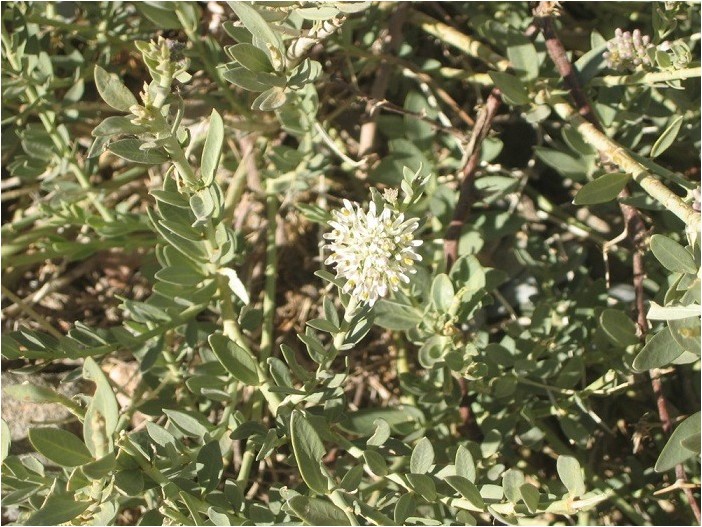
Hargal (Latin: Solenostemma Argel) is a drought-resistant succulent shrub from the Apocynaceae family, native to the deserts of the Arabian Peninsula and North Africa.
Since ancient times, the leaves and bitter sap running along the stems have been used by desert dwellers for medicinal purposes. Europeans learned of the plant in the early 19th century, when Friedrich Gottlob Heyn, a German botanist, described the shrub. This is where the plant’s Latin name, Hargal, came from, which continues to be pronounced in Arabic.
Plant Description
Like many plants in the Apocynaceae family, Hargal is a succulent plant that can store moisture in its stems and leaves to survive periods of drought.
The shrub’s height varies from 60 to 100 cm, which also helps it survive adverse climatic conditions. The shrub’s erect, succulent, and numerous stems are further protected from sunlight by short hairs on the stem surface. A bitter, clear sap (latex) flows within the stem.
The gray-greenish leaves are arranged oppositely on the stem, clinging to it with short petioles. The leaves are lanceolate with a pointed tip. For medicinal purposes, the leaves are harvested during the flowering period, which lasts four months. This long period allows for the preparation of dried medicinal leaves several times per season.
The bisexual flowers are gathered in umbel-shaped inflorescences on a peduncle emerging from the leaf axils. The inflorescences exude a pleasant aroma.

The flowers are followed by a pear-shaped fruit, resembling a pointed sac. Hidden beneath the hard shell of the dark purple “sac,” decorated with light purple and greenish stripes, are brown seeds. Seeds can remain in sandy soil for a long time, awaiting favorable conditions for germination (temperatures no lower or higher than 35 degrees Celsius, plus humidity).
While in Egypt, Bedouins collect hargal leaves in the wild, particularly in the Wadi el Laki Biosphere Reserve, in Sudan, the shrub has been “tamed” and industrially harvested for medicinal raw materials for sale both domestically and for export.
Healing Powers
The amazing endurance and unpretentiousness of Khargal has endowed the plant with unique healing abilities. In its above-ground parts, scientists have counted fifty active compounds that can cope with many human ailments. Along with the usual list of diseases that traditional healers treat with herbs, Khargal is able to help in more complex situations.
Diseases of the digestive, respiratory, urinary tract; pain in the kidneys and uterus; treatment of radiculitis, syphilis, jaundice, allergies – are subject to a healing decoction of Khargal leaves.
If you need to treat a weakened nervous system, neutralize pathogens that have penetrated the human circulatory system, an infusion of Khargal flowers and leaves will come to the rescue.
Purulent wounds are treated with crushed leaves of the plant.
If vision deteriorates, the juice of the leaves, used in the form of drops, will help. The juice will also cope with a hysterical and tiresome cough.
But Hargal’s greatest value is his ability to regulate the functioning of the pancreas, which is responsible for the amount of insulin in the body, and his fearlessness in the fight against cancer cells, the growth of which Hargal can inhibit.
When treating with Hargal, it is important to dose the amount so as not to harm your health.
Where people are plagued by mosquitoes, including malaria ones, they resort to the help of Khargal, which is capable of destroying their larvae.
Hargal hargal





