Erisimum hieracifolium is a member of the Brassicaceae family. Its Latin name is Erisimum hieracifolium L.
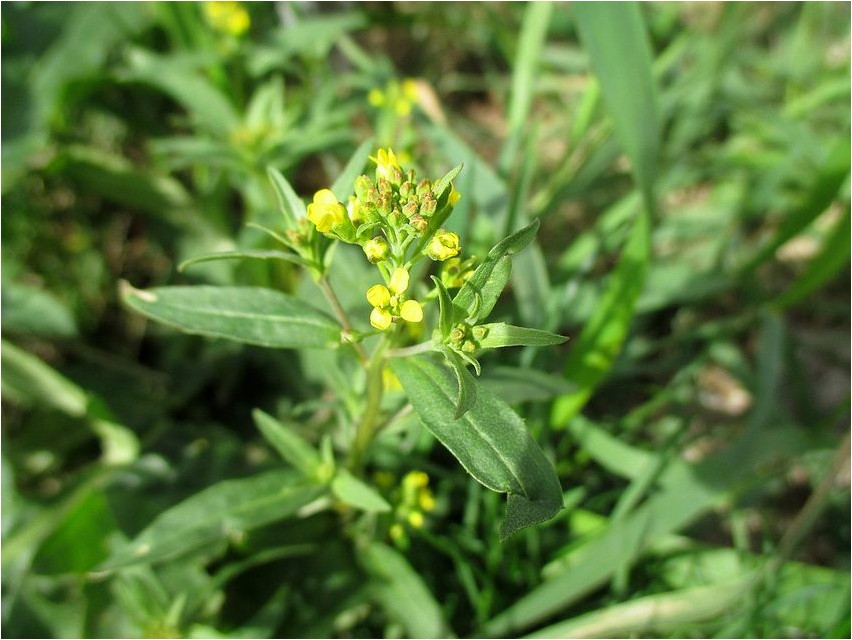
The family name of Erisimum hieracifolium is Brassicaceae Burnett.
Description of Erisimum hieracifolium
Erisimum hieracifolium is an annual or biennial herbaceous plant, growing approximately ten to thirty centimeters tall. Its stem is erect and covered with appressed hairs. The lower leaves are oblong, while the upper leaves are lanceolate and sessile. The sepals are approximately five millimeters long, while the petals are quite narrow, measuring eight to ten millimeters in length. The central honey glands are small, while the lateral glands are large and horseshoe-shaped, without hairs. The pods of the hawkweed celandine are straight, the seeds are very finely punctate, no more than one millimeter long, and brown in color.
The hawkweed celandine blooms from May to August. In the wild, this plant is found throughout the Arctic, Western and Eastern Siberia, Ukraine, Central Asia, and Belarus. It is also found in the following regions of the Far East: western Primorye, the Okhotsk region, and the Kamchatka region. Generally, this plant can be found in Europe, the Himalayas, and Mongolia. It prefers forest clearings, shrub thickets, forest edges, steppes, sandy, alkaline, rocky, and trashy areas. The plant can be found in the Lower Amur basin, and as an invasive plant, the hawk-leaved celandine can also be found in Primorye.
Description of the medicinal properties of the hawk-leaved celandine
The hawk-leaved celandine has very valuable medicinal properties, and its herb is recommended for medicinal purposes. The herb includes the stems, flowers, and leaves of this plant.
These valuable medicinal properties are explained by the plant’s content of alkaloids, vitamins C and P, flavonoids, cardenolides, and triterpene saponins. The seeds of this plant contain cholesterol, cardenolides, beta-sitosterol, campesterol, isothiocyanates, fatty oil, and 3-carbomethoxytropyl glucosinolate.
The plant is endowed with very valuable diuretic and cardiotonic effects. As for traditional medicine, an infusion of the herb of this plant is used for various heart diseases. Aqueous and alcoholic extracts of this plant are more active than digitalis extracts. It is noteworthy that this plant is poisonous; for this reason, special care should be taken when taking any products based on jaundice hawkweed.

For various heart diseases, it is recommended to use a very effective remedy based on jaundice hawkweed: to prepare such a remedy you will need to take one teaspoon of crushed dry herb per two glasses of boiling water. The resulting mixture should be infused for two hours, after which this mixture is filtered very carefully. Take this remedy one to two tablespoons three times a day. It should be noted that in order to achieve the greatest effectiveness when taking this remedy based on Jatrebincofolia, you should follow not only all the features of preparing this remedy, but also all the norms for its administration.
Jaundice: medicinal properties and contraindications.





