Catalpa
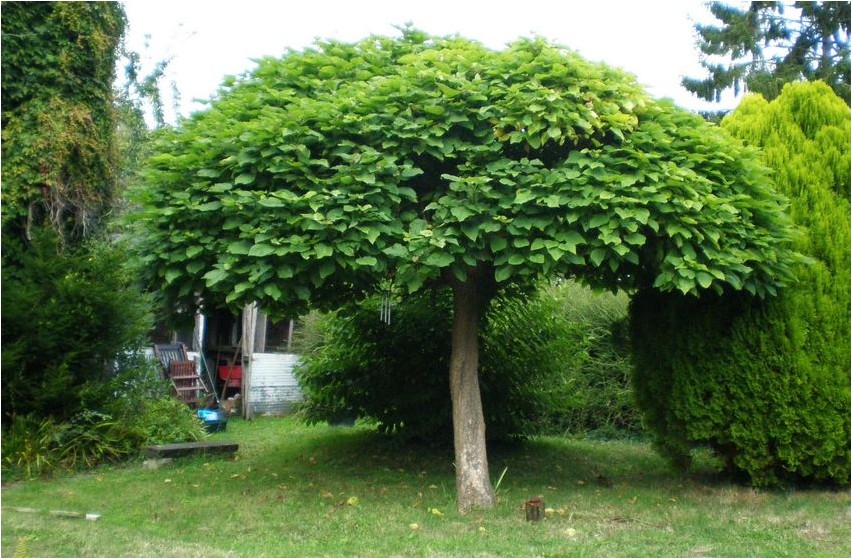
Catalpa (lat. Catalpa) is a genus of ornamental shrubs and trees of the Bignoniaceae family. Currently ten species are known.
The natural range of the catalpa is Japan, North America, China and India. In Russia and Ukraine, catalpa is grown as an ornamental plant.
Characteristics of culture
Catalpa is a picturesque deciduous or evergreen shrub or tree with a beautiful rounded crown that provides dense shade. The leaves are large, heart-shaped, opposite or whorled, long-petiolate, rich green, sometimes light green or yellow.
The flowers are medium-sized, funnel-shaped, white or cream in color with dark spots or dots located in the throat, collected in erect paniculate inflorescences. The fruit is a long hanging capsule up to 40 cm long, containing many volatile seeds. The fruits make the catalpa especially decorative; they remain on the branches almost all winter.
Catalpa is a heat-loving plant; most species tolerate extremely warm climates. The crop is not frost-resistant; it tolerates short-term drops t o-25C. Catalpa is demanding on soil and air moisture.

Growing conditions
Catalpa is quite demanding in terms of growing conditions. The plant thrives in sunny areas protected from northern winds. Soils are preferably fertile, moderately moist, and close to neutral in acidity. Subject to optimal growing conditions, catalpa blooms in the fifth year after planting.
Reproduction and planting
Catalpa is propagated by seeds and summer cuttings. Sowing is carried out without preliminary preparation of the seeds, but to increase germination, the seeds are soaked in warm water for a day. The crop can be sown both in spring and autumn. Planting depth is 0 1-1. 5 cm. Sowing indoors in special seedling boxes under film is not prohibited. It is important to provide the seedlings with diffused sunlight, regular watering and a temperature of 15-25C. When the weather becomes stable outside, the seedlings are planted in open ground.
Cuttings of the crop are carried out in the second half of summer. The cuttings are cut 10 cm long and planted in a mixture of sand and peat until rooting. Once the cuttings develop a developed root system, they are transplanted to a permanent location. The distance between plants should be 4-5 m. Planting depth — 1-1. 2 m. When planting, humus, peat, sand, as well as wood ash (5-8 kg) and phosphate rock (50 g) are added to the holes.
Care
Catalpa care requires regular but infrequent watering (at a rate of 18 liters per tree). During drought, watering frequency is increased. The plant responds well to mineral and organic fertilizers. Three applications are required per season. The soil around the trunk is periodically loosened and weeded.
Young plants are protected for the winter: the crown and trunk are wrapped in burlap, and the trunk area is mulched with a thick layer of peat or humus. This latter procedure prevents the root system from freezing. Sanitary pruning is performed annually in the spring. Trees are cleared of frozen, diseased, and broken branches. Formative pruning is performed as needed.
Uses
Catalpa is distinguished by its high ornamental value and rapid growth, but not all species are suitable for cultivation in the Russian Federation. The cool climate of the temperate zone allows for the cultivation of only four species. That”s why catalpa is a rare guest in gardens. Tall varieties look magnificent in single plantings, as well as in various tree compositions. Catalpa pairs perfectly with magnolias, oaks, and other plants.