Azimina
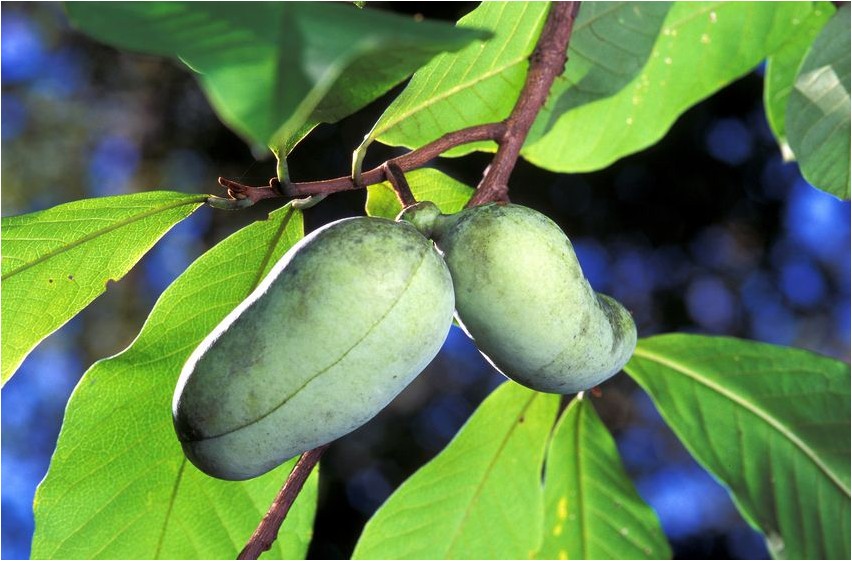
Pawpaw (lat. Asimina) is a genus of deciduous and evergreen plants of the Annonaceae family. Other names include paw paw, banana tree, Nebraska banana.
These names were given to the plant due to the external resemblance of the fruit to bananas. Today, there are 8 species of pawpaw, only one of which (pawpaw three-lobed) is cultivated in Russia and nearby countries. Natural range — North America.
Characteristics of culture
Pawpaw is a deciduous or evergreen tree up to 12 m high with a uniformly leafy crown of a wide pyramidal shape. The bark is gray, smooth. Young shoots are densely pubescent. The leaves are large, leathery, light green, oblong-ovate, narrowed to a thickened petiole and pointed towards the apex, 22-35 cm long, 7-12 cm wide. The underside of the leaves is pubescent, the upper side is glossy with a shine. In autumn the leaves turn yellow. The flowers are brown-purple or red-violet, bell-shaped, located on last year”s shoots, and bloom simultaneously with the leaves.
The fruit is a juicy cylindrical berry, always with curled ends. The fruits are collected in clusters of several pieces. The weight of one fruit varies from 60 to 200 g. Unripe fruits are dark green, over time they become pale yellow, then brown. The pulp of the fruit is tender, light yellow or creamy, has a sharp pineapple-strawberry aroma and a sweetish-luscious taste. The fruits can be picked green; they ripen within 10-12 days in a well-lit room. Pawpaw blooms in April-May, the fruits ripen in September-October. Subject to optimal conditions and proper care, pawpaw produces high yields — from 25 kg and above. Some gardeners use pawpaw as an ornamental plant.
Growing conditions
Pawpaw is a light-loving crop that develops well in sunny areas. Young plants need light shade from direct sunlight. In full shade, plants practically do not bloom and produce very low fruit yields. The crop is undemanding to soil conditions, tolerates heavy soils, but does not tolerate waterlogged areas and lowlands with stagnant cold air. It is not forbidden to grow pawpaw in pots indoors, although the tree will not be pleased with its tall growth.

Reproduction and planting
Pawpaw is propagated by seeds, root suckers and layering. Seeds are subjected to preliminary stratification, which lasts 90-120 days at a temperature of 0C. You can sow seeds before winter, in which case they undergo natural stratification. Shoots with such sowing appear only by July of the next year. When planting stratified seeds, seedlings appear after 7 weeks. Seedlings have a very sensitive root system, and they do not like transplanting. Therefore, it is best to sow plants in large and deep pots and then transfer them. Fill the pots with a mixture consisting of light fertile soil, rotted manure, wood ash and fine sand. Pawpaw grown from seeds begins to bear fruit only after 5-6 years.
Care
Young plants develop very slowly. And in order to stimulate growth, it is important to carry out regular watering and fertilizing. The soil in the tree trunk zone should always be moist; drying out and stagnation of water should not be allowed. During active growth, the crop is fed according to the following scheme: at the beginning of June — with rotted manure, in mid-June — with water-soluble complex mineral fertilizers, at the end of June — with wood ash and pond sludge. The pawpaw needs annual pruning, both sanitary and formative.