Rhodiola rosea
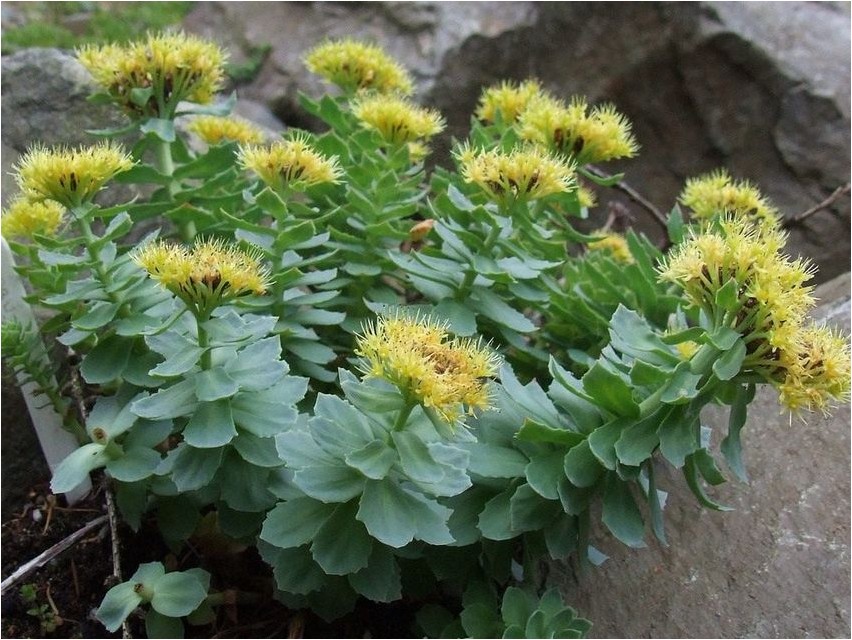
Rhodiola rosea is one of the plants of the family called Crassulaceae; in Latin the name of this plant will be as follows: Rhodiola rosea L. (Sedum roseum (L.) Scop., S. rhadiola DC.).
As for the name of the Rhodiola rosea family itself, in Latin it will be: Crassulaceae DC.
Description of Rhodiola rosea
Rhodiola rosea or golden root is a perennial herbaceous plant. The root of this plant is straight, quite thick, taproot and will develop into a branched rhizome. The rhizome of this plant will be colored in brownish tones, while the outer layer of the rhizome is corky, it is painted in lemon-yellow tones, but when cut, the rhizome will be yellowish or white. Several stems will extend from the top of the Rhodiola rosea rhizome, the height of which varies between forty and sixty-five centimeters. Such rhizomes will be unbranched, erect, they are endowed with alternate sessile bare leaves, which come together in the upper part. The leaves of Rhodiola rosea will be sessile, thick, obovate-elongated or narrowly lanceolate, they are endowed with a wedge-shaped base, from the middle and above such leaves will be sharply toothed, sometimes they can be entire, and the length of the leaves is about one to three and a half centimeters. The inflorescence of this plant is multi-flowered, dense, apical and corymbose. Rhodiola rosea flowers are dioecious, they will be endowed with elongated linear petals, colored in greenish or yellow tones; in male flowers, the length of such petals is three to four millimeters. The fruits of this plant are elongated leaflets that are directed upward and are endowed with numerous small-sized seeds.
Flowering of this plant will begin approximately two to three weeks after the snow melts, while fruiting occurs from August to September. Under natural conditions, Rhodiola rosea is found in the Carpathians in Ukraine, Altai in Western Siberia, Eastern Siberia, the Arctic, in the Urals in the European part of Russia and in the mountains of Eastern Kazakhstan. For growth, this plant prefers pebbles, banks and river valleys, screes, thickets of bushes in wet mountain meadows, rock cracks, tundra, pebbles, gravelly and rocky slopes.
Description of the medicinal properties of Rhodiola rosea
Rhodiola rosea is endowed with very valuable healing properties, and it is recommended to use the roots and rhizomes of this plant for medicinal purposes. Such medicinal raw materials should be harvested after the end of the seed ripening period from August to September.
The presence of such valuable healing properties should be explained by the content of flavonoids, essential oils, carbohydrates, aromatic compounds, anthraquinones, phenols and their derivatives, alkaloids, organic acids, phenolcarboxylic acids and their derivatives in the roots and rhizomes of this plant. Also, the rhizomes of this plant will contain quite a large amount of manganese, lead, barium, copper, silver, zinc, cobalt, nickel, chromium, titanium, cadmium and silene.

Preparations created on the basis of Rhodiola rosea will have a stimulating effect on the central nervous system, have the ability to improve the energy supply of the brain, normalize metabolic processes, and will also improve mental and physical performance, increase resistance to various extreme factors. In addition, such healing remedies based on this plant will delay the exhaustion of the adrenal glands under stress, prevent the involution of the thymus gland and prevent the metabolic manifestations of stress.





