Delphinium consolida
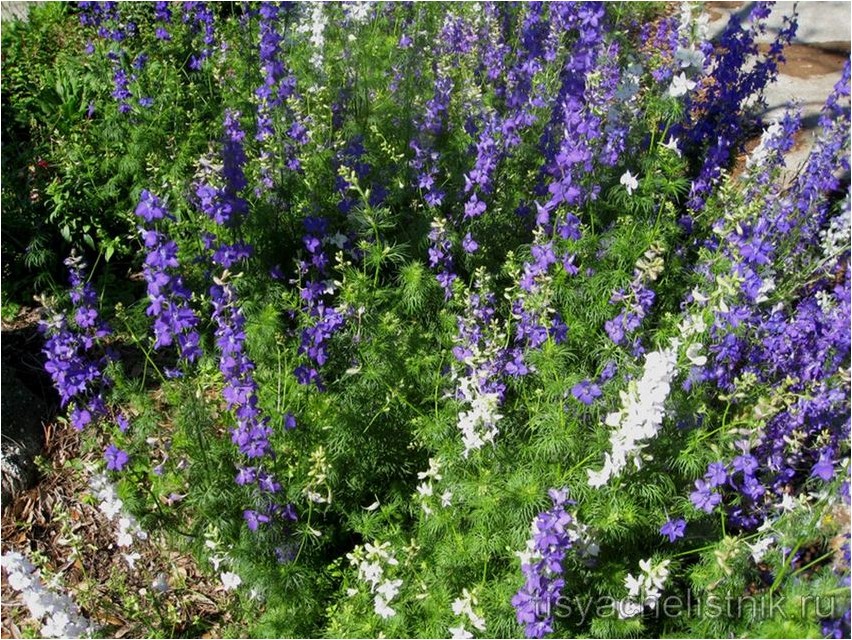
Delphinium consolida is a member of the buttercup family. Its Latin name is Delphinium consolida S. F. Gray.
The Latin name for the family of Delphinium consolida is Ranunculaceae Juss.
Description of Delphinium consolida
Delphinium consolida is an annual herbaceous plant, reaching heights between twenty-five and seventy centimeters. The plant itself is glabrous and slightly pubescent. The upper stems are spreading and branched, although very rarely they can be simple. Delphinium consolida leaves are bi- and tri-tripartitely dissected into narrow linear lobes, approximately one to three and a half centimeters long and approximately half a millimeter to two millimeters wide, with the lower leaves borne on petioles. The bracts are short, more or less appressed. The flowers of this plant are bright purple, although very rarely they can be pale blue. The tepals are approximately twelve to sixteen millimeters long and five to eight millimeters wide. The leaflet of the Consolida splendid is glabrous, twelve to fifteen millimeters long, and the seeds are covered with transverse rows of short, membranous scales.
The flowering period of the Consolida splendid occurs from June to July. In the wild, this plant is found in Ukraine, European Russia, Belarus, Western Siberia, the Caucasus, and Moldova. It is noteworthy that this plant is not only a highly valuable honey plant but also an ornamental plant. Description of the medicinal properties of Consolida magnifica
Consolida magnifica has very valuable medicinal properties. For medicinal purposes, it is recommended to use the herb and seeds of this plant. The herb includes the flowers, stems, and leaves. It should be noted that this plant is poisonous, so extreme caution should be exercised when handling Consolida magnifica.
The presence of such valuable healing properties is explained by the plant’s content of carbohydrates, tannins, vitamin C, anthocyanins, kaempferol, quercetin and the following alkaloids: delsolin, ayaconin, delcosin, consoidin, lycoctonin and anthropoillicoctonin. The seeds of this plant contain fatty oil. It should be noted that in its fresh form, the herb Consolida splendor has received quite wide use in homeopathy.
As for traditional medicine, an infusion prepared from the herb of this plant has become quite widespread. This infusion is recommended for use for various gastrointestinal diseases, pneumonia and whooping cough, for ascites, and also as a rather valuable diuretic and choleretic agent, to regulate the menstrual cycle and to facilitate childbirth.

An infusion of flowers and herbs of this plant is recommended for use for headaches; as for external use, such remedies are used for conjunctivitis. The juice of the consolidum splendid herb is used topically as a wound-healing agent, providing a curare-like effect.
An infusion of leaves and a decoction of the seeds of this plant should be used for convulsive coughs, bronchial asthma, and also as a stimulant and astringent. It is noteworthy that the ointment prepared from the seeds of consolidum splendor is recommended for use for scabies.
CONSOLIDA fam. Ranunculaceae


