Poisonous buttercup
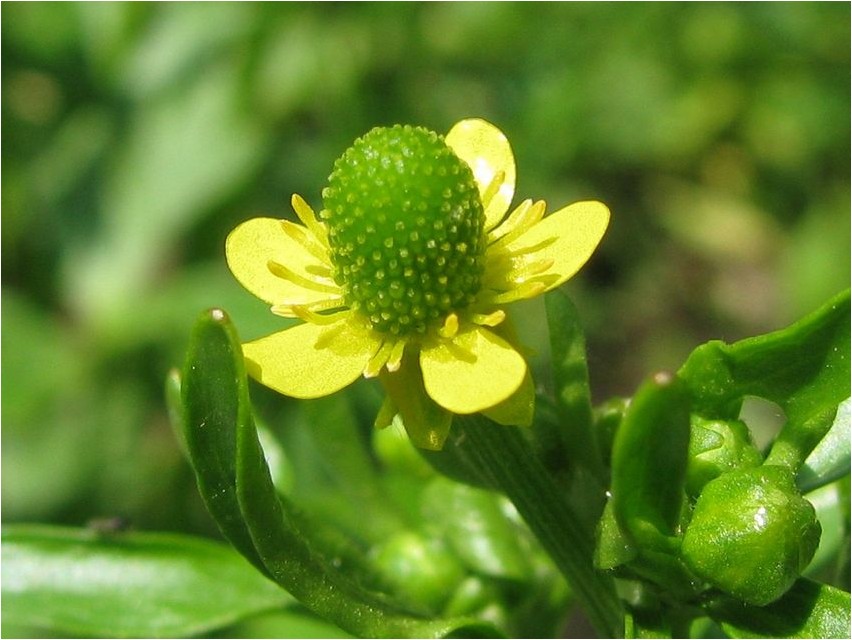
Poisonous buttercup is one of the plants of the family called Ranunculaceae; in Latin the name of this plant will be as follows: Ranunculus sceleratus L.
As for the name of the poisonous buttercup family itself, in Latin it will be: Ranunculaceae Juss.
Description of poisonous buttercup
Poisonous buttercup is a one- or biennial herbaceous plant. The height of the stem of such a plant will vary between ten and forty-five centimeters; it can be either bare or endowed with appressed hairs. The leaves of the poisonous buttercup will be somewhat thickened and bifid, while the upper leaves are either trifid or trifid into oblong-linear lobes. The flower stalks of this plant will stick up and are hairy. The flowers of the poisonous buttercup are colored yellow, and their diameter reaches only ten millimeters. The sepals of this plant are longer than the petals, and they will also curve downward. In total, the poisonous buttercup has five or six petals, but sometimes it can have more. The receptacle of this plant is hairy and elongated, the length of the fruitlets does not reach two millimeters, and their nose is very short.
The poisonous buttercup blooms from April to July. Under natural conditions, this plant is found in almost all regions of Russia, in Asia, Europe, Ukraine, Belarus, as well as in the Far East, except for the Arctic and highlands. For growth, this plant prefers the banks of water bodies, weedy wet places, muddy places, damp and swampy meadows.
Description of the medicinal properties of poisonous buttercup
Poisonous buttercup is endowed with very valuable healing properties. As for traditional medicine, this plant is most often recommended for external use. The juice of the poisonous buttercup, which has been previously diluted with water, is used to lubricate the skin areas of the body that have been affected by scabies. The same product can be used to wash festering wounds and sore eyes. Crushed fresh leaves of this plant are applied to warts, and are also used as an external remedy that will stimulate regenerative processes. In addition, fresh crushed leaves of poisonous buttercup are used in the treatment of wounds, eczema, scab, burns, boils, ulcers, itchy skin, rashes, abscesses, hives and erysipelas.
The crushed herb of this plant is used as an exhaust patch: such a healing agent should be applied to the skin as a very effective distraction and pain reliever. For rheumatism, it is recommended to steam your feet in an infusion prepared from the poisonous ranunculus herb.

As for Tibetan medicine, here the herb of this plant is used as a blister remedy, and is also used for edema, various diseases of the female genital organs, dizziness, colitis and enteritis. It is noteworthy that in homeopathy, the herb of poisonous ranunculus is used to treat edema of renal origin.
In Chinese medicine, it is recommended to use the seeds and skin of the roots of this plant as an antipyretic for colds, and the seeds are also used as a tonic.
It should be noted that the herb of this plant is endowed with a very effective laxative effect; for this reason, it is recommended to use the herb of poisonous buttercup for constipation. Due to the fact that the chemical composition of this plant has not yet been fully studied, new ways of using medicinal products based on poisonous buttercup may appear in the near future.





