Rock Wormwood
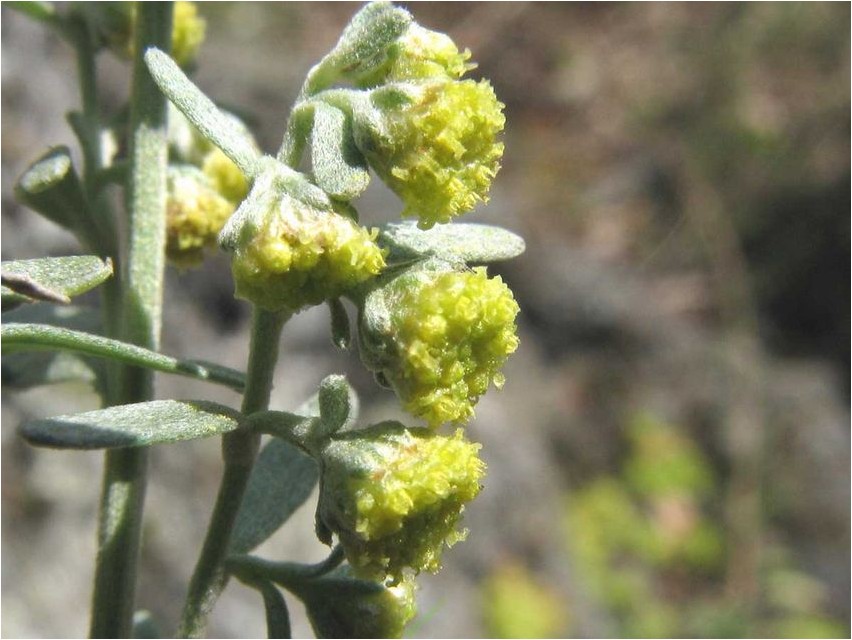
Rock wormwood is a member of the Asteraceae or Compositae family. Its Latin name is Artemisia rupestris L. (A. viridis Willd.).
The family name of rock wormwood itself is Asteraceae Dumort. (Compositae Giseke).
Description of Rock Wormwood
Rock wormwood is a perennial herbaceous plant, reaching heights between seven and sixty centimeters. Its stems are woody at the base, more or less branched, and develop a small number of sterile, annual shoots. The stems of northern wormwood are fruiting, erect, and brownish-purple in color, with the simple stems densely hairy in the upper portion. The flower heads of rock wormwood are spherical, approximately four to seven millimeters wide, and are arranged in a narrow racemose-spicate inflorescence. The marginal florets of this plant are pistillate, numbering only sixteen. The corolla is narrowly tubular, and the disk florets are bisexual. Rock wormwood achenes are finely grooved, oblong-ovate in shape, and quite small.
Rock wormwood blooms in August. In the wild, this plant is found in Central Asia, all regions of Eastern Siberia except the Yenisei region, the Volga-Kama region of European Russia, all regions of Western Siberia except the Ob River, and in the Baltic states on the islands of Moona, Hapsal, and Ezel. This plant prefers forest edges, dry saline meadows, high-mountain meadows, forest meadows, sparse deciduous slopes, steppe, rocky and gravelly slopes, and even cliffs.
Description of the medicinal properties of rock wormwood
Rock wormwood has very valuable medicinal properties, and its fruits and herb are recommended for medicinal purposes. The herb includes the inflorescences, stems, and leaves. These valuable medicinal properties are attributed to the essential oil found in the above-ground parts of this plant.
It should be noted that the experiment proved that an infusion based on the herb of this plant has the ability to increase the acidity of gastric juice, increase gastric secretion and will also increase the content of pepsin in the composition of gastric juice. This plant is effective for hypoacid gastritis. Infusion and tincture prepared from the herb wormwood will exhibit cardiotonic and hypotensive properties. The essential oil of this plant, in turn, will exhibit anthelmintic properties, and the chloroform extract of the leaves and inflorescences of wormwood has antitumor activity.

As for Tibetan medicine, an infusion prepared from the leaves and herbs of wormwood is widely used here. This medicinal plant is used for carbuncles and boils, and is also used as a very effective wound healing agent. An infusion based on the fruits and inflorescences of wormwood should be used for pulmonary tuberculosis, bronchitis and pneumonia. An infusion and decoction of the herb of this plant is indicated for use in various diseases of the heart and stomach.
For hypertension, the following remedy should be used: one teaspoon of crushed dry herbs of this plant is taken in a glass of boiling water. The resulting mixture is infused for about one to two hours in a warm place and carefully filtered. Take this remedy based on wormwood three times a day, one or two tablespoons.





