Baptisia

Baptisia (Latin: Baptisia) is a genus of herbaceous flowering perennial plants in the legume family (Fabaceae). The genus is native to eastern and southern North America, where they grow in forests and pastures.
The plants are shrubs, the height of which varies depending on the species and growing conditions. Flexible stems are covered with compound leaves consisting of relatively small leaflets. The racemose inflorescences are formed by papilionaceous flowers, typical of plants in the legume family, and come in a wide variety of colors: white, cream, yellow, light blue, blue, and purple in various shades. Many species are saturated with toxic substances, posing a certain threat to animals and people, especially inquisitive children left unsupervised. What”s in a name?
The Latin name of the genus “Baptisia” is derived from an ancient Greek word meaning “to impregnate with dye” or “to color.” This name stems from the presence of chemicals in the plant tissues of some Baptisia species that can dye fabrics.
Due to some similarities between Baptisia plants and Indigofera plants, known as sources of a blue, permanent dye, the genus Baptisia is sometimes called “Wild Indigo” or “False Indigo” in English literature.
Description
The perennial life of plants in the genus Baptisia is supported by a deep-seated underground rhizome, from which a network of roots extends into the soil, and branched, erect stems emerge from the surface. Their height, depending on the species and growing conditions, ranges from half a meter to one and a half to two meters.
Compound leaves consist of three simple leaflets, resembling clover in number and the leaves of many legumes in appearance, including Acacia, Indigo, and others.
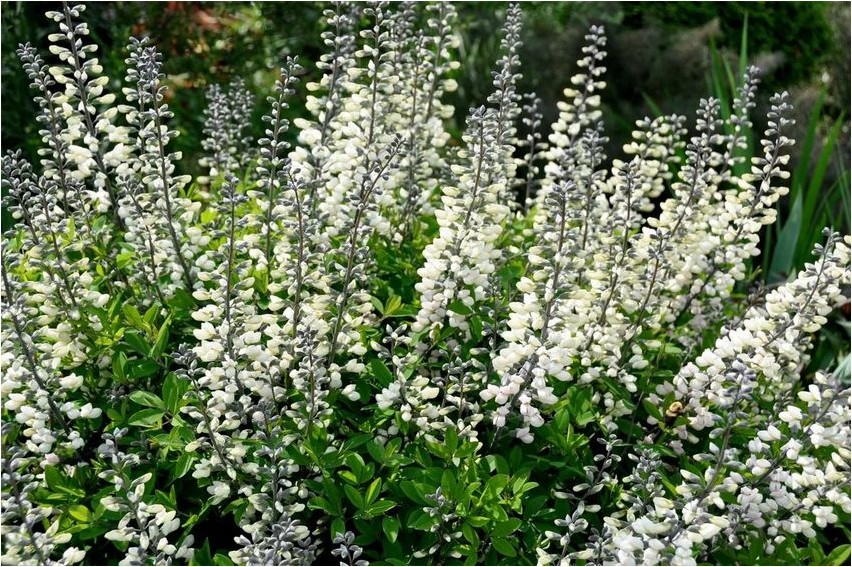
The most picturesque part of the plant are the large, showy flowers that form racemose inflorescences. The bell-shaped, two-lipped calyx protects the butterfly corolla from vicissitudes, the sail of which does not tend to amaze the observer with its size, and therefore does not exceed the length of the wings, as in some representatives of the Legume family. Ten free stamens with the same free ovary (the so-called superior ovary, in contact only with the receptacle with its base) complement the beauty and picturesqueness of the flower. Nature has given the genus a wide range of colors, and therefore flower petals of different species choose their own personal color from such a set of colors as white, cream, yellow, blue, light blue, violet.

The crown of the growing season is the beans, swollen with a large number of seeds hiding behind the fruit valves.
Varieties
Today, the genus includes about thirty plant species. As an example, we list some of them:
* Southern baptisia (lat. Baptisia australis) is the most common species of the genus “Baptisia” in nature. The plant is commonly known as “Blue wild indigo” or “Blue false indigo”. It is a shrub from one to one and a half meters in height with gray-green leaves and butterfly flowers with colors ranging from light blue to deep purple.
* Baptisia tinctoria (lat. Baptisia tinctoria) — has other names, for example, “Yellow false indigo”. It is a shrub from half a meter to one meter in height, the stems of which are covered with complex leaves consisting of three silver-green leaves slightly more than one centimeter long, and yellow moth-like flowers.
* White baptisia (lat. Baptisia alba) — has common English names “White wild indigo” (White wild indigo) or “White false indigo” (White false indigo). With moth-like white flowers.
Usage
Similar to the Australian genus of plants called “Indigofera,” plants of the described genus were also used by Indians, only in this case, American Indians, for dyeing fabrics.
The relative winter hardiness of the plant makes it possible to grow a spectacular shrub in Russian conditions, in places where winter is not characterized by severe and prolonged frosts.
Baptisia flower planting and care Photo