Impatiens impatiens
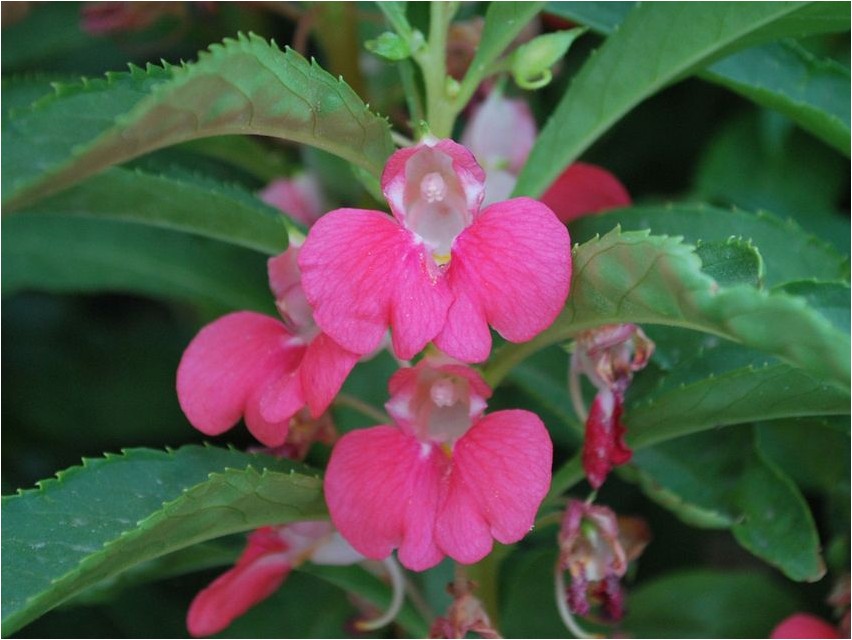
Impatiens balsamina is one of the plants of the family called balsamaceae; in Latin the name of this plant will be as follows: Impatiens balsamina L.
As for the name of the impatiens balsamic family itself, in Latin it will be: Balsaminaceae Rich.
Description of impatiens impatiens
Impatiens impatiens is an annual herbaceous plant, endowed with an unbranched and straight stem, the height of which will be about twenty-five to forty-five centimeters. The leaves of this plant will be quite narrow and lanceolate, at the top they are pointed, at the base they will be wedge-shaped, they run down the petiole, and along the edge they will be serrated. The flowers of impatiens impatiens will be quite large, they are on short stalks and are clustered several in the axils of the leaves, and the length of such flowers will be about two and a half to three and a half centimeters. Such flowers will be colored purple-white or pink, they can be either variegated or double. The spur of the petal-shaped sepal of this plant will be bent, and its length will be about one to one and a half centimeters. The fruit of impatiens impatiens is a pubescent ovoid capsule.
The flowering of this plant occurs from July to August, while the fruits of impatiens impatiens ripen from August to September. Under natural conditions, this plant is found in the Far East, southern Europe, Ukraine and Central Asia. As for the general distribution, this plant is found in India, Asia Minor, Southern Europe and China.
Description of the medicinal properties of Impatiens balsamic
Impatiens balsamina is endowed with very valuable healing properties, and for medicinal purposes it is recommended to use the seeds and flowers of this plant both fresh and dry. Seeds should be harvested from August to September after they ripen. The fruits should be torn from the stem, then dried and sifted through a mesh.
The presence of such valuable healing properties should be explained by the content of fatty oil, parinoric acid, saponins and basaminosterol in this plant. The aerial parts of Impatiens impatiens and its seeds contain essential oils, amino acids, proteins, and sugar, while quercetin and kaempferol were found in the flowers.

Aqueous solutions based on the stem and seeds of this plant have the ability to inhibit and inhibit the growth of Staphylococcus aureus, typhoid bacillus, dysentery pathogens, green purulent bacillus and streptococcus. A decoction prepared from Impatiens impatiens flowers is recommended for use for various types of bruises, amenorrhea and rheumatic joint pain.
As for external use, the fresh flowers of this plant should first be crushed to a pulpy mass. After which such a healing remedy based on impatiens balsamina is recommended for use topically for poisonous snake bites, lichen, carbuncles, boils and various types of difficult-to-heal wounds. It is noteworthy that the root of impatiens impatiens with the white flowers of this plant is recommended for use as a very effective anesthetic and narcotic.
It should be noted that the chemical composition of this plant has not yet been studied well enough, for this reason it is possible in the near future that new methods of using valuable medicines based on Impatiens balsamina, which is very, very effective in medicinal terms, will emerge.





