Common Mordovnik
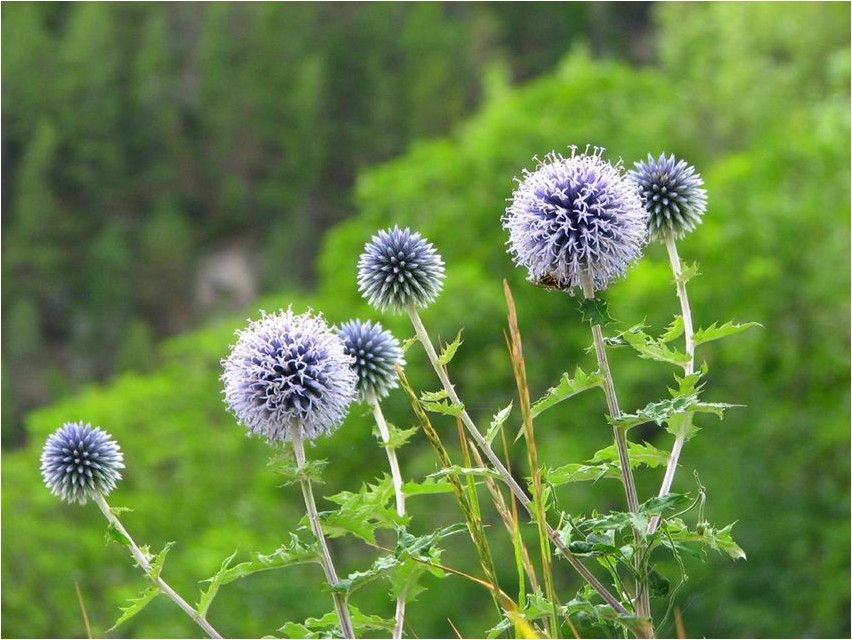
Echinops ritro (lat. Echinops ritro) is a herbaceous perennial plant of the genus Echinops (lat. Echinops), classified by botanists as belonging to the Asteraceae family (lat. Asteraceae).
Its funny ruffy inflorescences are used in decorative floriculture. Common Echinacea has healing abilities that help improve the functioning of the human cardiovascular system, as well as have a beneficial effect on the nervous system. In addition, traditional healers are trying to combat baldness of male heads with an infusion of seeds.
What’s in your name
The spherical heads of the inflorescences are so picturesque that they certainly give rise to different associations.
For botanists looking for a Latin name for a genus of morphologically similar plants, the inflorescences evoked an association with the appearance of bristly hedgehogs, and therefore the name of the genus was based on two Greek words meaning “hedgehog” and “appearance” in Russian. Thus, the Latin name of the genus “Echinops” was born, which is the first word in the name of any plant species included in this genus.
For Russian people, the inflorescence evoked a completely different association. The combat appearance of the inflorescence was reminiscent of the ancient weapon of Russian heroes – a valiant mace, which more than once passed through the faces of any wickedness that tried to seize Russian lands. Hence the verb “mordovat” and the name of the plant genus – Mordovnik.
The specific Latin epithet “ritro” stretches back from the depths of centuries of European peoples, who since ancient times have called various species of plants of this genus with this very word. Although the meaning of the word was lost over the centuries, botanists did not bother and assigned the name, which had long been familiar to people, as a species epithet for a plant widely represented in Europe. The Russian specific epithet is not a translation from one language to another, but rather speaks of the omnipresence of the plant in the vastness of our country.

People, as often happens, came up with their own names for the plant. But, since a number of them echo the names of other plants, firmly assigned to them by botanists, it is more logical not to resort to such names, so as not to create confusion and groundless disputes.
Description
Mordovnik loves straightness, which is expressed in its taproot, which is thinly branched and thick, going deep in order to more effectively provide nutrition to powerful, erect stems that branch only slightly in its upper part. The height of the stem, depending on the living conditions of the plant, ranges from 0. 3 to 1. 5 meters, and the surface is protected by a white felt covering.
The pinnately dissected leaves are very picturesque and give the bush a decorative appearance even when the time for flowering has not yet come. The dark green surface of the leaf blade can be bare or covered with a light cobweb mesh, which becomes thicker on the reverse side, turning into a white felt covering. The basal leaves, as well as the stem leaves, located in the lower part of the stem, are equipped with petioles. Higher up the stem, the leaves lose their size and roots, becoming sessile directly on the stem.
The leaves are also picturesque by the spiky, serrated edge of the leaf blade, which adds to the belligerence of the plant. In addition, this edge of the leaf was the reason for the popular names “Black Sedge”, as well as “Black Sedge”, which belong to completely different plants.
Mordovnik vulgaris acquires a special decorative effect during the flowering period, when the ends of its stems are armed with capitate spherical white-bluish-blue inflorescences, characteristic of Asteraceae, but only from tubular flowers alone, provocatively sticking out in all directions.
The crown of the growing season is the cylindrical achenes.
Healing abilities
Common Mordovnik is an officially recognized healer. Medical scientists discovered in its seeds a low-toxic alkaloid called “echinopsin”, which can help an injured human nerve.
Preparations from the plant help normalize heart function, tone skeletal muscles, and help with low blood pressure.
A decoction is prepared from the seeds to stimulate hair growth.





