Arizema
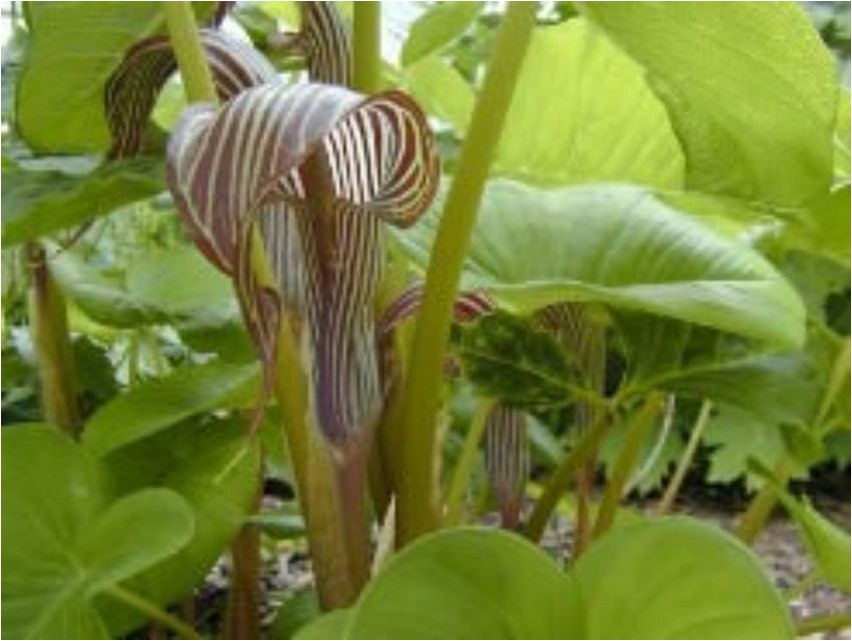
Arizema (lat. Arisaema) is a relatively small genus of herbaceous plants that belongs to the Araceae family. Another name is monopoly; in the USA the plants are even called cobra.
Natural habitats include tropical and mountain forests, deserts and semi-deserts, rocks (including limestone), savannas, meadows. Representatives of the genus can be photographed both in the hot countries of Africa and in Russia, mostly in the Primorsky Territory, Sakhalin and the Kuril Islands.
Characteristics of culture
Arizema is represented by perennial evergreen herbaceous plants up to 2 m high, endowed with an underground stem, at the end of which there is a spherical tuber bearing stolons or small nodules. A feature of the representatives of the genus is the presence of underdeveloped (reduced, scale-like) hard bud leaves on them, which perform protective and storage functions.
The foliage from the vagina is formed in the amount of 1-4 pieces; it, in turn, has from 3 to 19 pinnately dissected leaves. Also known in culture are species that are characterized by simple oval or lanceolate foliage. The flowers are equipped with a straight cylindrical tube; it can have wide mouths and longitudinal stripes that are visible to the naked eye. The plate is concave or expanded, less often it has a vertical elongated formation at the end. The peduncle is short, there may be tubercles on top.
What is interesting and surprising is that the inflorescences of the crop in question are optical traps, due to which insects linger in the flower tube longer than on all others. The fruits are represented by red berries of an ovoid or obverse conical shape, they are characterized by a round tip. The seeds, in turn, are spherical or ovoid, hard, brown, and rough to the touch.
Features of cultivation
Representatives of the genus can hardly be called whimsical plants; on the contrary, they can boast of high resistance to unfavorable climatic conditions. They actively develop in the same area for many years without any problems, even in the absence of frequent watering. However, the crop still puts forward some requirements for growing conditions. Так, сажать ее рекомендуется на легких, хорошо дренированных, в меру увлажненных и питательных почвах. You should not even try to grow arisema on heavy, highly acidic, swampy, damp and saline soils.

Despite the fact that many types of arizema are resistant to cold, it is not recommended to plant them in areas not protected from cold northern winds, and especially in lowlands with stagnation of cold air, precipitation and melt water. For the winter, a good thick shelter is desirable; it is better if the material is natural, for example, fallen dry leaves or spruce branches. Heat-loving species should be transplanted into wide and deep containers for the winter and kept indoors at a temperature of 2-4C until spring.
It is also worth noting that at the base of the stem near the tuber, with frequent rainfall (especially in spring and autumn), quite a lot of water accumulates, which almost always leads to rotting of the tuber and, as a result, death. To prevent the rotting process, it is very important to systematically hill up the plants. This procedure must also be carried out for tall specimens, otherwise they may break at the base. In addition to hilling and covering for the winter, arizema needs regular watering and fertilizing with complex mineral fertilizers (in early spring and mid-summer).