Bearded Gentian
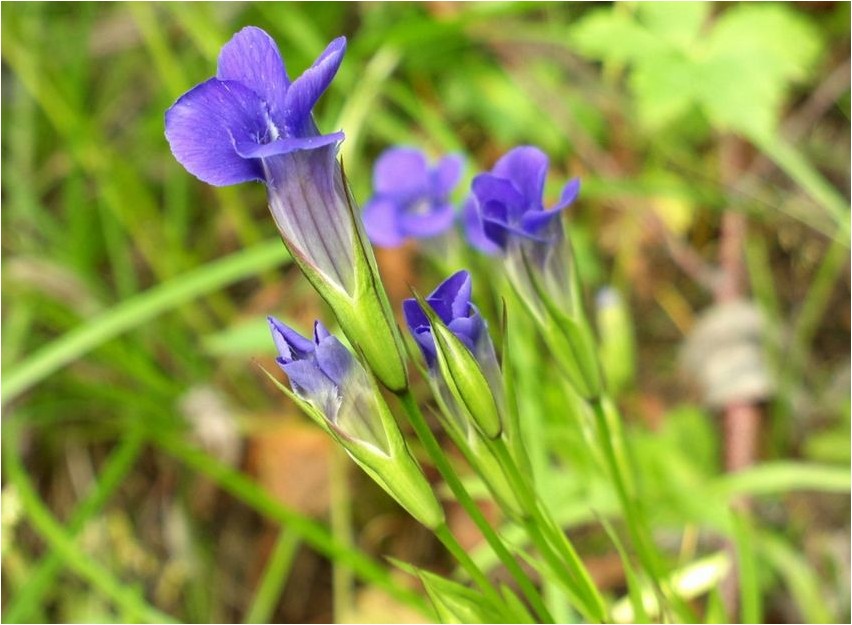
Beared Gentian is a member of the Gentianaceae family. Its Latin name is Gentianopsis barbata L. (Froll) (Gentiana barbata Froll).
The family name of bearded gentian is Gentianaceae Juss.
Description of Bearded Gentian
Beared Gentian is an annual or biennial, hairless herbaceous plant with green foliage. Its height ranges between six and sixty centimeters. Its stems are erect, branching at the top, and its basal leaves form a rosette. It’s worth noting that the leaves of this plant will wilt over time and become either oblong or oblong-obovate, sometimes even blunt. Bearded gentian is approximately two to four centimeters long and one and a half to five centimeters wide. The flowers are tetrahedral, borne singly at the ends of branches or stems, and are borne on fairly long peduncles. The calyx of bearded gentian is narrowly bell-shaped, approximately twenty-three to twenty-seven millimeters long, and approximately one and a half times shorter than the corolla itself. The corolla itself is blue, narrowly funnel-shaped, and approximately thirty to thirty-five millimeters long. The capsule of this plant is oval-oblong, and the seeds have a transparent, honeycombed skin. The bearded gentian blooms from July to August. In the wild, this plant is found throughout European Russia, as well as in the Arctic, Central Asia, Western and Eastern Siberia, and the Okhotsk region of the Far East. It prefers meadows, forest edges, rocky, meadow, and steppe slopes, as well as marshy areas, forest clearings, sparse forests, shrublands, and alkaline riverbanks in both mid-mountain and high-mountain zones.
Description of the medicinal properties of bearded gentian
It is recommended to use the flowers and herbs of this plant for medicinal purposes. The presence of such valuable healing properties is explained by the content of essential oil, coumarins, alkaloids, tannins, xanthones, isocoparine, isoorientin, as well as the following carbohydrates in bearded gentian: sucrose, glucose and primverose. Moreover, in the aerial part of this plant there will be xanthones, alkaloids and the following flavonoids: cosmosin, timanina, chrysoeriol, luteolin and apigenin.
In Tibetan and Mongolian medicine, the herb of this plant is considered one of the main drugs for various diseases of the hepatobiliary system, cholecystitis, cystitis, liver diseases, which will be complicated by pneumonia. In Tibetan medicine, this plant is used as part of various complex preparations for acute endocarditis, stomach and kidney diseases, septic conditions, as well as chronic and acute infections. In addition, such remedies are also effective for malignant tumors, laryngitis, malaria, neurasthenia and burns, and also as a means that will regulate metabolism. In Mongolian medicine, the valuable properties of this plant are used as antipyretics, which especially applies to infectious diseases. Moreover, in Chinese medicine this plant is used as a tonic.
In Tibetan medicine, this plant is also recommended for use for heart neurosis, general neuroses, tachycardia, shortness of breath, nephritis and gout.

Gentian snow globe. Brief overview, description of characteristics, where to buy gentiana divisa





