Sedum white-pink
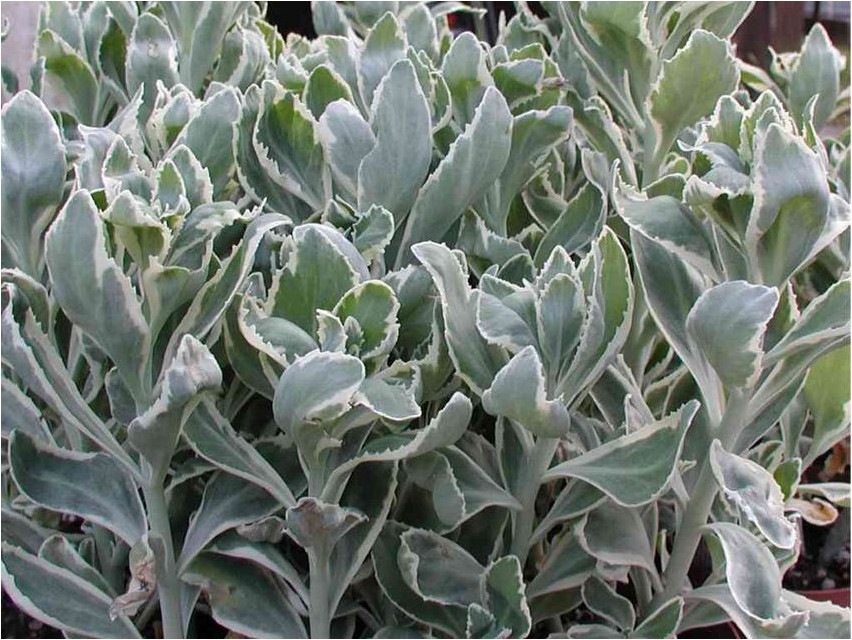
White-pink sedum is one of the plants of the family called Crassulaceae; in Latin the name of this plant will be as follows: Sedum alboroseum L.
As for the name of the white-pink sedum family itself, in Latin it will be: Crassulaceae DC.
Description of white-pink sedum
White-pink sedum is a perennial herbaceous plant whose height will vary between thirty-five and sixty centimeters. The rhizomes of this plant are cord-like, thin, and they will extend in a bunch from a short woody rhizome. The stem of the white-pink sedum will be powerful, strong, densely leafy and straight, and its height will fluctuate between sixty and one hundred centimeters. The leaves of this plant are almost sessile, alternate, oblong-ovate, and towards the base they will be wedge-shaped. The length of such leaves will be about seven to ten centimeters, and the width will be one and a half to four centimeters; from below, these leaves will be endowed with quite abundant dark and elongated dotted glands. The inflorescence of this plant is dense, its width will be about seven to ten centimeters, and its length will be ten to thirty centimeters. Such an inflorescence of white-pink sedum will be complex, umbellate-paniculate and poorly branched; it will have about ten spread branches, each of which will bear an independent shield. The flowers of this plant will be five-membered, the length of the petals will be about six to six and a half millimeters, and the petals will be colored white or pink. The white-pink sedum fruits will barely protrude from the corolla; they will be oblong and have a short spout. The length of the seeds of this plant will not exceed one millimeter, and they will be colored brownish.
This plant blooms from July to August. Under natural conditions, white-pink sedum is found in the Far East in the valley of the Tym River. For growth, this plant prefers river valleys, moist seashores, rocky and sandy slopes.
Description of the medicinal properties of white-pink sedum
White-pink sedum is endowed with very valuable healing properties, and it is recommended to use the leaves of this plant for medicinal purposes.
The plant’s valuable medicinal properties are attributed to its fructose, kaempferol, sucrose, quercetin, sedoheptulose, esculetin, kaempferitrin, and kaempferol 3-rhamnoside. In Japanese medicine, an infusion made from the leaves of this plant is widely used. This remedy is used as a detoxifying agent and for various skin conditions. In China, similar remedies are used for fevers and as detoxifying agents for various poisonous insect bites.

For colds, the following remedy based on this plant is recommended: to prepare this remedy, take one tablespoon of crushed dried sedum albus herb and one cup of boiling water. The resulting mixture is recommended to steep for about two hours, then strain thoroughly. Take the resulting remedy, made from white-pink sedum, three times daily, one-third to one-quarter cup. It’s worth noting that if the remedy is prepared and used correctly, positive results will be noticeable very quickly.





