Dereza
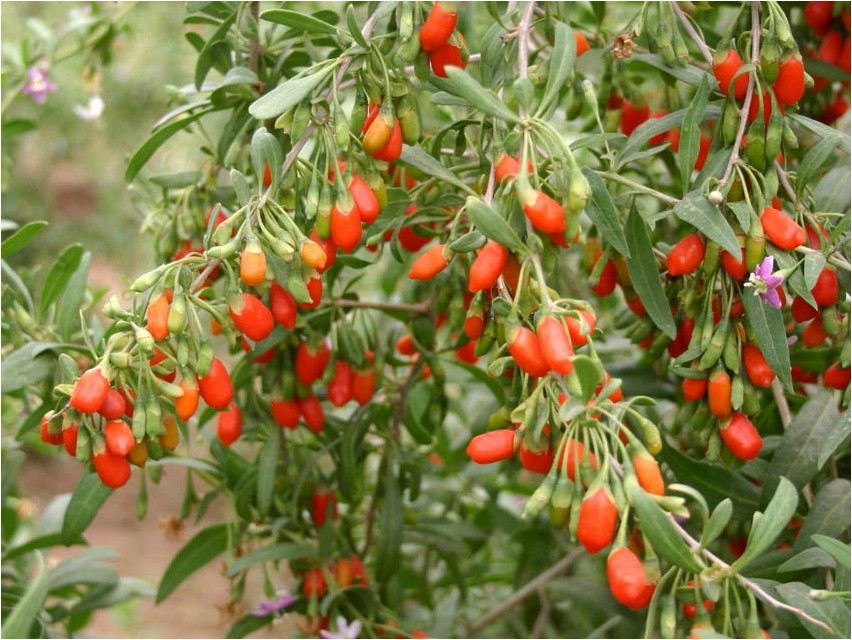
Dereza (lat. Lycium) is a genus of shrubs of the Solanaceae family. The genus contains about 90 species. Other names are lycia, Tibetan barberry, buldurgun, goji and wolfberry.
Distributed everywhere except the far north. Tolerates many types of soil, including saline and dry. Typical places of growth in nature are roadsides, rocky crevices, slopes and mountains. Some members of the genus are poisonous.
Characteristics of culture
Dereza is a perennial deciduous shrub equipped with thorns. The leaves are simple, entire, short-petioled, opposite, up to 8 cm long. The flowers are purple, greenish-white or white, axillary, collected in bunches or solitary. The calyx is three or five-toothed, preserved during the fetus. The corolla is tubular-funnel-shaped, equipped with a conical or cylindrical tube. The fruit is a multi-seeded berry of red, yellow, orange, black or purple color.
Growing conditions
Dereza feels good in sunny or partially shaded areas. The crop is undemanding to soil conditions and can grow normally on low-fertility, saline and poorly moistened soils. Drainage is not required, but encouraged.
Dereza grows quite quickly, over time it occupies large areas, displacing other cultivated plants. Therefore, it is advisable to plant plants along fences and ditches. Dereza is resistant to frost, although winter hardiness varies among all species.
Reproduction
Dereza is propagated by seeds and cuttings. Seeds are sown immediately after collection. The seeds are removed from the fruit, washed, dried and sown in the ground. When sowing in spring, the seeds are pre-soaked in warm water for two days and then treated with a weak solution of potassium permanganate. It is recommended to sow seeds in seedling containers superficially while maintaining a constant level of humidity.

When cuttings, planting material is cut from one- or two-year-old shoots. The length of one cutting can vary from 10 to 15 cm, each should have at least 3-4 buds. The cuttings should be cut obliquely. For rooting, cuttings are planted in containers filled with a mixture of sand and peat. Planting depth — 3-5 cm.
Care
The main task of caring for wolf trees is timely pruning. With the onset of spring, a third of the old shoots are removed from the bushes. The crop does not need weeding, since it can independently suppress surrounding plants. Watering is carried out only during drought; wolfberry does not accept excessive watering.
Application
Dereza is a rather attractive plant; it is ideal for landscaping garden plots and parks. Looks great in group and single plantings. Some representatives of the genus are used in folk medicine. In the east, medical preparations are produced from the fruits of the crop, which are useful for people suffering from diseases of the nervous and cardiovascular systems. In addition, these drugs improve kidney and liver function.
Dereza
https://www. youtube. com/watch? v=3lmE0apBszE& amp; t=4s





