Borago
Бораго (лат. Borago) — травянистый однолетник из семейства Бурачниковые. В народе бораго именуют огуречной травой либо бурачником.
Description
Borago is a stiff-haired annual that can grow from sixty centimeters to a meter in length. The roots of borage are rod-shaped, and the hollow, ribbed and fairly thick stems branching upward can be either ascending or straight.
The lower stem and basal leaves are oval or elliptical in shape. Closer to the bases, they gradually narrow into short petioles, and their tips are rather blunt. As for the stem leaves, they are characterized by an oblong-ovate shape. All of them are stem-embracing and sessile and, like the stems themselves, are abundantly covered with whitish and rather stiff hairs.
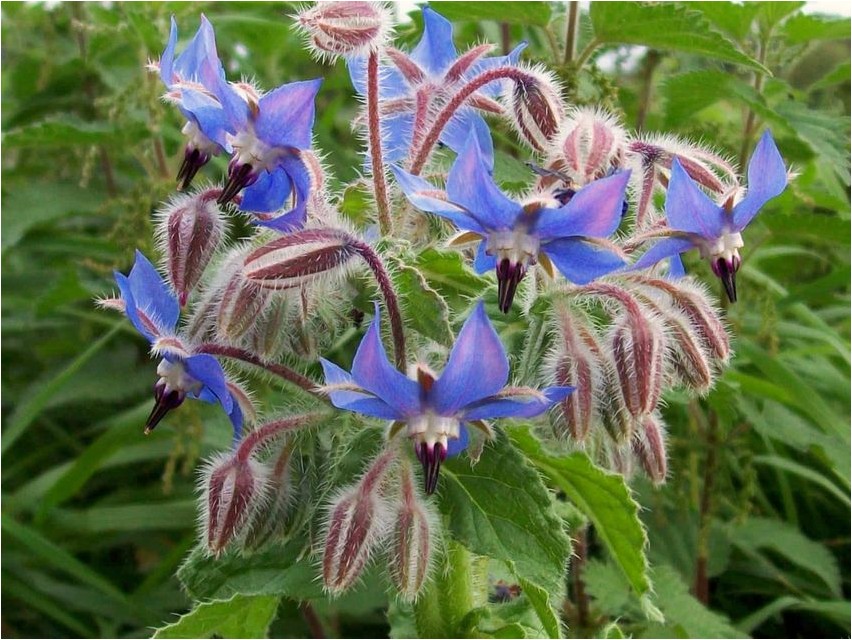
Сидящие на длинных ножках цветочки бораго собираются в причудливые завитки. Their densely coarsely hairy calyxes are divided almost to the very base into several linear-lanceolate lobes. Each flower has five stamens, and their corollas, which are longer than the calyxes, are equipped with short tubes and are colored either whitish or dark blue. Полюбоваться цветением данного растения можно с июня по август.
Borago fruits are small-tuberous and oblong-ovoid nuts that ripen from July to September.
Where does it grow
Родина бораго — Юго-Западная Европа и Сирия. In its wild form, this grass can be found in a number of countries in South America, North Africa and Southern Europe. Встречается бораго и в Малой Азии. Quite often, this useful herb grows as a weed, but in countries with well-developed beekeeping (France, England, etc.) it is also grown as a honey plant.

Application
With the addition of borage, okroshkas, salads and excellent side dishes for fish and meat dishes are prepared. In addition, this herb is an excellent pergonos and honey plant — the honey from it is very light and tasty. Borago leaves are eaten fresh, and flowers are either candied or fresh.
And if you plant borage at the same time as potatoes, this plant will help reduce the activity of the Colorado potato beetle, which will save up to 95% of the harvest.
The above-ground parts of borage are sometimes used to dye wool fabrics — they acquire a rich blue color.
Borage is considered an excellent laxative and diuretic. The leaves of this herb (both fresh and dried) are an excellent remedy for skin conditions, gout, and rheumatism. They also have demulcent, diaphoretic, and soothing properties. Vitamin-rich salads with borage help prevent inflammatory processes in the intestines and kidneys and also have a beneficial effect on metabolism.
The minerals contained in borage help strengthen the cardiovascular system and have a positive effect on blood composition. Potassium and calcium, found in the leaves of this plant, are vital for maintaining a healthy nervous system.
Borage is also used in cosmetology, where it is used to create excellent skin care products for sensitive and problematic skin.
Cultivation
Borago is planted primarily in sunny areas on light, calcareous and sandy soils, and can be planted several times throughout the year. Typically, this valuable herb is planted in the fall and spring. Winter sowings are equally successful.
When planting, borage seeds are buried to a depth of about three to four centimeters, with the distance between rows no less than sixty centimeters.
Borage doesn”t require any special care: it requires regular weeding, fertilizing, and thinning. During drought, borage can be pampered with watering, applying up to ten to fifteen buckets of water per 100 square meters.