Santol
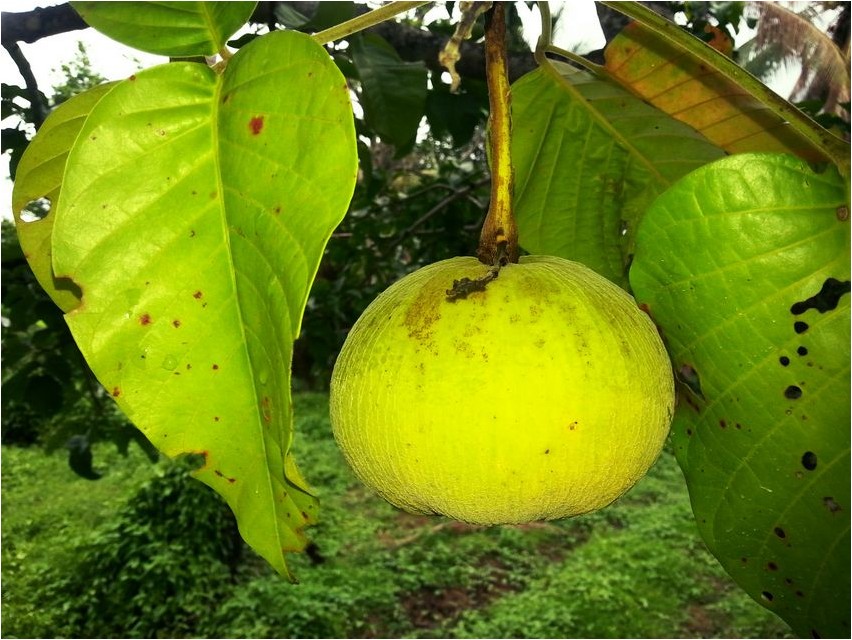
Santol (lat. Sandoricum koetjape) is a fruit tree belonging to the Meliaceae family.
Description
Santol is a fast-growing evergreen tree that can reach a height of fifteen to forty-five meters. And the length of its elliptical or oblong leaves ranges from fifteen to thirty centimeters.
The size of santol flowers usually does not exceed one centimeter, and the flowers themselves are colored yellowish-greenish or pink.
The spherical fruits of santol reach a diameter of four to seven and a half centimeters. There are currently two varieties of fruits (by the way, they were once considered different species) — with yellow and reddish velvety peel. And in Thailand, brownish or reddish fruits are most often found. The skin of santol contains latex, and inside both fruits there is a sweet and very juicy transparent white pulp, in which brownish and fairly large seeds in the amount of three to five pieces are lost. In addition, the pulp is divided into several segments. Externally, santol slices are somewhat reminiscent of peeled mangosteens — for this reason, in France and England, santol is called false or wild mangosteen.
The rind of santol is quite thick, so it is not difficult to peel it with your hands. The harvest season for these juicy fruits is usually from June to August.
Where does it grow
The birthplace of this culture is considered to be the Malay Peninsula, Southern Laos, Cambodia and Vietnam. From these states, santol gradually spread to Mauritius and the Philippines, as well as to Indonesia and India. Currently, rich harvests of santol are harvested in these countries.

For most peoples of Southeast Asia, santol is of great economic importance.
Application
It is perfectly acceptable to eat santol in its unprocessed form. In addition, various alcoholic drinks, as well as marmalade, jellies and jams are prepared based on this fruit. And the Thais specially soak santol to get something like soaked pears or apples. Santol also makes a wonderful dessert with a gravy of crushed ice and rich syrup.
Quite often, santol is sold with long stalks — after cutting off the peel, Thais eat it straight “on a stick”. Or you can simply cut the fruit into two parts and, having eaten the sweet core separately, eat the remaining sweet and sour pulp with a spoon. Some gourmets eat santol with pepper or salt — in this case it turns into a kind of vegetable.
As for the seeds, they are completely inedible; in fact, consuming them can cause serious intestinal problems, as they contain toxic substances.
The bark and leaves of santol are widely used medicinally, making excellent poultices. Some parts of the leaves boast pronounced anti-inflammatory properties. Furthermore, experimental studies have shown that extracts from the stems of this plant have anti-cancer properties, while extracts from its seeds have insecticidal properties.
Santol is very useful for strengthening bone tissue and is an excellent aid in cardiovascular diseases. This fruit has a general tonic effect on the body and is recommended for those with a weakened immune system. Santol is equally beneficial for dental and bone health—it is very rich in phosphorus and calcium.
Santol wood also has some economic value—it polishes beautifully and is easy to work with. These properties make it suitable for furniture making. Contraindications
If you have an individual intolerance, it is not recommended to consume santol—the compounds it contains can easily provoke allergic reactions.
Fruit Queen of Thailand — UNIQUE SANTOL FRUIT! | กระท้อนทรงเครื่อง