Kale
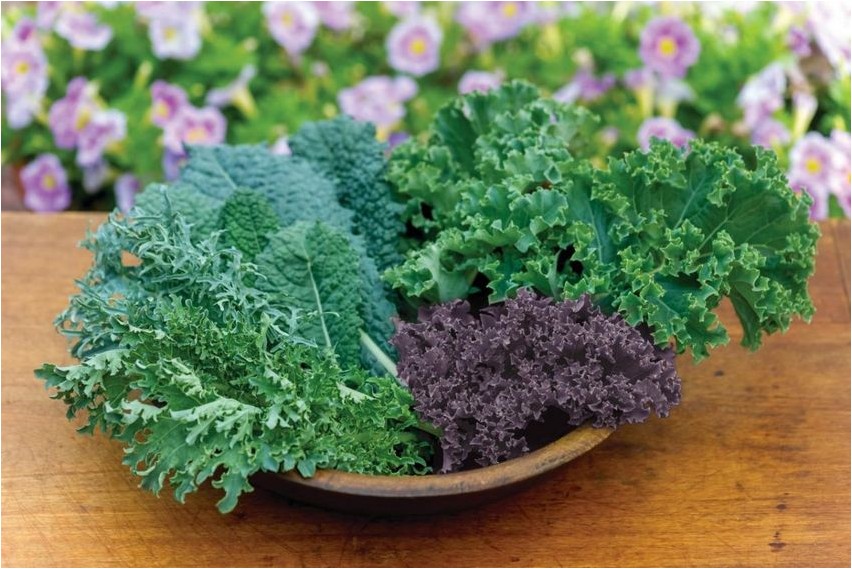
Kale (lat. Brassica oleracea var. sabellica) is an annual vegetable crop from the Brassica family.
Description
Kale cabbage does not form heads and is very similar in appearance to ordinary salad leaves. And the carved curly leaves of this vegetable can have a purple, reddish or green color.
Some scientists believe that this type of cabbage is the closest relative of wild cabbage. However, until now it has not been possible to find out exactly where kale first appeared.
Application
Only leaves of kale cabbage are eaten — its stems are so tough that hardly anyone would want to eat them. In most cases, this cabbage is eaten fresh: it is added to all kinds of salads and some other dishes. And if you combine crushed leaves with various spices, you get an incredibly tasty sauce that can be used as a dressing for both fish and meat dishes. In addition, kale is very good when stewed, especially if you stew it with meat or mushrooms. By the way, they stew it in the same way as the cabbage white fellow. If the cabbage harvest is “pleased” with an abundance of fairly coarse leaves, they can always be pickled or salted.
In terms of the content of substances necessary for the full functioning of the body, kale cabbage can be safely considered a real leader. The complete protein it contains is much easier to digest than its animal counterpart, and omega-3 acids will be the best support for the youth of the body. And ascorbic acid perfectly helps in the fight against various infections and viruses and excellently strengthens the immune system.
In addition, kale contains glucoraphanin, which has antibacterial and anticarcinogenic properties. It also contains indole-3-carbinol, a rare substance endowed with the ability to block the growth of cancer cells.

Regular consumption of kale helps maintain visual acuity for a long time. Moreover, this low-calorie product is very useful for maintaining excellent shape during various diets, and for vegetarians it will help replenish protein deficiency. And it is also quite possible to compensate for the lack of calcium with the help of kale cabbage. Regular consumption of such cabbage will definitely help normalize the functioning of the digestive system and reduce cholesterol levels.
Kale is an excellent general tonic that helps with poisoning and chronic inflammation.
Contraindications
Kale cabbage has only one contraindication — individual intolerance.
Growing
Kale cabbage is famous for its truly incredible frost resistance — it can easily tolerate frosts down to minus fifteen degrees, and after defrosting it becomes even tastier.
In general, the technology for growing this crop is similar to the technology for growing other varieties of cabbage. As a rule, from the moment the first shoots appear to its full maturation, it takes from seventy to ninety days.
Kale cabbage is planted at a distance of forty centimeters from each other. The seeds are sown in April — they germinate without difficulty even at temperatures of five to six degrees.
As for care, the main care for kale consists of loosening the soil and regular watering. In addition, it is also spudded several times throughout the summer. And if you leave a few bushes of this crop for the winter, then in the spring it will begin to grow again and will soon delight you with a good harvest.





