Geranium false Siberian
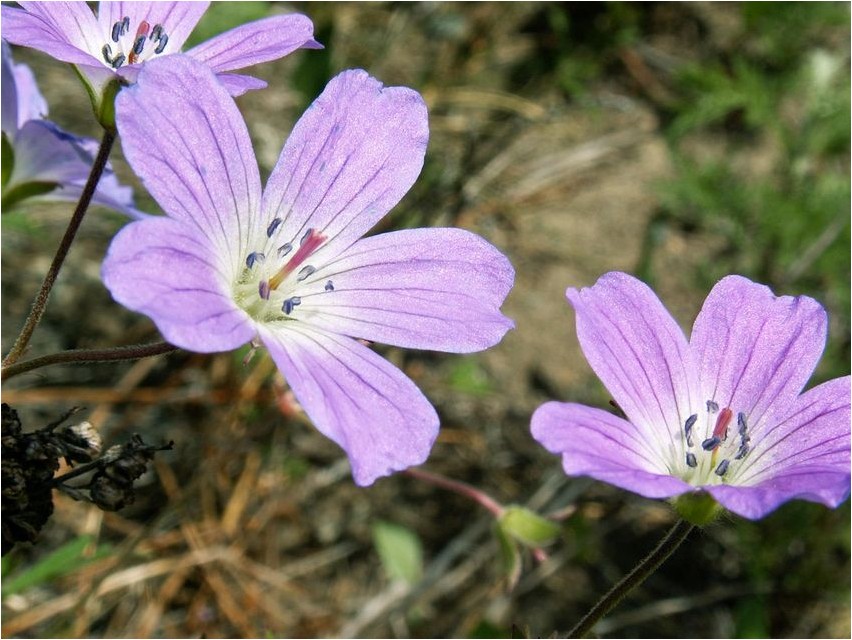
False Siberian geranium is one of the plants of the family called Geraniaceae; in Latin the name of this plant will be as follows: Geranium pseudosibiricum J.
Mayer. As for the Latin name of the pseudo-Siberian geranium family itself, in Latin it will be: Geraniaceae Juss.
Description of false Siberian geranium
False Siberian geranium is a perennial herbaceous plant. This plant will be endowed with a rather short rhizome, its thickness at the top will be about one centimeter, the rhizome will be enlarged due to light brown stipules, the fleshy roots are colored in dark brown tones. The height of the stem of this plant will be about thirty to sixty centimeters; the basal leaves of this plant are on petioles, the length of which reaches thirty centimeters. In this case, the middle petioles will be short, but the upper ones will be almost sessile. The flowers of this plant are terminal, they sit in a loose umbrella-shaped inflorescence. The bracts will be linear, their length will be about two to five millimeters, and their width will be equal to one millimeter. The sepals are oblong, the petals can be from pale blue to bright purple in color, while their length will be about six to fifteen millimeters, the petals are whole, and at their base they will be hairy.
Flowering of pseudo-Siberian geranium occurs from June to July. The ripening of the fruits of this plant occurs in July-August. Under natural conditions, this plant can be found in Central Asia, Eastern Siberia, as well as in Western Siberia in all regions, with the exception of Verkhnetobolsk. In the European part of Russia, this plant is found in the Zavolzhsky and Volga-Kama regions. For growth, false Siberian geranium prefers light forests, meadow slopes, lawns and forest edges, and this plant can also be seen along mountain river valleys.
Description of the medicinal properties of pseudo-Siberian geranium
False Siberian geranium is endowed with quite valuable healing properties, and for medicinal purposes it is recommended to use the herb of this plant, which should be harvested during flowering. The herb of this plant will contain tannins, flavonoids and vitamin C, and the roots of this plant will contain tannins.
As for traditional medicine, this plant is recommended for use for epilepsy, insomnia, and diseases of the gastrointestinal tract. It is noteworthy that in the scientific medicine of Mongolia, an infusion of the herb of this plant is used as a hemostatic and astringent, and in folk medicine this remedy is recommended to be taken as a tea substitute, as well as for acute and chronic blepharoconjunctivitis.

For gastritis with increased secretion, it is recommended to prepare the following remedy: to prepare it you will need to take twenty grams of crushed dry herb of pseudo-Siberian geranium per three hundred milliliters of boiling water. The resulting mixture should be infused for about two to three hours, after which it is important to strain this mixture very carefully. This remedy should be taken about one hundred milliliters three to four times a day before meals.
For acute and chronic blepharoconjunctivitis, the following remedy will be especially effective: it is recommended to wash the eyes with a twenty percent infusion of the herb of this plant.
It should be noted that despite all its very valuable healing properties, the study of pseudo-Siberian geranium has not yet come to an end. Therefore, it is quite possible that new options for using this plant will soon appear.





