Asparagus salad
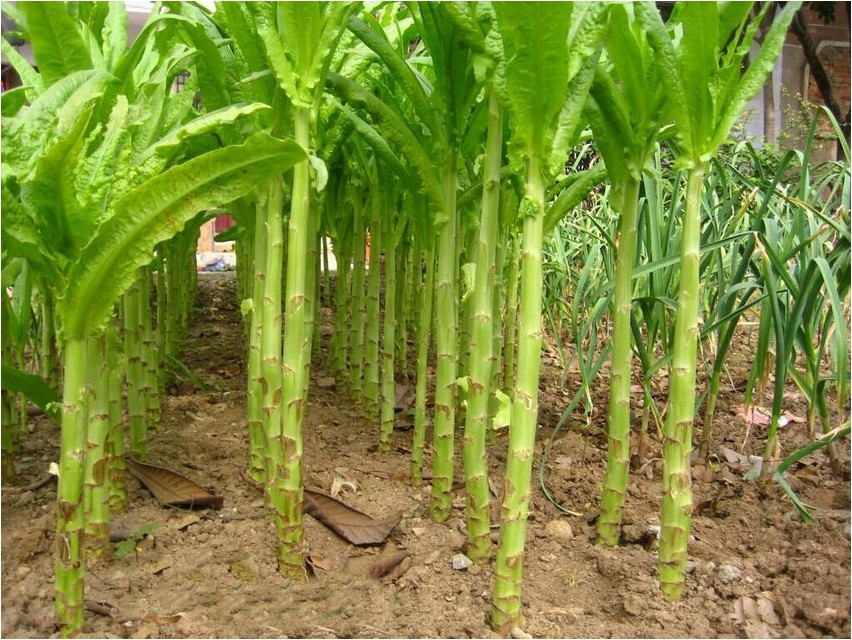
Asparagus lettuce (lat. Lactuca asparagus) is a herbaceous plant of the Asteraceae, or Asteraceae, family. The plant is known as Uysun.
Asparagus lettuce is widely cultivated in Mongolia, Nepal, India, China, Japan and Taiwan. The plant is a staple winter crop among Asians during the winter season. In Russia and European countries, uysun is grown only in household plots. In Kyrgyzstan, Tajikistan, Turkmenistan and Uzbekistan, the most common variety is Dungansky; it is also cultivated in the CIS countries.
Characteristics of culture
Asparagus lettuce is an annual plant that, as it grows, forms a thick, juicy stem up to 80 cm high. Depending on the shape of the leaf blade, asparagus lettuce is divided into two types: narrow-elongated-leafed — has a long stem, oval-elongated-leafed — short, thick. The species differ in terms of flowering and fruit ripening. Both leaves and stems are eaten. The leaves have a bitter taste, but after cutting over time they become tender, sweet, with a refreshing taste. The stems taste like asparagus.
Growing
The crop is grown mainly by seedlings. In different regions, planting dates are different; for example, in Ukraine, asparagus lettuce is sown in greenhouses in February, and planted in open ground in mid-to-late April. In central Russia, seeds are sown in seedling boxes in March, and planted in the ground at the end of May — beginning of June. Seed the seeds in shallow grooves at intervals of 10 cm. The grooves are covered with a thin layer of soil, watered and covered with film. The seeding rate is 2-3 g per square meter. The air temperature in the room should be at least 20-25C; with the emergence of seedlings, the temperature is reduced to 16-18C. Before planting seedlings in the ground, the seedlings are regularly watered, and the soil between the rows is loosened in order to prevent the formation of crust.
When 1-2 true leaves appear on the seedlings, the crops are thinned out, leaving a distance of 4-5 cm between plants. The seedlings are fed at two times: the first time — immediately after thinning, the second — in the phase of three true leaves. For feeding, urea, superphosphate and potassium salt are used. Planting seedlings in open ground depends on the region. Seedlings are planted in a wide row according to a 60*40 cm or 70*40 cm pattern. Crops can be planted as a compactor for tomatoes or cucumbers. For winter storage, the crop can be sown directly into the ground (from mid-May to mid-June).
Care

Care consists of watering, weeding and loosening. A week after planting, the culture is fed with urea (at the rate of 10 g per sq. m), superphosphate (12 g per sq. m) and potassium salt (4 g per sq. m). When sowing in early spring, the plants are earthed up in mid-summer.
Harvest
Harvesting is carried out when 15-20 leaves appear on the plants until budding. The interval between collections should be 5-7 days. With repeated harvests, you can get a larger harvest than with one-time harvests. Moreover, the repeated collection of leaves contributes to the formation of a thick and long stem. To increase the mass of the asparagus lettuce stem, all leaves are cut off from the plants over a couple of weeks. The stems should not be allowed to overgrow.





