Saleros europaea
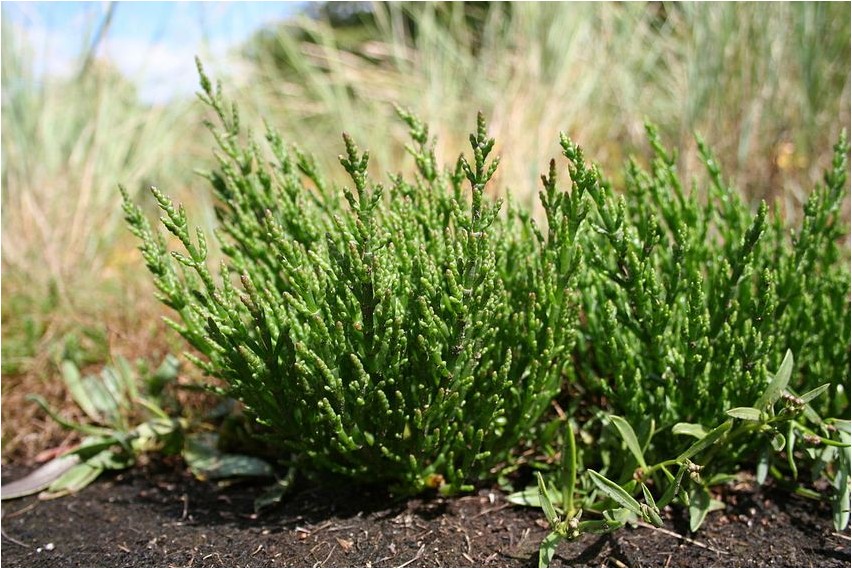
Salicorus europaea is one of the plants of the family called Chenopoaceae; in Latin the name of this plant will be as follows: Salicornia europaea L.
As for the name of the European saltwort family itself, in Latin it will be: Chenopodiaceae Vent.
Description of European saltwort
European saltwort is known by many popular names: salt grass, grassy saltwort, yalgu, biryugon, mokredinnik, solonets, salt grass and solyanka. Saleros europaea is an annual herbaceous glabrous green plant whose height will vary between ten and thirty-five centimeters. The stem of this plant is jointed and will almost always be erect, it is endowed with opposite bare and jointed branches, and sometimes such a stem may be reddened. The calyxes of European saltwort will be slightly thickened under the node and are also cylindrical. It is noteworthy that the leaves are completely absent; instead, short opposite sheaths will be located in the nodes of this plant. The inflorescences of European saltwort will be in the form of rather dense juicy cylindrical spikelets, their length will be equal to one to six centimeters, and their width will be about two to two and a half millimeters. Such inflorescences are located on short stalks at the ends of branches and stems. The flowers of the European saltwort will be bisexual, with the top flower often being larger, while the lateral leaves are located below the middle one, forming a kind of triangle. The perianth of this plant is a rhombic shield with a hole from which the stigmas and stamens will protrude, and the ovary is unilocular. The length of the ovoid, vertical and short-haired fruits will be about one and a half millimeters.
European glasswort blooms in the second half of summer, from late June to August. In the wild, this plant is found in Crimea, the Caucasus, Ukraine, Central Asia, the Daurian and Angara-Sayan regions of Eastern Siberia, the Ob, Irtysh, and Verkhnetobolsk regions of Western Siberia, and the following regions of European Russia: Dvina-Pechora, Trans-Volga, Lower Volga, Volga-Don, Black Sea, and Trans-Volga. Glasswort prefers saline deposits, sors, wet salt marshes, gypsum-bearing and salt crusts, seashores, and the shores of salt lakes.
Description of the medicinal properties of glasswort
Glaswort has very valuable medicinal properties, and the herb is recommended for medicinal purposes. The term “herb” includes the flowers, leaves, and stems. Such valuable medicinal properties can be attributed to the alkaloids saligerpine and salicornine found in the herb and roots of European glasswort.
This plant is quite widespread in folk medicine. A decoction made from dried glasswort herb is indicated for use as a laxative, stomachic, antiscorbutic, diuretic, anti-inflammatory, tonic, and purgative. A decoction based on this plant’s herb has the ability to improve digestion and is also useful for chronic constipation, dropsy, nephritis, and cystitis. Furthermore, this herbal remedy based on European glasswort has the ability to slow the growth of malignant tumors and excessive granulation tissue growth.





