Aspidistra elata
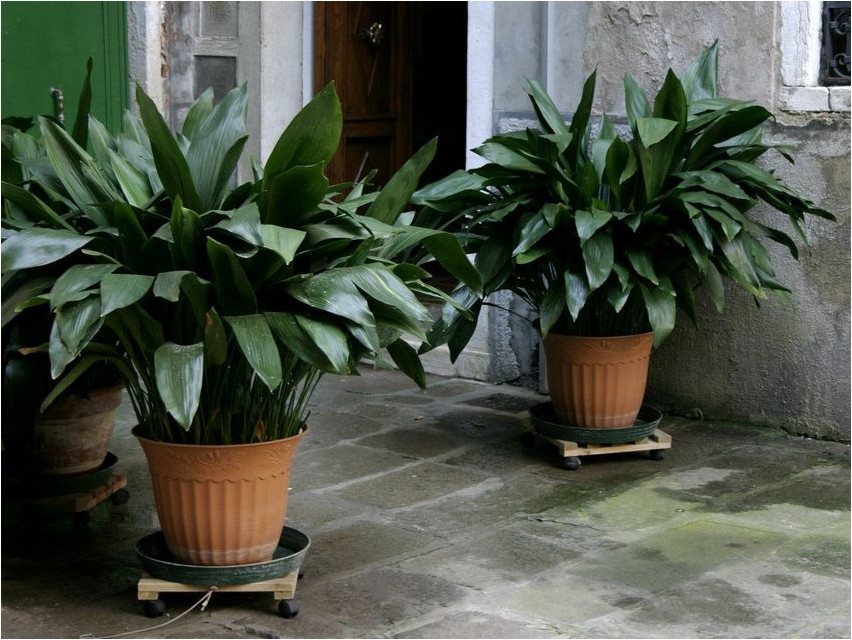
Aspidistra elata is also known by the following names: mother-in-law’s tongue, cast-iron plant, and even butcher’s palm.
The name “aspidistra” itself comes from two Greek words meaning “shield” and “star.” This genus includes approximately eight species, native to Asia.
It’s worth noting that this plant isn’t particularly demanding in terms of care. In summer, it should be moved outdoors, but in a shaded location. During this time, it also requires ample watering and regular misting. However, aspidistra can tolerate both temporary moisture shortages and excesses. Good drainage is also essential.
Aspidistra is a perennial herbaceous plant that can have either a creeping, above-ground rhizome or an underground, segmented rhizome. Its leaves are glossy, stiff, and elastic. The blades of these leaves are broadly oval or broadly lanceolate, approximately fifty centimeters long and fifteen centimeters high. At the base of the leaf are one or two scale-like leaves that envelop the entire petiole. The flowers on the rhizome are located just below the soil surface. The perianth has eight lobes, and their color is either yellow-brown or crimson. The plant produces a berry-like fruit. Aspidistra is native to Japan and China. In the wild, it grows in shady forests.
There is also a garden form of this plant, with leaves covered in both white and cream stripes.
Aspidistra Care

As a matter of fact, as mentioned above, this plant can thrive in almost any conditions. The main thing is to provide protection from direct sunlight. The plant pot can even be placed near north-facing windows or in the center of the room, away from any windows. In winter, choose a cooler location for this plant, but avoid temperatures below 5 degrees Celsius and above 15 degrees Celsius.
Therefore, the lighting should be intense, but the plant should be kept in partial shade. Regarding humidity, moderate humidity is optimal. The plant will require fertilizing during the summer. During the summer, apply a weekly flower fertilizer, but keep the amount at a moderate level.
Aspidistra alta propagates by dividing the rhizomes during planting. For rooting, the soil temperature must be at least 18°C (64°F).
The plant does not tolerate transplanting well, so this procedure should only be performed when absolutely necessary. A substrate that will promote proper plant development should consist of equal parts leaf mold, humus, sand, and peat. In addition, you will need twice the amount of turf mixture.
When growing this plant, you may encounter the following dangers: aphids and spider mites. Overwatering and exposure to intense sunlight can cause leaf burn and even root rot. To combat aphids and spider mites, spray with appropriate products.
It should be noted that calamus also has many beneficial properties. Medicinal substances and elements are found in almost all parts of the plant. Aspidistra elata has found widespread use for urinary stones, various gastrointestinal ailments, muscle pain, diarrhea, and cramps.