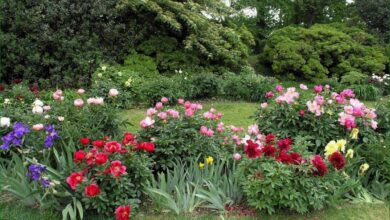
Mock Orange
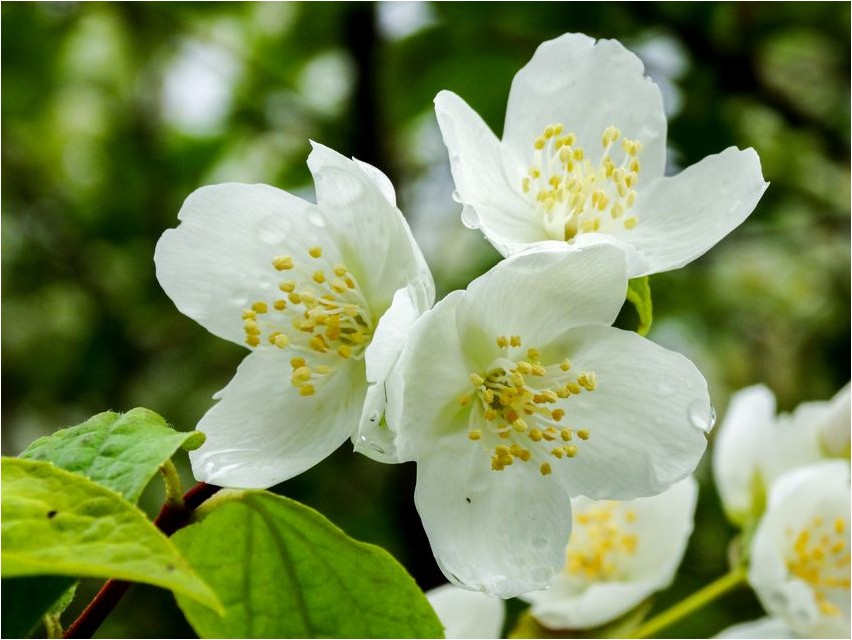
Mock Orange (Philadelphus) is a genus of shrubs in the Hydrangeaceae family. In Russia, this plant is often called garden jasmine.
Crop Characteristics
Mock Orange is a deciduous shrub whose trunk and branches are covered with thin gray bark, sometimes brown and peeling. The leaves are simple, opposite, ovate or oval, entire or serrated, rounded at the base or slightly pointed at the tips, 6-7 cm long, and borne on short petioles. The upper surface of the leaves is smooth, while the underside is slightly pubescent.
The inflorescence is a raceme of 4-9 flowers. The inflorescences form on young lateral shoots, sometimes in the axils of the upper pairs of leaves. Flowers are single, double in some varieties, medium or large, reaching 6-7 cm in diameter. They can be white, yellowish, or creamy white, and have a sweet aroma. The calyx is goblet-shaped with 4 or 5 concave sepals. The fruit is a capsule (3-5 locular) with small seeds.
Popular varieties
*Aurea — This variety is characterized by dense shrubs with an irregular, spherical crown, reaching a height of 2 m. The leaves are green with a golden hue, and the medium-sized flowers are creamy. Used in group plantings, it looks especially harmonious when combined with lilac, juniper, and spruce.

*Gnome — This variety is a highly branched, low-growing shrub (up to 0. 5 m) with a spherical crown. The leaves are small, green with a yellowish tint, and it does not bloom. Used in dense, merging plantings.
*Innocent — This variety is characterized by shrubs up to 2 m tall. The leaves have a distinctive pattern of white and yellow spots, and the flowers are single or semi-double, cream-colored, and reach 3. 5 cm in diameter.
*Belle Etoile — This variety is a compact shrub about 1 m tall. The leaves are small, ovoid, and have an elongated tip. The flowers are simple, bell-shaped, with a purple spot in the center, reaching 4 cm in diameter, and have a pleasant strawberry aroma. This shrub blooms profusely and regularly and tolerates severe frosts.
*Gletcher — This variety is characterized by spreading shrubs with drooping branches, reaching 2 m in height. The leaves are medium-sized, green, and the flowers are double or semi-double, gathered in clusters of 5-7, and reach 4 cm in diameter.
*Avalanche — the variety represents low shrubs with a cushion-shaped crown. The leaves are small, oval in shape, with a retracted tip. The flowers are simple, reach 1 cm in diameter, and have a strawberry aroma. Flowering begins at the end of June and lasts for 2 weeks.
Growing conditions
Mock orange is a shade-tolerant crop, drought-resistant and not demanding on the soil. However, on poor soils, shrubs grow poorly, and flowers and leaves become smaller. The best option is loamy soils, provided with moisture and rich in humus. Heat-loving varieties prefer areas protected from the wind and scorching sun, with light soil.
Landing
It is advisable to plant mock orange in the fall, but it is not forbidden to plant it in early spring. The depth of the planting pit should be 50-60 cm, and the diamete r-40-50 cm. The soil removed from the pit is mixed with humus and sand in equal quantities. Part of the resulting substrate is poured into the hole, the seedling is lowered, the roots are straightened and covered with the remaining mixture. When planting, you must ensure that the root collar is not buried. It is important to form a funnel-shaped depression around the base of the trunk. This is necessary in order to retain irrigation and atmospheric moisture.
Care
Caring for mock orange does not cause gardeners any problems. In September, the plant is fed with organic fertilizers deeply incorporated into the soil. During the growing season, the shrub is kept in a moderately moist state; watering is carried out only when there is a lack of natural precipitation. To retain moisture for a longer period, tree trunk circles are mulched with peat, leaf humus or loose compost.
Immediately after flowering, the plant needs to be fed with mullein infusion (at the rate of 10 liters per bush). Sanitary pruning is carried out in early spring before the buds open. After flowering, the bushes are thinned out and formed, crooked and old branches are removed.