Mirris
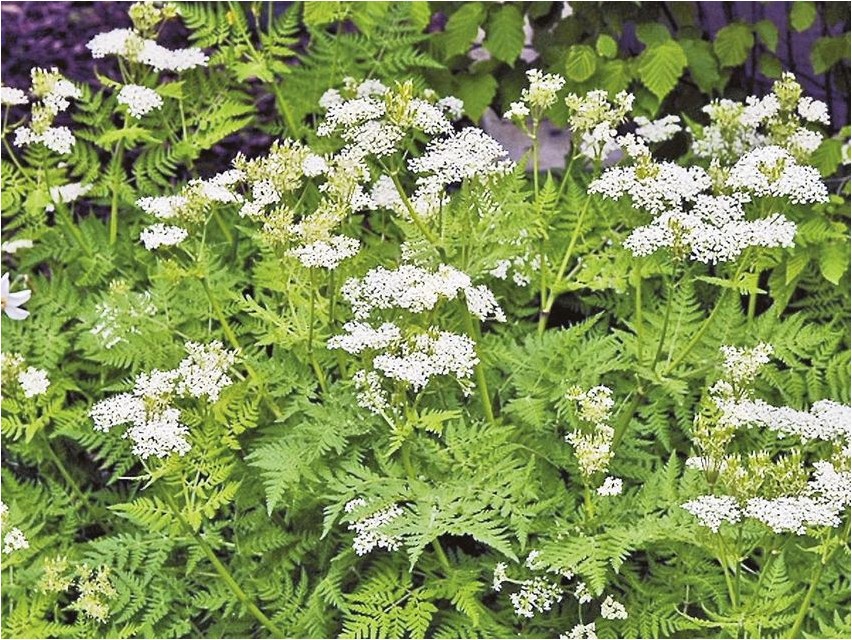
Mirris (lat. Mirrhis) is a decorative foliage flowering plant belonging to the Umbrella family. This plant is popularly called wild parsley, spicy or fragrant butene, as well as frankincense or Spanish chervil.
Description
Mirris is an upright umbelliferous perennial that blooms in its second year and boasts surprisingly beautiful lacy leaves. And its height usually ranges from seventy to one hundred and twenty centimeters. The roots of myrrh are thick, tap-like and highly branched.
In the first year of its development, myrrh forms quite large rosettes of fragrant and delicate elegant green leaves (they emit a fairly strong and well-defined spicy aroma), and starting from the second year, this plant pleases with its flowering, which usually occurs from June to July-August. The petiole leaves of this plant are slightly pubescent and repeatedly pinnately dissected.
Miniature white myrrh flowers form luxurious inflorescences in the form of complex umbrellas without wrappers. Myrrhis fruits are linear-lanceolate or linear viscocarplets, the width of which ranges from four to five millimeters, and the length reaches fifteen to twenty-five millimeters. And the seeds of this plant are quite large, black and shiny.
In one place, myrrh grows well for up to ten years, while it is able to winter without shelter and quite easily runs wild.
Where does it grow
Myrrh is native to Western European mountain forests. Now, under natural conditions, this plant can be found in Southern and Central Europe, from Spain with France in the west and to Italy and Yugoslavia in the east. Myrrh is cultivated a little less frequently in other European regions (Eastern and Northern Europe) or in South American spaces, where this plant often runs wild.

Usage
Most often, myrrh is grown as a medicinal or spicy plant. This plant boasts a very impressive content of mineral salts, vitamins and essential oils. And myrrh seeds are also very rich in fatty and essential oils. And young fresh seeds, roots and leaves of myrrh can be used as a spice for various vegetable dishes – in most cases, myrrh is used in the same way as anise. It is quite possible to add myrrhis to salads and soups.
In a number of European countries, fragrant myrrh is quite actively used for medicinal purposes, as well as in veterinary medicine – for this purpose, both above-ground parts of plants and roots with seeds are used. The roots of myrrh will serve well for coughing and, if necessary, to regulate digestion, and its herb is an excellent expectorant, wound-healing, disinfectant and emollient, which is widely used for a number of gastric ailments and anemia. This herb is especially useful for children and the elderly.
Growing and care
Myrrris is characterized by unpretentiousness, as well as impressive drought and winter hardiness. This plant will feel equally good in the sun and in the shade. But it is better to choose loamy and fertile soils for it.
As for the moisture regime, it should be moderately humid. It is especially important to pay due attention to watering in hot and dry summers.
The soil on which myrrh grows needs to be loosened from time to time. Weeding will not be superfluous either.
Myrrh can be propagated either by dividing bushes or by seeds – in the latter case, the seeds are usually subjected to stratification. It is quite possible to sow this plant before winter.





