Jatropha
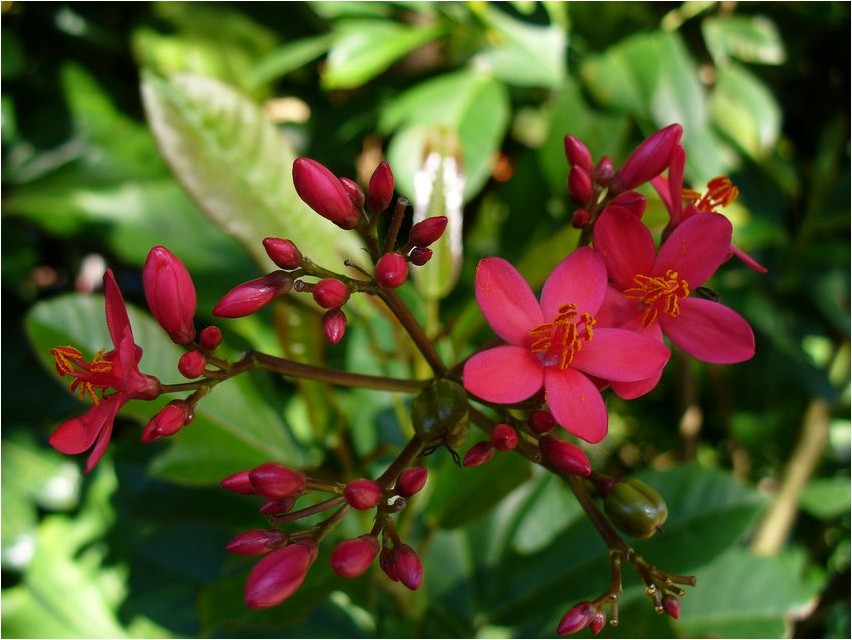
Jatropha (lat. Jatropha) is a genus of amazing plants of the Euphorbiaceae family, distinguished by the presence of an unusual stem, called by botanists “caudex” and which is one of its decorative elements.
Like many relatives in the family, milky sap flows through the vessels of plants, from which people have learned to extract diesel fuel.
What’s in your name
The Latin name of the genus is based on two Greek words: “doctor” and “nutrition”. How this relates to nutrition is not very clear, because all parts of the plant genus are poisonous, but the traditional use of Jatropha for medicinal purposes explains the presence of the word “doctor”.
Description
One of the decorative elements of Jatropha is an amazing creation of nature, which botanists gave the name “caudex”. It is something between a rhizome and a stem. The caudex can be completely hidden in the soil, or partially rise above the surface of the earth, decorating the plant.
Caudex differs from the usual plant stems in its thickness and shape, which can take the form of a pot-bellied bottle or a fairy-tale jug.
The caudex differs from the rhizome of plants in the process of its development. While the rhizome grows at the expense of the upper layers, gradually approaching the surface of the earth, and leaving its lower layers to die off, the caudex in its lower part turns into a tap root, which serves the plant for many years.

The leaves of different Jatropha species can take on a wide variety of shapes, being whole or dissected. The flowers are usually small but bright.
The fruit is a tricuspid capsule, similar to olives, inside of which there are rather large black seeds with a light tip. The seeds contain up to 30% oil. The oil is inedible for humans, but is suitable for the production of biodiesel and biogas.
Varieties
* Whole-edged jatropha (lat. Jatropha integerrima) – the species is represented in nature by an evergreen shrub that grows to almost a meter in height. The leaves are three-lobed. Five-petalled red flowers.
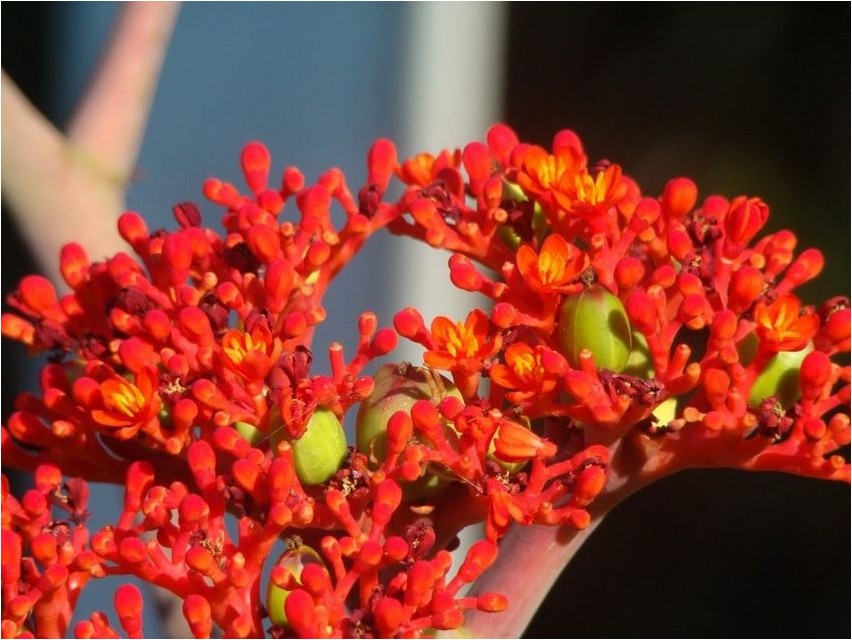
* Gouty jatropha (lat. Jatropha podagrica) is a half-meter tall succulent shrub with large dissected leaves growing from the caudex. The most popular representative of the genus for growing as a houseplant. Bright red flowers form inflorescences crowning branched peduncles.
* Guitar-leaved jatropha (lat. Jatropha pandurifolia) is an evergreen shrub, the leaves of which nature gave the shape of a guitar. Or, a person made a guitar by looking at the leaves of a given type of Jatropha. The “guitars” come with a decoration in the form of red flowers.
Growing
In a climate favorable to Jatropha, green living fences are made from it, protecting against the invasion of livestock. In addition, Jatropha plantations are grown to harvest its oily seeds, from which fuel is produced for domestic needs. In our area, Jatropha is grown in flower pots, wanting to add a touch of exoticism to the interior of the home.
Jatropha is highly drought tolerant, but when grown for seed collection, the plant requires watering. Jatropha growing in a pot also needs watering.
Choose a place for the plant that is well lit, but without direct sunlight.
The soil is required to be fertile, additionally fertilized, loose, permeable, and not creating stagnation of water. The caudex should not be completely covered with soil, since it is not a rhizome, but a plant stem. Moreover, it fulfills one of the decorative roles of Jatropha, making the plant original, different from the usual Russian indoor plants.
When working with the plant, you should use personal protective equipment, since the milky sap of Jatropha is toxic.
Jatropha is propagated by sowing its oily seeds, which have excellent germination if they are provided with a comfortable temperature of plus 20 degrees. Can be propagated by cuttings taken from side shoots.
Unusual indoor flowers Jatropha, or bottle tree.
Jatropha
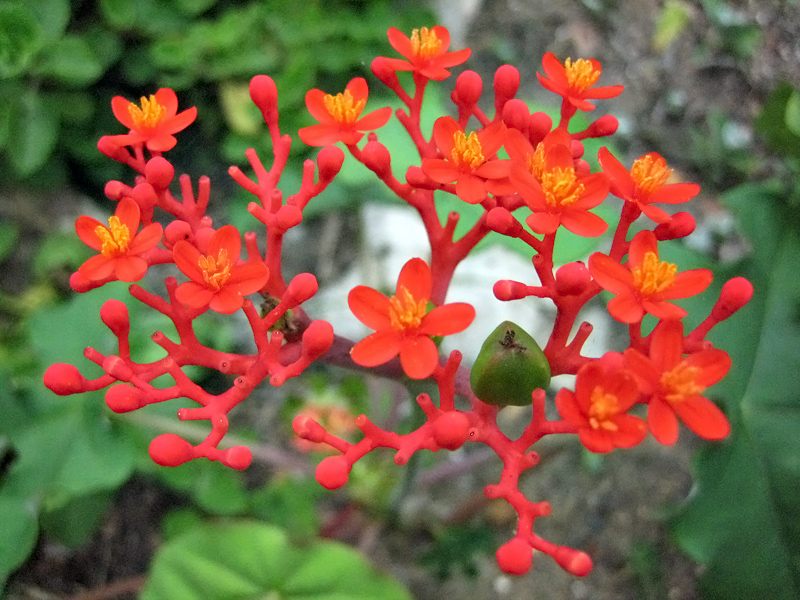
Jatropha belongs to the Euphorbiaceae species, and there are more than 170 varieties of it in nature. They grow to about 0. 5 m in height, have a thick trunk at the base and a narrower one at the top, reminiscent of a bottle. It is in the trunk that the plant accumulates water in order to survive drought in nature. In winter, the trunk looks bare, and only in spring does flowering and leaves begin to appear. Jatropha flowers are small, red, collected in umbrellas. Then wide foliage appears on a long petiole. Jatropha, or bottle tree, as it is often called in common parlance, is not a frequent visitor to modern apartments and houses. With its unusual appearance, jatropha greatly decorates the interior of a home.
Care. Jatropha thrives in a sunny spot away from direct sunlight. Special temperature conditions are not necessary. A normal room temperature of 18-22°C (64-72°F) in summer and no lower than 14°C (55°F) in winter is ideal. Water regularly during the growing season, once the surface soil has dried out. Stop watering when the plant’s leaves drop. Resume watering when new shoots appear, which occurs in spring. Use settled water. Jatropha doesn’t require a specific humidity level; it tolerates dry air well. The only requirement is to wipe dust off its leaves.
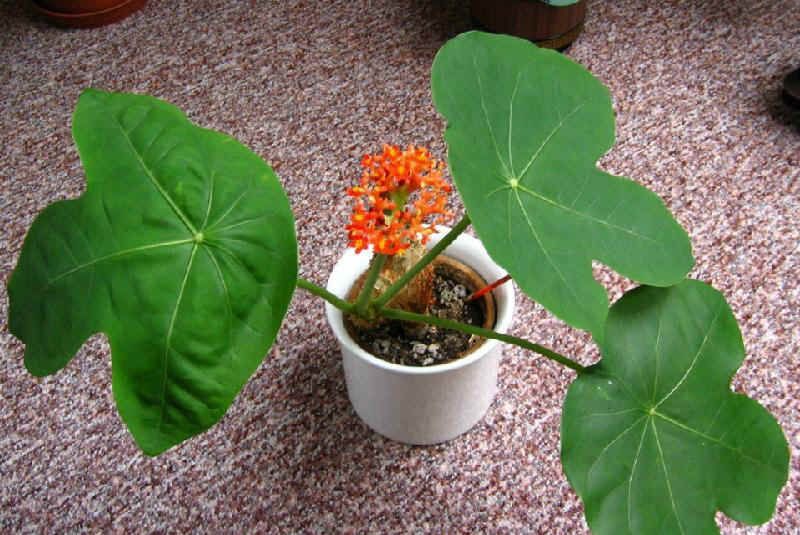
Repotting. Jatropha doesn’t need to be repotted frequently; every two years is perfectly acceptable. The best time to do this is spring, the period of active growth. The substrate is a mixture of turf and leaf mold mixed with acidified peat and sand, with the addition of small stones. The planting container should be wide and shallow. Proper drainage is also important. Jatropha doesn’t require much fertilizing, but during the growing season, you can fertilize it with a special cactus fertilizer. Fertilizing is prohibited in winter.
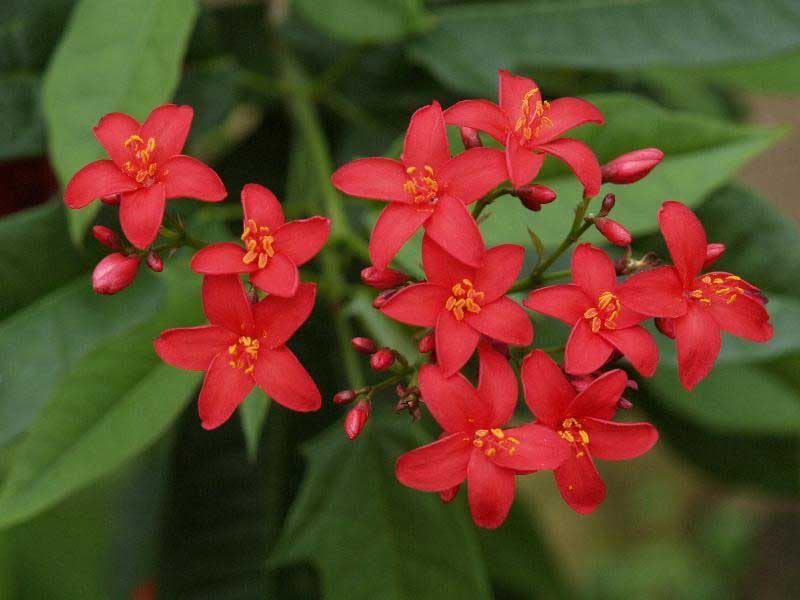
Propagation. Jatropha can be propagated by seeds and cuttings. Seeds are sown in soil and placed in a greenhouse. Under favorable conditions, sprouts will appear. Cuttings are propagated by cutting a shoot from a mature plant, rooting it in soil, and placing it in a warm place. The cuttings usually take root well within a month.
Jatropha photo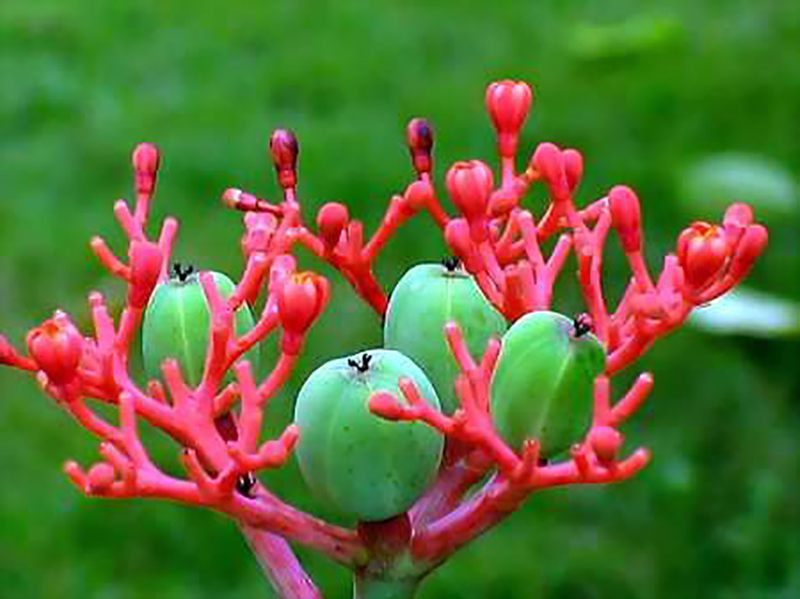 jatropha photo[/caption]
Jatropha jatropha
jatropha photo[/caption]
Jatropha jatropha