Roystoneea or Royal Palm
Royal Palm — the official Latin name of the plant genus is “Roystonea”, which is translated into Russian as “Roystonea”.
The genus is a representative of the Palm family (lat. Palmaceae). Its large growth, smooth trunk and lush crown of feathery picturesque leaves make the palm a noticeable aspect of the landscape and a popular participant in man-made parks and palm alleys of resort towns in tropical and subtropical regions of the planet.
What”s in your name
The Latin name of the genus “Roystonea” immortalizes the name of the military civil engineer Roy Stone (Roy Stone, 1836 — 1905), who participated in the American Civil War on the side of the North and held the rank of general. He also participated in the Spanish-American War, in the capture of the island of Puerto Rico, where he distinguished himself with good work in road construction. It was in memory of this work of his that the slender and beautiful palm trees that grew on the islands of the Caribbean Sea were given the name “Roystonea”. After the war, he became one of the first leaders of the Department of Public Roads, and contributed his efforts and knowledge to improving the construction and design of American roads.
Description
The Roystonea genus is a community of large palm trees that have one smooth trunk from ten to thirty meters high, not armed with the sharp remains of leaf petioles that have outlived their time on Earth, which are common to other palm trees. Since living conditions may vary from year to year, this is reflected in the thickness of the trunk, which may vary along its length, having a more convex appearance in some places. The color of the trunk ranges from gray-white to gray-brown. Only the species “Roystonea violacea” has a purple-brown or purple trunk.
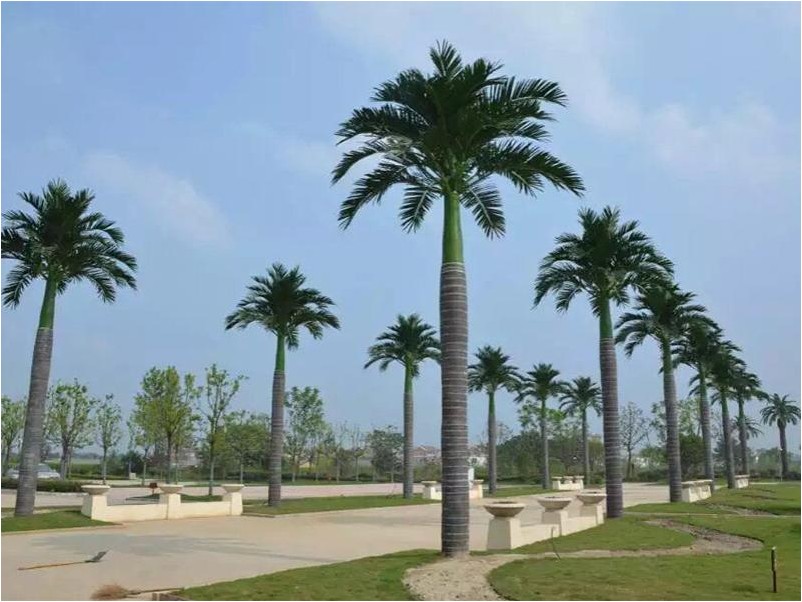
Palm leaves consist of a sheath at the base of the leaf, a petiole and an awn. The base of the leaf forms a distinctive green sheath around the uppermost part of the trunk, known as the “crownshaft”, which extends from 1. 4 to 2 meters of the trunk”s length. The petiole connects the base of the leaf with the awn (or leaf blade) pinnately divided into leaf segments located in two or three planes.

Palm trees of the genus Roystonea have the ability to easily shed leaves in strong winds, thereby preventing the tree trunk from tipping over, that is, thus maintaining its stability.
From a narrow horn-shaped bract, branched panicles of inflorescences are born, formed by unisexual but monoecious (that is, both female and male flowers are present in the same inflorescence) flowers, most often white.
The fruit is a drupe, spherical or oblong in shape, acquiring a dark purple color when fully ripe.
Varieties
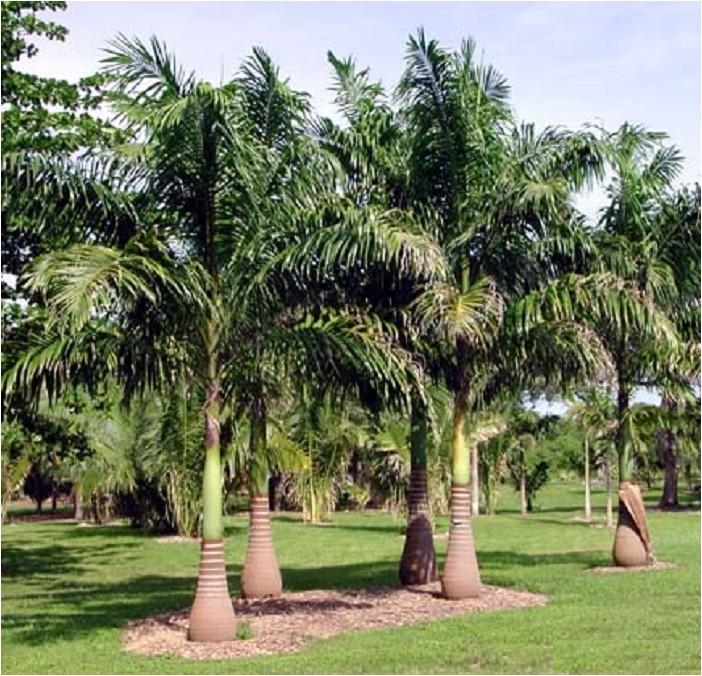
The genus includes eleven species of monoecious palms native to the Caribbean islands. A few of them:
* Roystonea vegetable (lat. Roystonea oleracea), or Roystonea Caribbean, or Caribbean royal palm. The tallest palm of this genus reaches a height of forty meters.
* Roystonea regal (lat. Roystonea regia), or Roystonea cubana, or Cuban royal palm.
* Roystonea stellata is a species known only from one collection of the French botanist Frere Leon, made in 1939.
* Roystonea violet (lat. Roystonea violacea) — distinguished by a violet-brown or purple color of the trunk and purple flowering.
* Roystonea altissima (lat. Roystonea altissima) is endemic to the island of Jamaica. Although the species has such an obligatory name, among other species of the genus the palm tree is still not the tallest.
Usage
In addition to its decorative role in landscape decoration, some parts of the palm tree are used for food. A salad is prepared from the core of the trunk, and palm seeds can replace coffee beans.
In Cuba, the seeds of the Royal Palm were fed to pigs. The lard of such pigs has a grainy structure and is recognized as the best lard for consumption.
To get fruits from tall palm trees, men had to be virtuoso climbers, reaching the top of the tree with the help of a specially tied rope.