Siberian Leptandra
Siberian Leptandra is a member of the Scrophulariaceae family. Its Latin name is Leptandre sibirica (L.) Nutt ex G. Don. fil. (Veronica sibirica L.).
The Latin name of the Siberian Leptandra family is Scrophulariaceae Juss.
Description of Siberian Leptandra
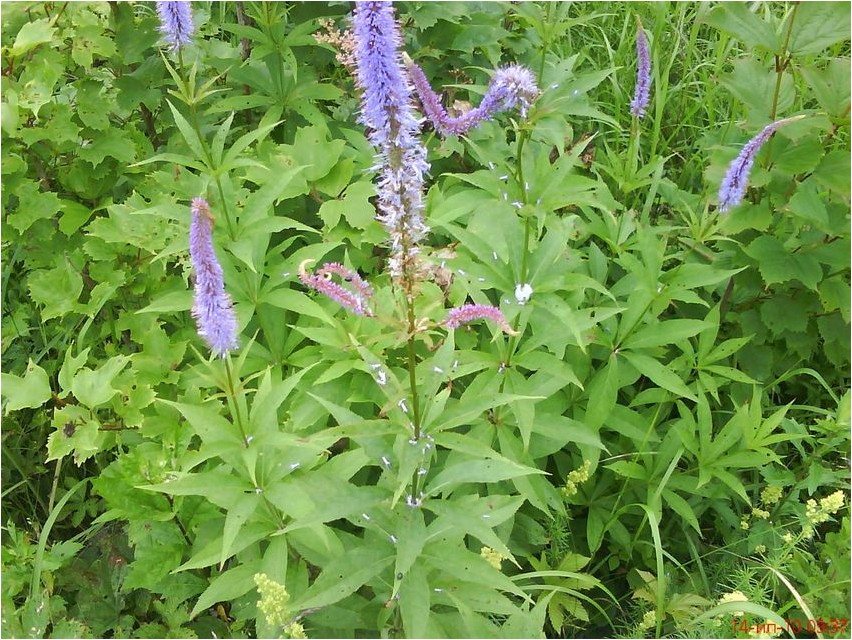
Siberian Leptandra is a perennial herbaceous plant, reaching heights between 40 and 150 centimeters. Its stems are quite large, grooved, and rounded, and can be either pubescent or glabrous. The leaves of the Siberian Leptandra are arranged in whorls of three to nine and can be either oblong or oblong-lanceolate. These leaves are approximately four to twelve centimeters long and two to four centimeters wide. The flowers of the Siberian Leptandra are quite numerous and sessile, clustered in terminal spike-shaped inflorescences, and are approximately thirty centimeters long, with the corolla being seven to eight millimeters long. The corolla is purple, white, or pink in color, with highly fused lobes forming a tube, and is hairy internally, with the tube being significantly longer than the calyx and limb. The capsule of the Siberian Leptandra can be either oblong or ovoid, and is bilocular, measuring two and a half to three millimeters in length. The seeds of this plant are three millimeters long and ovoid in shape. The Siberian Leptandra blooms from June to July, while the fruits ripen in August-September.
In the wild, this plant is found in the Daurian and Angara-Sayan regions of Eastern Siberia, as well as in Sakhalin, Primorye, and the Amur region of the Far East. Siberian Leptandra prefers mountain meadows, forests, forest edges, floodplains, and shrubby areas. Description of the medicinal properties of Siberian Leptandra
Siberian Leptandra is endowed with very valuable medicinal properties. For medicinal purposes, it is recommended to use the herb, roots, and rhizomes of this plant.
The presence of such valuable medicinal properties can be attributed to the presence of alkaloids, saponins, coumarins, cardenolides, and the following iridoids: catalpol acetate, methylcatalpol acetate, aucubin, aucubin acetate, odontoid, isocatalpol, odontoid acetate, methylcatalpol, and catalpol.
Leptandra sibirica has antispasmodic, anti-inflammatory, astringent, hypotensive, diuretic, antispasmodic, wound-healing, hemostatic, and anthelmintic effects. Remarkably, an experimental study demonstrated that the extract of this plant’s herb can relax intestinal smooth muscles, reduce the rate and increase the amplitude of contractions of isolated uterine horns in rats, reduce peristalsis, and is also used as a sedative and hypotensive agent. In folk medicine, an infusion made from this plant is quite common. This remedy is used for stomach pain, colds, bleeding, tuberculosis, and cystitis. In the form of a tea, this remedy based on Siberian Leptandra is used for gastric and duodenal ulcers, gastritis, and is also a very effective antipyretic.

“Mom, I failed my Unified State Exam” – Siberian
Leptandra Siberian Leptandra