Common toadflax
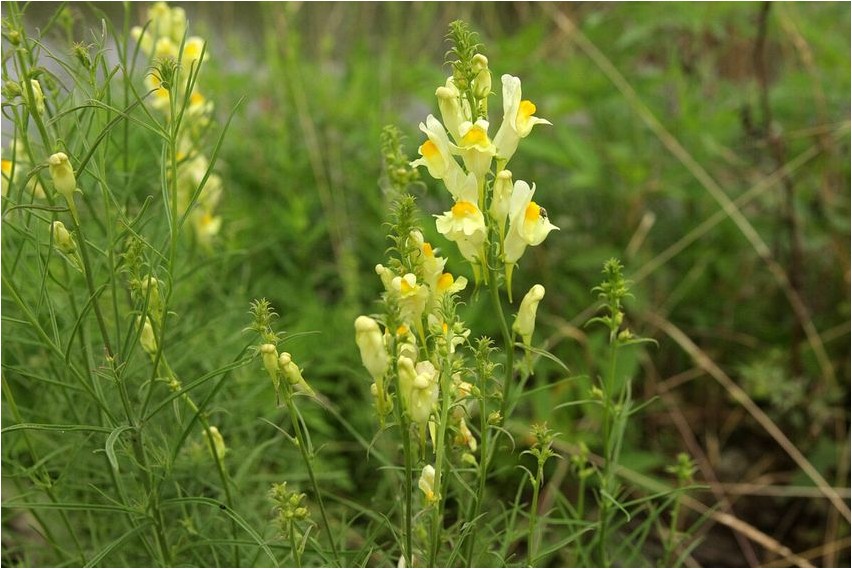
Common toadflax is one of the plants of the family called Noricaceae; in Latin the name of this plant will be as follows: Linaria vulgaris Mill.
As for the name of the toadflax family itself, in Latin it will be: Scrophulariaceae Juss.
Description of toadflax
Common toadflax is known under very numerous popular names: vidalnik, rams, bagan, snapdragon, zornitsa, flax of the Virgin Mary, cups, hare’s blood, drunken grass, field rosemary. Common toadflax is a perennial herbaceous plant, endowed with a simple and branched stem, the height of which will range between thirty and eighty centimeters. The leaves of this plant are quite numerous and alternate, they are sessile and acute, and also linear-lanceolate. The flowers will most often develop from the axils of the upper stem leaves, which are lemon yellow in color. Such flowers are two-lipped, they are equipped with a long spur and are collected in rather thick and long apical racemes. The fruit of the toadflax is an oblong capsule, and the seeds of this plant are disc-shaped and have a membranous edge. Flowering of toadflax occurs from July to September, while the fruits will ripen in August. For growth, this plant prefers wastelands, ditches, places along roads, steppe slopes, dry pine forests and sandy places. Under natural conditions, this plant is found in the European part of Russia, Ukraine, Belarus, Western Siberia and the Ussuri region.
Description of the medicinal properties of toadflax
Common toadflax is endowed with very valuable healing properties, and it is recommended to use the herb of this plant for medicinal purposes. The term grass includes leaves, flowers and stems. It is recommended to harvest such raw materials throughout the entire flowering period of toadflax.
It is noteworthy that the grass of this plant is endowed with a very unpleasant odor, which will persist even when dried. Toadflax grass should be dried in the shade under a canopy or in attics with very good ventilation. It should be noted that toadflax is a poisonous plant and can cause poisoning in animals. For this reason, it is important to exercise extreme caution when handling this plant.
As for traditional medicine, toadflax has become quite widespread. This plant is endowed with diaphoretic, anti-inflammatory, expectorant, restorative, choleretic, mild laxative, analgesic, diuretic and anthelmintic effects; in addition, toadflax will also regulate the functional activity of the gastrointestinal tract. In addition, this plant is used for dropsy, shortness of breath, headache, jaundice, dizziness, which will be accompanied by vomiting, as well as for anemia, diathesis, cystitis, hemorrhoids, bedwetting, ascariasis and in the initial stages of prostate hypertrophy.

Flaxseed is used in the form of infusions, decoctions and ointments for compresses, washes, baths, lotions and sitz baths for various skin diseases, wounds, hemorrhoids, lichen, ulcers, dermatitis, polyps and warts. In addition, products based on toadflax are used for dandruff, itching and even hair loss. For hemorrhoids, an ointment made from the fresh juice of the herb of this plant with lanolin is especially effective.





