Radish
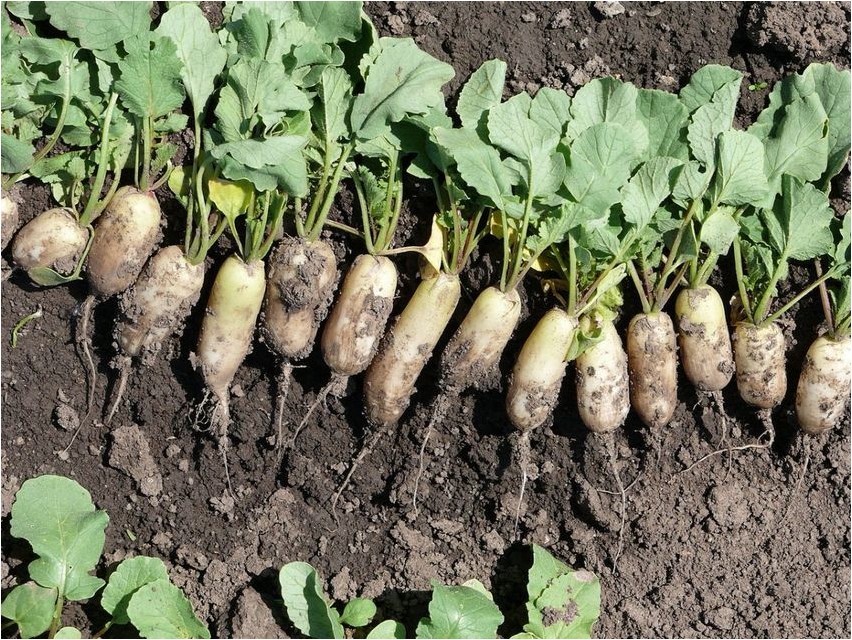
Radish (Latin: Raphanus) is a vegetable crop; an annual or perennial plant in the family Cruciferae. It grows naturally in temperate Asia and Europe. In Russia, the common radish is widely used.
Crop Characteristics
Radish is a plant with simple or branched stems bearing entire, lyrate, lobed, or dissected foliage. The peduncle is round, pubescent, and branched. The inflorescences are racemose, with a separate corolla of white, light purple, pink, or lilac.
The fruits are cylindrical pods containing round or flattened-round, brown, gray, or yellow seeds. The seeds remain viable for up to five years. The roots are thick, edible, and come in a variety of shapes and colors. There are two radish cultivars: summer and winter. Summer varieties include those characterized by rapid ripening, while winter varieties require approximately 120 days to produce ripe fruit. Radish is considered a long-day plant; sowing in late April or early May results in early flowering, often bypassing the root formation phase.
Growing Conditions
Radish is considered a cold-hardy plant, but requires temperatures of 18°C (64°F) for normal development. Seedlings emerge at 5°C (41°F) and can easily withstand frosts down t o-3°C (-3°F). Radish prefers sunny sites with moderately moist, loamy, loose, permeable, neutral soils. When grown in sandy soils, the roots develop too flabby and have little shelf life. Adequate phosphorus and nitrogen in the soil are also important for the plant.
The best predecessors for radish are potatoes, garlic, and cucumbers. Radishes should not be sown after Brassicas. They should not be replanted in the same location for three years. The crop is extremely demanding of organic fertilizers, although it does not respond well to fresh manure and undecomposed compost; the roots will crack, branch, and become bitter.
Sowing

Before you start sowing, you need to carefully dig up the area, add urea, superphosphate and potassium fertilizers to the soil. Strongly acidic soils are preliminarily limed. Radish sowing is carried out in 2 terms: summer varieties — in early spring, winter varieties — in early June. Sowing in July threatens that the root crops develop poorly, become coarse, and the stems begin to stem. Moreover, if sowing is untimely, there is a high probability of seedlings being damaged by cruciferous flea beetles, a dangerous pest for the crop.
Radish is sown in a row, leaving a distance between rows of 30-35 cm. Seeds are planted to a depth of 2 cm. Experienced gardeners advise sowing winter varieties in nests, that is, 3 seeds per hole. To protect plants from flea beetles, it is recommended to plant marigolds or garlic on all sides of the ridge.
Care procedures
There are no particular difficulties in caring for the crop in question. It needs regular soil aeration, weeding, fertilizing and watering. When three leaves appear on the plants, the crops are thinned, leaving a distance of at least 25 cm. Repeated thinning is possible.
During the maintenance process, one should not allow the formation of a dense soil crust between the rows; applying mulch, for example, peat, to the ridges will help to cope with this problem. During the entire growing season, the crop requires a couple of feedings: the first is carried out in the three-leaf phase, the second — at the moment of fruit formation. For fertilizing, you can use complex mineral fertilizers, mullein infusion or slurry.
The beds with crops are loosened at least twice a month. The depth of loosening is 5-7 cm. The volume of watering is increased at the moment the sprouts peck and root crops form.
Diseases and pests
Often the crop is affected by a disease — downy mildew. It appears on the leaves, petioles and stems of the plant in the form of a white coating, which turns brown over time. If measures are not taken immediately, the plants will begin to bend, dry out and fall off. You can fight powdery mildew with a 1% solution of Bordeaux mixture.
An equally dangerous pest of radishes are cruciferous flea beetles, which cause significant damage to plantings. If pests are detected, the radish is pollinated with ground sulfur.
Even one slice of GREEN RADISH causes IRREVERSIBLE PROCESSES in the body. Doctors are shocked!