Tenacious bedstraw
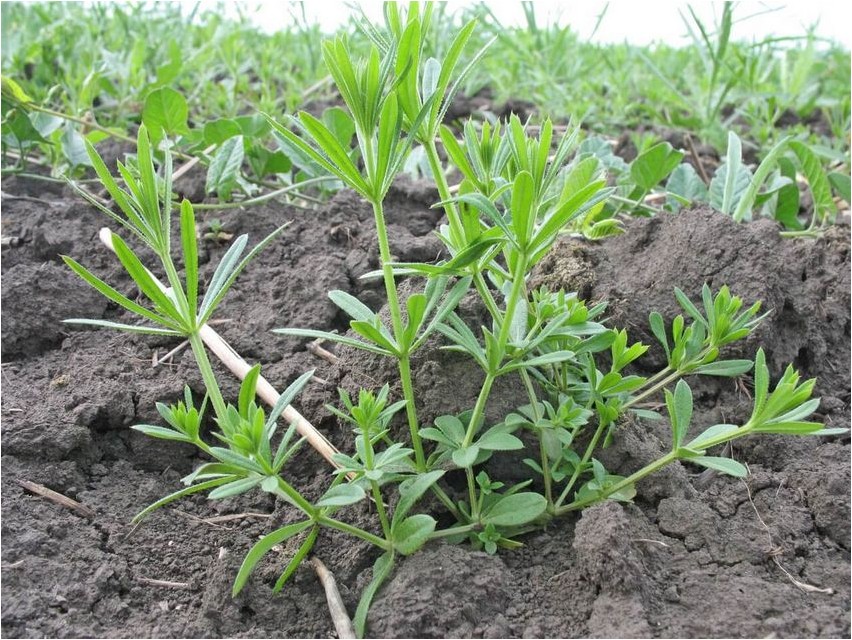
The tenacious bedstraw is one of the plants of the family called Rubiaceae; in Latin the name of this plant will be as follows: Galium aparine L.
As for the name of the tenacious bedstraw family itself, in Latin it will be: Rubiaceae Juss.
Description of the tenacious bedstraw
Tenacious bedstraw is known by numerous popular names: wolfberry, hemorrhoid grass, jerk, sticky grass, resinous grass, tar, pinworm, burdock grass, strew the ground, cling, cats and dogs, biting midge and flatbread. Tenacious bedstraw is an annual herbaceous plant, endowed with tenacious ascending stems, the height of which will fluctuate between twenty-five and one hundred and twenty centimeters. The stem of such a plant will be stiff-haired at the nodes, and along its entire length it is lined with small bristles, which will also be bent back. The leaves of the bedstraw are tenacious, narrowly lanceolate, they are arranged in six to eight pieces in bulbs, which are located at the very nodes of the stem. The flowers of this plant are quite small in size, they are collected in sparse axillary semi-umbrellas and are painted white. The corolla of the tenacious bedstraw is fused at the very base and has four petals; there are only four stamens of this plant, and the pistil, in turn, will be endowed with two stigmas and a lower ovary. The fruits of this plant are nuts, round in shape, which will be dry and open with two flaps; such nuts will also be seated with hooked bristles, painted in white tones.
The tenacious bedstraw blooms from June to September. Under natural conditions, this plant is found in the Caucasus, Moldova, Central Asia, the European Arctic, Sakhalin, Belarus, Ukraine, the European part of Russia, Western and Eastern Siberia. For growth, this plant prefers gorges, forests, damp meadows, shrubs, shelterbelts, gardens, vegetable gardens, clearings, crops, places near springs, garbage places, places near roads and railway embankments. It should be noted that this plant is a malicious weed that will contribute to the lodging of grain reserves.
Description of the medicinal properties of tenacious bedstraw
Tenacious bedstraw is endowed with very valuable healing properties, and it is recommended to use the roots, fresh juice and herbs of this plant for medicinal purposes. The term grass includes flowers, stems and leaves. The presence of such valuable healing properties is recommended to be explained by the content of the coloring substance, anthraquinones and iridoid asperuloside in the composition of this plant. The herb contains vitamin C, monotropein, citric acid, glycosides asperuloside and monotropein, tannin and the following trace elements: strontium, boron, copper, titanium, iron, manganese, nickel, thallium and molybdenum. The seeds of this plant, in turn, contain protein and fatty oil.
As for traditional medicine, here this plant is quite widespread. Preparations based on tenacious bedstraw are recommended for use as a very effective diuretic, choleretic, hemostatic, antipyretic, antispasmodic, antitumor and anti-inflammatory agent. It should be noted that such preparations based on this plant were used in Ancient Greece and Ancient Rome.

Fresh juice of the herb of this plant is used for epilepsy, bedstraw powder is used for various female diseases, ascites, scarlet fever, rheumatism, intestinal colic, malignant tumors and liver diseases.





