Polemonium coerulum is a member of the Polemoniaceae family. Its Latin name is Polemonium coerulcum L.
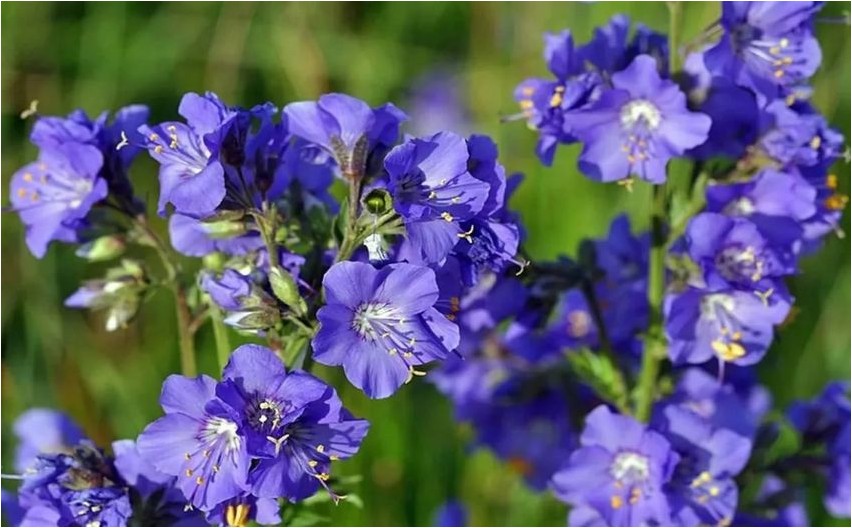
The Latin name of Polemonium coerulcum is Polemoniaceae Juss.
Description of Polemonium coerulum
Polemonium coerulum is known by many common names: forest rowan, twin grass, blue bran, blueweed, stoloflower, khmira, urochnaya grass, beauty, sparrow grass, Yegorievskoe spear, and Nikolaevskaya grass. Polemonium coerulum is a perennial herb with a thick horizontal rhizome and numerous fibrous roots. The stems of this plant are solitary, but sometimes there may be several. The height of these blue cornflower stems will range between forty and one hundred centimeters. These stems are erect, and can be either simple or branched at the top. The leaves of this plant are alternate, with the lower ones petiolate and the upper ones imparipinnate and sessile. They consist of seventeen to twenty-one pointed leaflets, oblong-ovate in shape. The flowers of blue cornflower are quite small, bluish-purple or bright blue in color, and are fragrant and have a broadly bell-shaped, five-lobed corolla. The flowers of this plant are gathered in a loose panicle located at the very end of the stem. The fruit of blue cornflower is a three-locular, multi-seeded capsule.
This plant blooms from June to July. In the wild, this plant is found in Ukraine, Moldova, Belarus, European Russia, and Siberia. Blue Polemonium prefers clearings and damp meadows in forest-steppe and wooded areas.
Description of the medicinal properties of blue Polemonium
Blue Polemonium has very valuable medicinal properties, and it is recommended to use the rhizomes, roots, and herb of this plant for medicinal purposes. The term “herb” includes flowers, stems, and leaves.
The presence of such valuable healing properties should be explained by the content in this plant of fatty and essential oils, flavonoids acacetin, myricetin and quercetin, triterpene saponins, triterpenoids cameliagenin and polymonylgenin, the steroid beta-sitosterol, phenolcarboxylic acids and their derivative chlorogenic acid. The inflorescences, leaves and stems contain flavonoids, the fruits contain saponins, and the flowers contain saponins, anthocyanin delphinidin and carbohydrates.
As for Korean medicine, an aqueous infusion prepared from the herb and roots of blue cyanosis is used for pulmonary tuberculosis, chronic bronchitis and bronchiectasis, and is also used as a very effective sedative, hemostatic, hypotensive and expectorant.

In Russian folk medicine, a decoction and infusion based on herbs and roots of blue cyanosis is indicated for use in various nervous and mental diseases, spasmophilia, headaches, rabies, dysentery, acute and chronic bronchitis, stomach and duodenal ulcers. Externally, the herb of this plant in the form of a poultice is used for snake bites. Infusions and decoctions prepared from the roots and herbs of blue cyanosis are used in traditional medicine in Belarus for rabies and nervous diseases. The experiment proved that the dry extract of the roots of this plant has the ability to provide antibacterial and hemostatic effects.
Blue cyanosis. Alefirov A. N.





