Gentian latinaceae
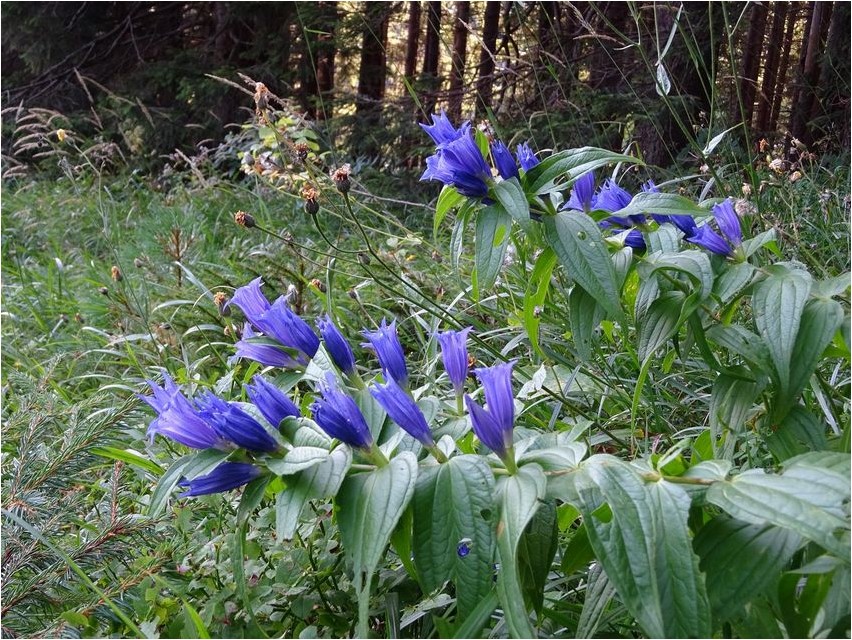
Gentian is one of the plants of the family called Gentianaceae; in Latin the name of this plant will be as follows: Gentiana asclepiadea L.
As for the name of the gentian family itself, in Latin it will be: Gentianaceae Juss.
Description of gentian
Gentian is a perennial herbaceous plant, the height of which can vary between fifteen and one hundred centimeters. The rhizome of this plant is multi-headed and quite thick. The stems will be numerous, densely leafy and unbranched. The leaves will be sessile, with the lower leaves being ovate-lanceolate and the upper leaves lanceolate, pubescent and oblong-pointed. The length of the gentian leaves will be about five to nine centimeters, and the width will be two to four centimeters; usually the leaves are endowed with five veins. The flowers are located in the axils of the upper leaves; it is noteworthy that they will be numerous. The calyx will be bell-shaped in shape, its length is approximately ten to eighteen millimeters, and the calyx will be approximately three times shorter than the corolla. The corolla is painted in dark azure or blue tones, and sometimes the corolla can also be white, and its length will be about twenty-five to thirty millimeters. The blades of such a corolla will be triangular, between them there are solid folds, which will be asymmetrical and much shorter than the blades themselves.
This plant blooms at the very end of the summer season and will last until autumn. Under natural conditions, gentian latinata is found in the Carpathians in Ukraine, as well as in the European part of Russia in the Ladoga-Ilmen region. For growth, this plant prefers shrubs, meadows, sparse forests, forest clearings and edges from the lowlands to the upper belt. It is noteworthy that the gentian is an ornamental plant, and also an insecticide.
Description of the medicinal properties of gentian lastovneva
Gentian is endowed with quite valuable healing properties, and it is recommended to use the rhizome and grass of this plant for medicinal purposes. The plant contains fructose, sucrose, glucose, gentiobiose, gentiosterol, gentianose, benzamide, xantonin, flavonoids, as well as gentioflavin, gentianadin, gentiopunctine and gentianin. It should be noted that preparations based on this plant have found quite active use in hematuria and ophthalmia.
A decoction of the rhizomes and herb of gentian latinata is used for amenorrhea, as well as for liver diseases and as a detoxifying agent for snake bites. An infusion of the herb of this plant can also be used as a remedy that will stimulate the appetite, as a diuretic and wound healing agent. In addition, an infusion of the gentian herb is used for dyspepsia and achylia.

For anorexia, it is recommended to use the following remedy: to prepare it you will need to take one tablespoon of crushed dry rhizomes of gentian latinata or one tablespoon of crushed dry grass per glass of water. This mixture should be boiled for about three to four hours, and then left to infuse for two hours, after which the mixture is carefully filtered. This remedy should be taken approximately one third or one fourth of a glass three times a day.
For compresses, washing wounds, for dyspepsia, as well as as a diuretic and to stimulate appetite, it is recommended to prepare the following remedy: take one glass of boiling water for one tablespoon of dry crushed herb, leave the mixture for half an hour, and then filter. This remedy is taken one tablespoon three times a day thirty minutes before meals.





