Apricot
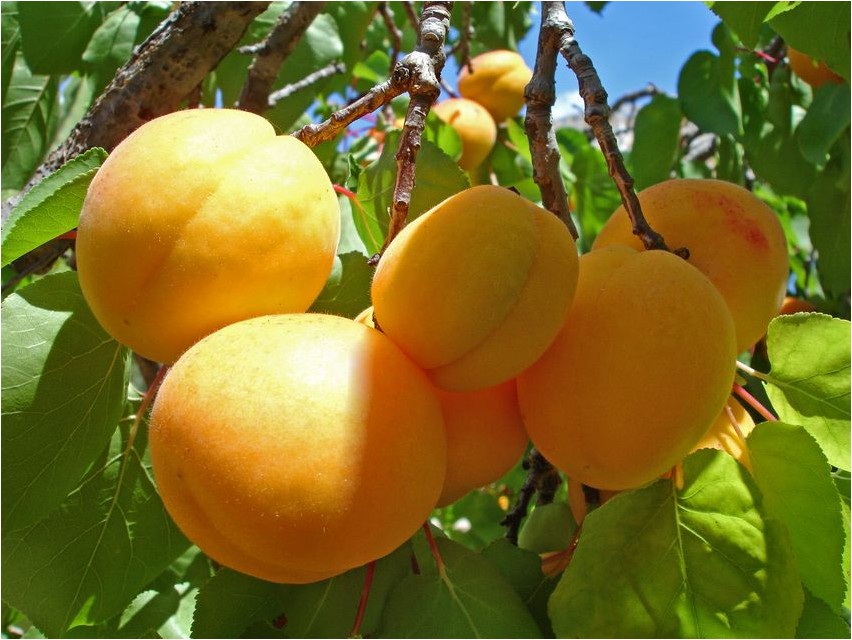
Apricot (lat. Prunus) is a popular fruit crop belonging to the genus of deciduous trees of the Rosaceae family.
Nowadays, many types of apricots are actively cultivated in warm countries (Armenia, Azerbaijan, some European countries), and are also cultivated in the south of the Russian Federation.
Description
Apricot is represented by deciduous trees up to 10-12 m high with a trunk covered with cracking gray-brown bark and a spreading crown. Annual shoots are brown in color with a red tint and are equipped with a huge number of small strokes. Apricot foliage is simple, can have an oval or ovoid shape, the tips are sharp, the edges are serrated, the arrangement is alternate. The leaves sit on long and thin glandular petioles.
Apricot flowers are small, single, and can be white or white-pink in color. During flowering, they emit a pleasant aroma that attracts bees and other insects. Apricot blooms in the third ten days of April — the first ten days of May. A distinctive feature of apricot is that the flowers form before the leaves unfold. The fruits are represented by juicy drupes, velvety to the touch; depending on the variety, they are round, ovoid or ellipsoidal; the color is usually yellow or orange, with the possible presence of a pinkish barrel.
The pulp of apricot fruits is sweet and sour or sweet, and can be either juicy or dry. Wild species bear bitter fruits that are unsuitable for food. The seed contains only one fruit. It is ovoid in shape and light brown in color, with a slight bulge on the sides. Apricot fruits ripen in mid-July — early August. In regions with a cold climate, fruiting is postponed to September — October. Apricot is considered a long-liver, with an average age of 60 years.

Location
Apricot is a light- and heat-loving crop, not too demanding on the composition of the soil. The crop bears fruit best on well-cultivated, loose, moist, permeable, neutral soils. The presence of lime in the soil is welcome. The plant is considered a drought-resistant crop and does not need protection from the wind. The crop is negative for saline and heavily waterlogged soils.
Reproduction and planting
Apricots are propagated mainly by seed and grafting. Planting of seeds is carried out early after the soil has warmed up or in late autumn under cover. When sowing in spring, long-term stratification is required (3 months).
The easiest method for obtaining apricots in the garden is to plant seedlings purchased from a nursery. It is preferable to plant in the spring. Autumn planting is not prohibited; it is carried out in the second ten days of September, in the southern regions — in the third ten days of September — the first ten days of October. The pit for planting is prepared either 2-3 weeks before the intended planting, or in the fall. The second option is optimal.
The size of the planting hole largely depends on the development of the root system of the seedling. Approximate dimensions: diameter — 70 cm, depth — 70 cm. A distance of four meters is maintained between plants. At the bottom of the pit, be sure to provide good drainage in the form of small crushed stone or broken bricks; the voids are filled with fertile garden soil mixed with rotted organic matter and mineral fertilizers. When planting, the roots of the seedlings are carefully straightened to avoid damage. There is no need to deepen the root collar. After planting the seedling, abundant watering is carried out.
Care
Apricot is quite demanding to care for. It requires systematic and abundant watering, especially during heat and drought. Stop watering in August, since the plant must have time to prepare for winter and complete all growth and formation processes. Otherwise, the young shoots will freeze.
It is also important to prepare trees for winter. In the fall, tree trunks and main skeletal branches are whitewashed with lime. Adding copper sulfate to the lime solution is welcome. At the beginning of spring, plants are treated from cracks and damage. For these purposes, garden var is used.
Most apricots begin bearing fruit in the seventh year after planting. Flowering occurs much earlier — usually in the third year. These terms largely depend on the quality of care. In addition to watering and fertilizing, plants need weeding, loosening and control of pests and diseases, which, unfortunately, often plague the crop, especially under unfavorable weather conditions.
Apricots also require pruning (both sanitary and formative). The formation of trees begins at the moment of planting the seedlings in a permanent place. The trunk and main skeletal branches are shortened. In the future, pruning is aimed at giving the trees a sparse tiered crown; it involves cutting fruit-bearing shoots by 1/2 and removing thickening shoots.