Lingonberry
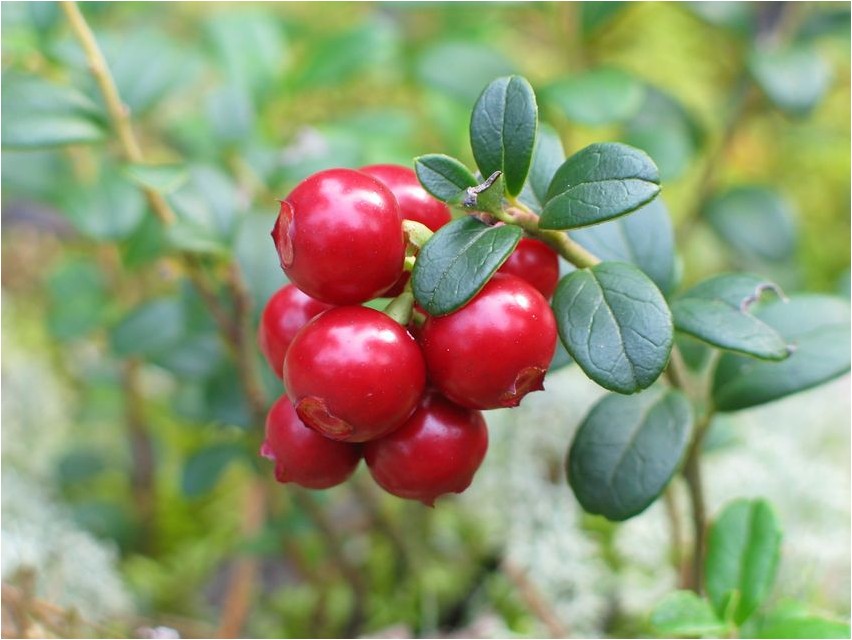
Lingonberry (lat. Vaccinium vitis-idaea) is an evergreen low-growing shrub of the genus Vaccinium of the Heather family.
Under natural conditions, lingonberries grow in coniferous and mixed dry forests, sometimes on dried peat bogs, swampy forests and tundra in the Far East, Western Siberia and the Caucasus.
Characteristics of culture
Lingonberry is a small shrub with a horizontal rhizome and erect shoots. The leaves are leathery, short-petiolate, frequent, elliptical or obovate, shiny, with entire curved edges, up to 3 cm long, equipped with pinpoint pits on the inside. The pits contain club-shaped formations, the cells of which are filled with a mucous substance that can absorb water.
The flowers are regular, bisexual, collected in drooping apical racemes. The corolla is pale pink or white, bell-shaped, sphenoletal, and has four slightly deflected lobes. Lingonberries bloom in May-June for 15 days. The fruit is a red berry that does not fall until the spring of next year.
Growing conditions
Lingonberry is a light-loving plant that produces good yields of berries in open sunny areas that are not subject to flooding and accumulation of cold air. The optimal acidity level is 4. 5-5. 5. These include well-drained, peaty soils, rich in minerals and maintaining productivity over a long period. Light loamy and acidic sandy loam soils are also suitable for growing the crop. The organic content in the soil should be above 15-20%; this is one of the most important conditions.

Site preparation
For any types of soil that do not have an acidic reaction, in addition to organic matter, add pure acidic peat, coarse sand or mineral soil (2 buckets per sq. m). Additionally, forest soil collected from plantations where lingonberries or blueberries grow is added. Fertilizing with mineral fertilizers is not prohibited, but an excess should not be allowed, as this will have a detrimental effect on plant growth and berry formation. Before planting the material, the soil must be leveled, this avoids the accumulation of water after heavy precipitation, in particular rains.
Landing
Depressions are formed on the ridges, filled with peat-sand substrate, seedlings are planted, and the voids are compacted. The edges of the ridges are reinforced with boards, the edges of which should protrude by 5-10 cm. This approach will also protect the plants from excessive waterlogging. The distance between rows should be about 30-40 cm, between plants — 25-30 cm. After planting, the tree trunk area is mulched with sawdust or peat. For the first 7-10 days, young lingonberries are watered abundantly.
It is advisable to purchase planting material from specialized nurseries; as a rule, such plants can easily withstand transportation, even long-term transportation. You can also propagate the crop by stem cuttings; they take root easily and grow quickly and produce good yields of berries. Cuttings are cut at the beginning of summer, the lower cut is placed under a bud or node. The cuttings are planted in nurseries until they take root. Transplantation to a permanent place is carried out after 1-2 years.
Care
Lingonberries need regular watering throughout the season, but at least 2 times a week. During a prolonged drought, the number of irrigations and volumes of water are increased. The plantings are regularly loosened and weeded, and after these procedures are mulched with sawdust, which not only fertilizes the soil, but also acidifies it.
Lingonberries are sensitive to spring frosts, especially during flowering, so at night the plants are covered with plastic wrap or heated with smoke. Lingonberries are fed only if they grow on poor soils, but not earlier than 4 years after planting. For fertilizer, it is best to use an aqueous solution of microelements. After 6-8 years, rejuvenating pruning is carried out, which consists of removing non-bearing and old shoots.
Popular varieties
Today there are about 20 varieties of lingonberries. The most popular are considered to be:
*Coral
*Sanna
*Ruby
*Kostromichka
*Sussi
*Erntesegen