Peach
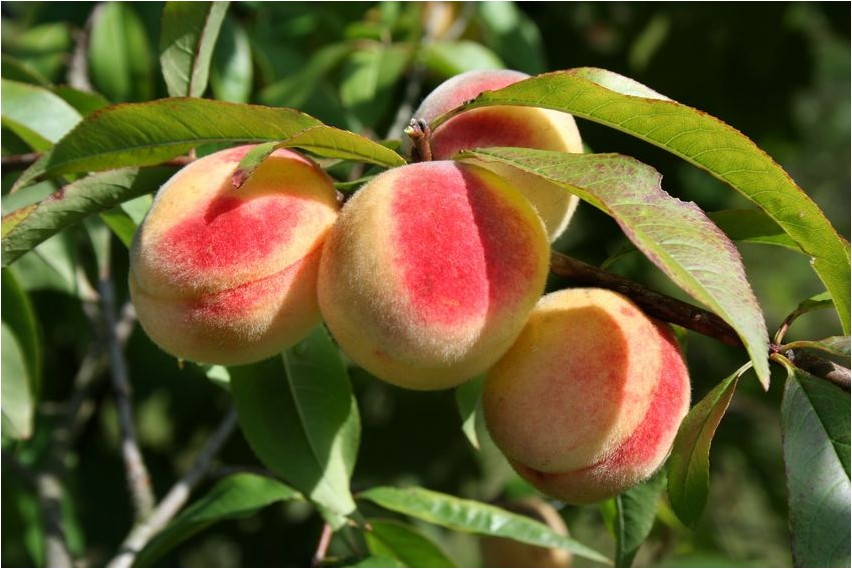
Peach, or peach tree (lat. Prunus persica) is a fruit plant of the Almond subgenus of the Rosaceae family. China is considered to be the birthplace of the peach, but this fact has not yet been confirmed.
Cultivated mainly in South America, Central Asia and Transcaucasia. In Russia it is grown only in the southern regions with a warm climate.
Characteristics of culture
Peach is a deciduous tree up to 8-9 m high with a trunk covered with red-brownish scaly bark. The crown is prostrate. Young branches are smooth, thin, old ones are rough, drooping, powerful. The leaves are lanceolate, narrowed towards the base, glabrous, shiny, serrate along the edge, arranged alternately. The outer side of the leaf blade is dark green, the inner side is light green, sometimes with slight pubescence along the veins. The flowers are simple, single or paired, goblet-shaped, reach 2. 5-3 cm in diameter, and can be red, white or pink. There are varieties with double flowers. The flowers bloom at the same time as the leaves or a little earlier. Peach blooms for 10-12 days; in strong sun and drought, flowering is reduced to 2-3 days.
The fruit is a drupe and can be round, flattened, oblate-rounded, oval, semicircular, ovoid or elongated oval. The skin of the fruit is thin, pubescent over the entire surface. The fruit is equipped with a pronounced lateral “seam”. The color of the fruit depends on the variety — from whitish-green to bright orange. The pulp is juicy, sweet and sour or sweet, very aromatic. Inside the fruit there is a brown, grooved, oval-shaped stone. Depending on climatic conditions and variety, the fruits ripen in July — September. The first fruits appear 3-4 years after planting. The largest harvests are obtained in 10-15 years. One mature tree bears up to 40-50 kg of fruit.
Growing conditions
Peach is a heat-loving plant, but can tolerate short frosts without problems. Temperatures belo w-20C have an extremely detrimental effect on the development of the crop; the flower and leaf soils of the plant are damaged, and the root system often freezes. As a result, the plants die without producing a full harvest. Peach also does not tolerate sudden changes in temperature. The optimal spring temperature for the appearance of flowers and leaves is 7-10C.
Peaches have no special soil requirements, tolerating acidic, sandy, clayey, and loamy soils. Growing them in waterlogged or saline areas is undesirable. Peaches are highly drought-resistant, but thrive on regular and moderate watering. Therefore, irrigation plays a significant role in ensuring a high-quality and abundant harvest. Insufficient moisture causes the fruits to become very small and tasteless.

Propagation
Peaches are propagated by seeds, cuttings, and grafting. Seed propagation is labor-intensive but effective. Plants obtained by sowing seeds are virtually indistinguishable from the original form. Seed propagation enhances the seedlings” adaptation to adverse conditions. Peaches are sown immediately after ripening; the pit can be left in place. The soil for sowing should be moderately moist and nutritious. Cuttings also produce good results.
Care
In addition to regular watering, the crop requires annual sanitary and formative pruning. Crown shaping of peaches begins as early as possible. The optimal time for pruning is early spring, but the exact dates depend on the growing region; for example, in Kuban, this procedure is carried out in late March. When planting seedlings, the first pruning is performed after one year. Weak and thickening shoots are removed, leaving the six thickest and strongest shoots. Subsequently, dry and damaged shoots are removed, and the main branches are shortened by 50-80 cm. Preventive treatment against pests and diseases is important for peaches. Common peach diseases include powdery mildew, clasterosporium leaf spot, and leaf curl. Fertilizing with mineral and organic fertilizers is also necessary.