Echinacea
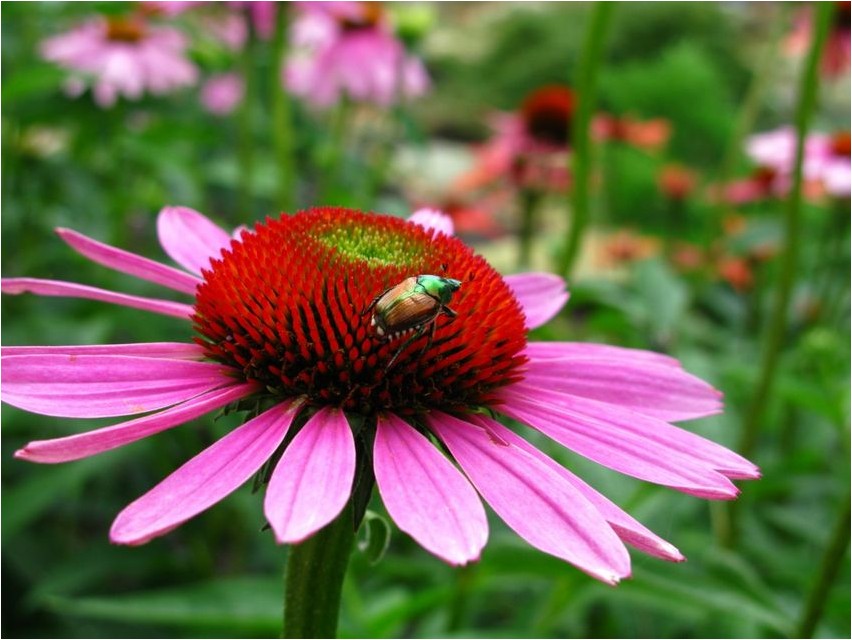
Echinacea (lat. Echinacea) is a genus of ornamental and medicinal plants of the Asteraceae family.
In culture, only one species is particularly popular – Echinacea purpurea; previously this species was included in the genus Rudbeckia. Today, Echinacea is widely cultivated to obtain medicinal raw materials and as an ornamental crop in many European countries, Russia and the North Caucasus. In folk medicine and pharmacology, the roots, leaves and flowers of Echinacea are used.
Characteristics of culture
Echinacea is represented by perennial plants that form a short rhizome, from which many small thin roots extend. The stems are simple, quite strong, highly branched, densely leafy, bearing a large number of alternate green leaves, which have a rough surface to the touch and decrease in size towards the top of the stem. An inflorescence-basket, characteristic of all representatives of the Asteraceae, or Asteraceae, family.
The receptacle of the inflorescence resembles a hemisphere; the basket itself consists of dark tubular flowers and reed flowers of pink, lilac-pink or purple color. Tubular flowers are considered to bear fruit; they are located in the center of the basket. Echinacea is a sun-loving and heat-loving crop. It boasts high winter-hardiness properties, as well as resistance to diseases and pests.
Features of cultivation
As mentioned, Echinacea prefers sunny areas; dense shade is extremely undesirable. The crop is undemanding to soil conditions, but develops best on loose, moist, water- and air-permeable, loamy soils with a neutral pH reaction. The crop will not tolerate heavy clayey, saline, waterlogged, highly acidic, or light sandy soils. Growing on strongly acidic soils is possible only with preliminary and subsequent (annual) liming.
Echinacea is propagated by seeds and by dividing the bush. The second method is the most common among gardeners, although the seed method does not cause any particular difficulties. Seeds are sown in open ground in spring. It is possible to grow through seedlings; for this, the seeds are sown in special containers filled with a moist nutrient substrate. Fine-grained washed sand is poured over the seeds. After sowing, apply abundant watering from a spray bottle. Shoots appear quickly in about 2-3 weeks.

Seedlings are planted in open ground in the middle – end of May (depending on the region, for example, in the Urals and Siberia, planting should be postponed to the third ten days of May – the first ten days of June). When sowing echinacea directly into open ground in the phase of two true leaves, thinning is carried out. Reproduction by dividing the bush is carried out in the spring. After division, the material is treated with growth-stimulating drugs and planted in pre-prepared wells. Caring for Echinacea is easy. Plants need rare watering (during drought), fertilizing (twice per season: the first is carried out in early spring, the second in the budding phase), weeding, loosening, as well as pruning the stems in the fall and mulching the root collar.
Useful properties
The therapeutic effect of echinacea is due to the presence of a huge number of useful components, including biologically active substances. It includes essential oils, polysaccharides, phenolic acids, organic acids, alkaloids, phytosterols, inulin, betaine, resins, tannins, etc. Many of these substances are valued for their antiseptic, antifungal, anti-inflammatory, immunomodulatory and protective properties.
Most often, echinacea is used to prepare herbal teas, tinctures and decoctions intended to strengthen the immune system and prevent influenza, colds, bronchitis, and sore throat. Preparations including echinacea are useful for both adults and children from 1 year of age. Some of them are recommended for kidney and urinary tract diseases, diabetes mellitus, liver and circulatory system diseases. Echinacea is also included in ointments and other remedies against skin diseases and injuries (eczema, urticaria, psoriasis, cuts, open wounds, burns, boils).