Platysperm
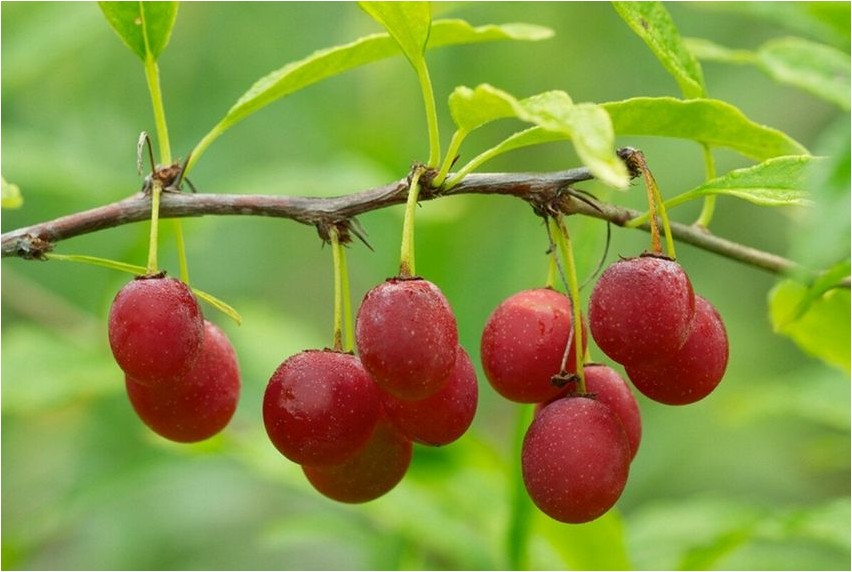
Princepia (Latin: Princepia) is an ornamental woody plant in the Rosaceae family. It is also known as Princepia.
Description
Princepia is a fast-growing deciduous shrub, reaching a height of two to three meters. Its leaves are topped with small spines—several on each leaflet. The bark of these shrubs is usually flaky, and their simple, alternate leaves have smooth or slightly serrated margins. Incidentally, the leaves can be either membranous or leathery.
Princepia”s yellow flowers are borne on branches in small clusters, averaging 1-4 flowers each, although sometimes these clusters can contain as many as eight flowers. All these flowers have a faint, yet very pleasant, scent!
The fruits of the flatseed plant are juicy drupes, ranging in diameter from 1. 3 to 1. 8 cm. Each drupe contains a single elliptical seed. Incidentally, the flatseed plant received its interesting name precisely because of the unique shape of its seeds—they are large, hard, laterally compressed, and boast a rather unique grooved surface of light brown or yellow. Incidentally, these seeds are often used to make all sorts of decorative crafts!
The flatseed plant was first described in 1886 by the botanist Oliver, although at that time the plant had a completely different name—Plagiospermum englishum. It was only in 1932 that the plant was classified in the genus Princepia by Academician V. Komarov (and the genus was named in honor of James Princep, a renowned American botanist). Where it grows
The Himalayas, Mongolia, and China are considered the homeland of the flatseed plant; it was only much later that the plant was brought to the Americas and Europe.
Uses

Flatseed is now quite rare in cultivation, yet this ornamental plant becomes stunningly beautiful with the onset of autumn—its wonderful coloring is imparted by the changing leaves and fruits.
In cooking, flatseed berries are often used to make compotes—they are very rich, and their flavor is somewhat reminiscent of the vibrant flavor of cherry compote. These berries are also edible raw. Flatseed has also found use in folk medicine—it is a powerful tonic.
Cultivation and Care
It is recommended to plant the flatseed plant in well-drained and fertile soils rich in lime (this beauty is a calcephile). This plant tolerates slight drought and slight shading very well, but the flatseed will grow and bear fruit much better in well-lit areas.
The flatseed plant tolerates pruning and replanting quite well, and this plant also boasts excellent winter hardiness. True, it is still better to cover young plants for the winter — if the weather gets too cold, the tips of annual shoots can sometimes freeze.
Propagation of flatseeds is carried out by sowing freshly harvested seeds — this is usually carried out in the fall. Also, for the purpose of propagation, green cuttings and layering are quite actively used. By the way, if a flatseed is planted for the purpose of subsequent harvests, then it is better to immediately plant at least two specimens, and even better — four or even five!
The flatseed plant is practically not affected by pests and diseases, and for this it is especially appreciated by many novice gardeners!
Chinese prinsepia (lat. Prinsepia) in the Southern Urals





