Kerria
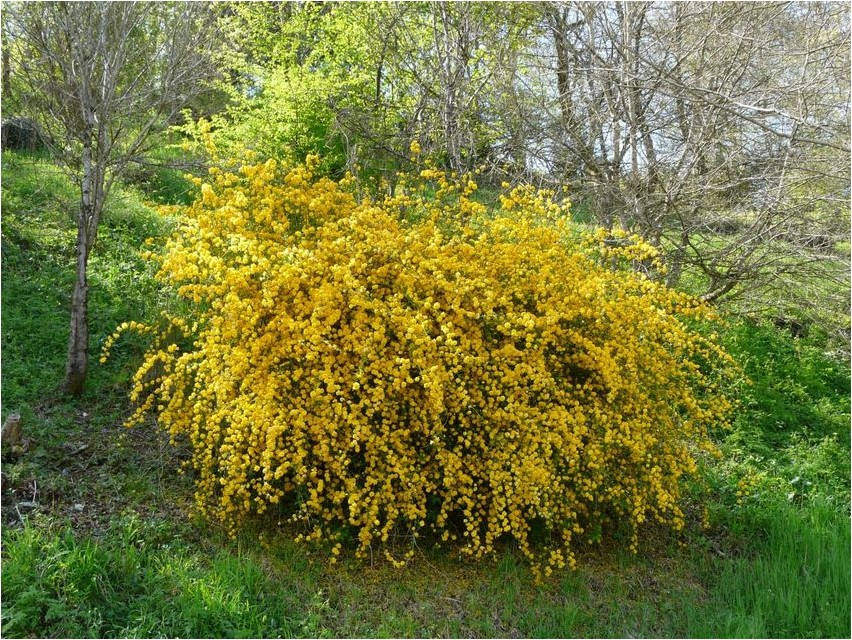
Kerria (lat. Kerria) is a beautiful deciduous shrub, a member of the Rosaceae family. Europeans often call it the Japanese Easter rose.
Description
Kerria is a deciduous, fast-growing and very decorative shrub, endowed with leaning thin branches, neat leaves and amazingly beautiful sunny yellow flowers. The height of the colorful bushes usually ranges from one to three meters, and their greenish-purple branches form magnificent cone-shaped crowns.
The leaves and flowers of kerria can boast of extraordinary decorativeness. The alternate and elongated, pointed lanceolate leaves reach a length of four to ten centimeters and are equipped with double serrations. Their upper parts are always smooth, and their lower parts are pubescent. The length of the bare petioles ranges from five to fifteen millimeters. In summer, the leaves are always light green, and closer to autumn they gradually acquire a spectacular bright yellow color.
The diameter of the magnificent kerria flowers reaches five centimeters. As a rule, they are solitary, in most cases double and endowed with broadly elliptical bright yellow petals. They also boast an incredibly persistent dandelion scent. The average duration of kerria flowering is twenty-five days, however, sometimes this period can stretch up to fifty days, and sometimes kerria pleases with repeated autumn flowering.
Kerria fruits look like wrinkled aggregate drupes of brownish-black shades, which can have either a hemispherical or obovate shape. And their length can reach up to 4. 8 mm. It is noteworthy that fruits are not formed in the middle zone.
This plant received its name in memory of the gardener William Kerr, who was very fond of oriental plants and collected them. At the beginning of the nineteenth century he went on an expedition to China to search for new and unknown vegetation, and there Kerr spent eight long years. It is worth noting that during this time the researcher managed to discover a great many new amazing plants, but only the beautiful kerria received his name.

The only representative of this genus is Japanese kerria, which has several different varieties and forms.
Where does it grow
Kerria came to us from the mountainous slopes and forests of Japan and southwestern China. In the wild, it can most often be observed in thickets growing on mountain slopes.
Growing and care
Kerria will feel best in well-lit areas, securely sheltered from too cold winds. However, it is also very comfortable in partial shade, but if the shading is too strong, the kerria will bloom very modestly. And with constant exposure to the open sun, the flowers gradually begin to “burn out,” that is, the tips of their petals turn pale and become whitish.
The soil intended for growing kerria must be moist and fertile, ideally loamy.
Kerria should be planted in early spring, before buds begin to appear. Autumn planting is not excluded — in this case it is necessary to cope with this task a month and a half before the onset of cold weather.
Kerria is very moisture-loving, but it does not tolerate excessive moisture, that is, watering should be plentiful, but without stagnating moisture. It is especially important to regularly water this plant in the heat and during the flowering period. This beauty also responds well to various feedings, and systematic pruning is an indispensable condition for maintaining its decorative properties.
Since kerria cannot boast of good winter hardiness, it must be covered in winter. Despite the fact that frozen shoots are endowed with the ability to quickly recover, plants attacked by frost subsequently bloom much worse.